
GCash Trading Scams Philippines: 5-Step Verify Checklist
Filipino students: spot fake funded trading offers before paying via GCash or Maya. Free 5-step checklist reveals red flags most scams fail at step two.
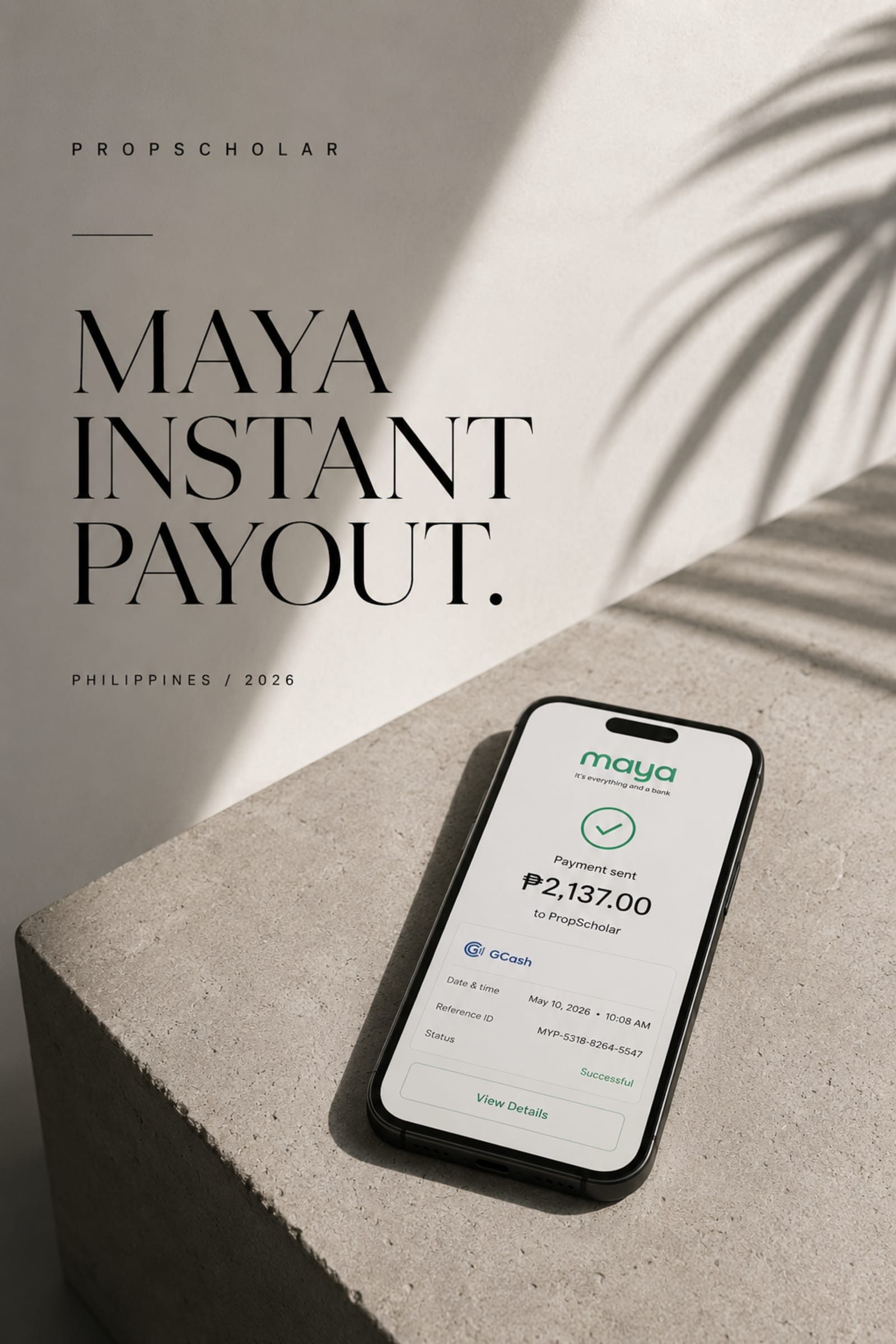
Filipino students: spot fake funded trading offers before paying via GCash or Maya. Free 5-step checklist reveals red flags most scams fail at step two.
Start your evaluationMaya Instant Payout Prop Trading Philippines 2026: How College Students Verify Legit Funded Accounts Before GCash Payment
TL;DR: Before you pay anything through Maya or GCash for a trading challenge, run through a five-point verification checklist. Most fake platforms fail at step two. PropScholar — a scholarship-based evaluation platform starting at $5 — accepts crypto globally and pays verified scholars within 4 hours.
Key takeaways:
- Fake funded-account platforms in the Philippines specifically target college students with GCash and Maya payment hooks
- A real evaluation platform publishes its rules publicly and never changes them retroactively
- Company registration, an active public community, and visible payout proof are the three non-negotiable trust signals
- PropScholar is not a prop firm — it's a scholarship-based evaluation platform, starting from $5, accessible via USDT crypto anywhere in the world
- Payouts are completed within 4 hours of verification — not "days" or "soon"
You're a college student in Manila, Cebu, or Davao. You've been watching trading content, you've got maybe ₱300–₱500 you can spare, and someone on Facebook or Telegram just offered you a "funded account" with instant Maya or GCash payouts. They're saying you can flip a small challenge fee into thousands of pesos within the week.
Some of those offers are real. A lot of them are not.
The problem is that the fake ones have gotten very good at looking legitimate. They copy real platform designs. They manufacture payout screenshots. They build short-term credibility by actually paying a few early users — then disappear once the volume builds. Filipino students, particularly those who are newer to trading, are getting burned at a rate that's genuinely alarming right now.
This article is a step-by-step guide to verifying any trading evaluation platform before you send a single peso. It also introduces you to a legitimate option that works even if you don't have a Maya or GCash setup — because the safest entry point right now is crypto.
Why Philippines College Students Are Being Targeted With Maya and GCash Trading Offers
Maya and GCash have become the default payment rails for young Filipinos — frictionless, instant, familiar. Scam platforms know this. By advertising "pay via GCash, get paid via Maya," they reduce your psychological resistance. It feels local, it feels safe, it feels like sending money to a friend.
That familiarity is exactly what they're counting on.
Here's the pattern: a Facebook group post or Telegram message promises a trading scholarship or funded challenge. The entry fee is small — sometimes as low as ₱99. The claimed payout is enormous relative to the fee. The payment method is GCash or Maya. There's no verifiable company name, no public rulebook, and the "support" is a WhatsApp number that vanishes after three weeks.
The payment method being GCash or Maya tells you nothing about legitimacy by itself. Real platforms can and do accept those wallets in some regions. The problem is when GCash/Maya is the only thing you can verify — because the platform has no other credible footprint.
The Five-Point Verification Checklist Before Any Trading Payment
Run every platform through these five checks before you pay. A legitimate scholarship-based evaluation platform passes all five. Most fake ones fail by step two.
1. Can You Find a Registered Company?
Ask the platform: what is your registered company name, and where are you incorporated? Then verify it independently.
A company registration is public record. If a platform can't give you a verifiable company name — or gives you one that doesn't appear in any public registry — that's a hard stop. It doesn't matter how good the website looks.
PropScholar, for example, is operated by a Private Limited company registered in India under the MCA (Ministry of Corporate Affairs). That registration is publicly searchable. You can read more about why company registration matters in this breakdown of what private limited registration means for traders.
2. Are the Rules Written Down and Publicly Available Before Payment?
Legitimate platforms publish their full evaluation rules — profit targets, drawdown limits, time limits, eligible instruments — before you hand over any money. Not in a PDF they email you after payment. Not "DM us for details." Publicly, on the website, readable by anyone.
If you can't read the full rulebook before paying, don't pay.
Also check: have those rules ever changed without warning? Platforms that alter rules retroactively — especially drawdown rules or payout conditions — are showing you a serious red flag. PropScholar's rules have remained public and unchanged since launch. That's not a boast; it's just what a legitimate platform looks like.
3. Is There a Live, Active Community With Real Traders?
A 3,000-person Discord server is hard to fake long-term. Look for a public community where traders post trade journals, ask questions, and — critically — where payout proof appears from multiple different accounts over time.
Screenshots of a single payout from the platform's own account mean nothing. Multiple traders, multiple dates, multiple accounts — that's what you're looking for.
PropScholar has an active Discord community of over 3,000 traders. Join the community and look at the payout-proof channel before spending anything.
4. What's the Actual Entry Cost, and Is It Proportional?
This one trips up a lot of beginners. The entry fee being small doesn't automatically make something safe — but it does change your risk exposure.
A legitimate evaluation platform charges a reasonable fee for the evaluation itself. PropScholar's entry starts at $5 (roughly ₱280–300 at current rates). The scholarship payout on a successful evaluation can be up to 400% of the entry. That math is transparent and published.
Compare that to a platform asking you for ₱5,000 upfront with vague payout terms and no company name. The fee being large doesn't make it more legitimate — it just makes getting scammed more expensive.
5. How Specific Are the Payout Terms?
"Fast payouts" is not a payout term. "Payouts within 24–48 hours" with no stated verification process is not a payout term.
A real platform tells you: what triggers a payout request, what verification is required, how long that verification takes, and what payment method the payout arrives through.
PropScholar's payout timeline is 4 hours after verification. That's a specific, checkable number — not a marketing phrase.
Does PropScholar Accept Maya or GCash for Filipino Traders?
Here's the honest answer: PropScholar's primary payment methods are UPI (for Indian traders) and cryptocurrency — specifically USDT — for global users including the Philippines.
This is actually better than it sounds, even if you've never used crypto before.
Buying USDT in the Philippines is straightforward through Binance P2P or local exchanges, and you can fund those accounts via GCash or Maya. So the path looks like: GCash/Maya -> buy USDT on a local exchange -> pay PropScholar in USDT. The whole process takes under 30 minutes once you've set up an exchange account.
More importantly, paying in crypto means your entry fee is borderless and your payout is traceable on-chain. There's no "our bank transfer is delayed" excuse. Either it arrived or it didn't.
If the $5 entry point is your concern — that's roughly ₱280. That's less than most university students spend on a single Grab order.
How PropScholar Compares to Fake Funded Account Platforms
Registered Company vs Anonymous Operator
PropScholar is operated by a registered Private Limited company in India — publicly verifiable. Most fake funded-account platforms targeting Filipino students through GCash or Maya have no company registration at all, or list a registration that doesn't check out. This single difference eliminates the vast majority of scam platforms in one step.
Fixed Public Rules vs Rules That Change After You Pay
Every PropScholar evaluation rule — profit target, daily drawdown limit, maximum drawdown, eligible assets — is published on the website before purchase and has never been changed retroactively. Contrast that with platforms where the payout conditions mysteriously shift the moment you're close to qualifying. You can read more about that pattern in how to spot red flags in trading evaluation scams.
Verified Community vs Manufactured Screenshots
A Discord community of 3,000+ traders generating organic payout discussion is qualitatively different from a Telegram group where the admin posts screenshots of transfers with no other members commenting. The Discord community is public — you can join before you pay and read it for yourself. That's deliberate transparency, not a marketing gimmick.
Scholarship Model vs Deposit Risk
PropScholar is not a prop firm. It's a scholarship-based evaluation platform. You pay an entry fee, you demonstrate skill against published criteria, you claim a scholarship payout. You're never putting trading capital at risk. Your maximum exposure is the entry fee — starting at $5.
That distinction matters especially for students in the Philippines where discretionary income is limited. The detailed comparison of the scholarship model versus traditional prop firm risk is worth reading if you want the full picture.
Step-by-Step: How a Filipino College Student Starts a PropScholar Evaluation
This is the actual process, not a summary.
First, buy USDT through a Philippine exchange — Binance PH, PDAX, or similar. Fund that exchange account via GCash or Maya. You need roughly $5–$10 worth of USDT to cover the cheapest evaluation plan plus any small network fees.
Second, go to PropScholar's shop and select the evaluation that fits your budget. The 1K 1-Step plan is the entry-level option at $1 for the evaluation itself — yes, that's under ₱60. Larger evaluation accounts come with proportionally larger scholarship amounts.
Third, complete checkout using your USDT wallet address. The transaction confirms on-chain — no waiting for a bank to process anything.
Fourth, access your evaluation trading account, follow the published rules, hit the profit target without breaching drawdown limits.
Fifth, submit your verification. Once verified, your scholarship payout arrives within 4 hours. Payouts are processed via crypto as well, which means you can convert back to PHP via the same exchange route if needed.
The entire experience is supported 24/7 — PropScholar offers multi-language support including assistance in English, and the Discord community has active traders from across Southeast Asia who can walk you through the process in real time.
What PropScholar's 1.5 Years of Operation Actually Tells You
One thing we've seen consistently across our trader community: the evaluation platforms that disappear within six months tend to have two things in common. They never published full rules before payment, and they never maintained a genuine community where payout proof was posted by real traders organically.
PropScholar has been operating for over 1.5 years. Rules have not changed. Payouts have continued. The Discord has grown to over 3,000 members. That's not a long track record by traditional standards — but in an industry where fake platforms come and go in weeks, 1.5 years of consistent, rule-stable operation with a verifiable company registration and a live community is a meaningful signal.
For a college student in the Philippines trying to decide whether to put ₱300 into a trading evaluation, that signal matters.
Before You Hit Pay on Anything — One Final Check
Before you send money through Maya, GCash, or any other wallet to a trading platform, send one email to that platform's official support address. Ask for their company registration number and the country of incorporation. Ask where payout proof from multiple scholars is publicly visible. Ask what specific rule triggers a failed evaluation.
A legitimate platform answers all three questions clearly and quickly. A scam platform either goes quiet, gives vague answers, or gets aggressive.
PropScholar's contact is business@propscholar.com. Ask us the same questions. We'll answer.
The ₱300 you save by spending ten minutes on verification is worth more than the ₱300 itself — because platforms that fail these checks tend not to pay out the ₱30,000 they promised either.
PropScholar is a scholarship-based trading evaluation platform operated by a Private Limited company registered in India. We are not a prop firm and do not manage or allocate institutional capital. Our model rewards proven trading skill with scholarship grants upon successful evaluation completion.
Related reading
- The Safest Way for a College Student to Start Trading and Not Lose Money
- Is PropScholar Legit or Fake? The Honest 2026 Review Every Trader Should Read Before Paying
- Is Online Prop Trading Legit or a Scam? A Complete Trust Guide
- Are Free Funded Accounts Real? What 'Free' Prop Offers Actually Cost You
- Cheap Prop Firms Are a Scam: How PropScholar Gives You the Easiest Evaluation and a Real Path to Reliable Funded Trading
- Which Trading Platforms Actually Pay Fast: What to Verify First
Ready to Prove Your Edge?
Join 500+ traders. Start from just $5. Get funded within days.
Frequently Asked Questions
Some trading evaluation platforms do offer payouts processed quickly to digital wallets, but the phrase 'Maya instant payout prop trading challenge' is also used by fraudulent platforms targeting Filipino students. Before paying, verify the company registration, read the public rules, and check for real payout proof in an active community. PropScholar pays verified scholars within 4 hours via crypto, which converts back to PHP through local exchanges.
More From PropScholar

Trader Safety
Freelance Content Writer in Philippines: Prove Trading Income Without Employment Tax Forms (USDT 2026)
14 min read

Beginner Trading
Prop Trading Evaluations Explained: What Beginners Actually Pay to Start
14 min read
Scholarship Model
After You Pass the $1 Challenge: Your $6 Payout Within 4 Hours
11 min read

Trader Safety
Is Pay After Pass Legit or Not? The Honest Answer for 2026
11 min read
Trader Safety
Verify Prop Firm Payouts Without a Lawyer: 3 Free Methods
11 min read
Trader Safety
Payout Denied After Passing? 7 Rule Clauses Indian Traders Miss
13 min read