Why a Private Limited Registration Matters When Choosing a Trading Platform
Before you pay a single dollar, rupee, or naira to any trading evaluation platform, you need to know who is actually on the other side. A Private Limited company registration is one of the clearest signals of legitimacy you can verify in under five minutes — and most traders skip it entirely. Here is why that check matters, what it actually proves, and how PropScholar's registration protects you a
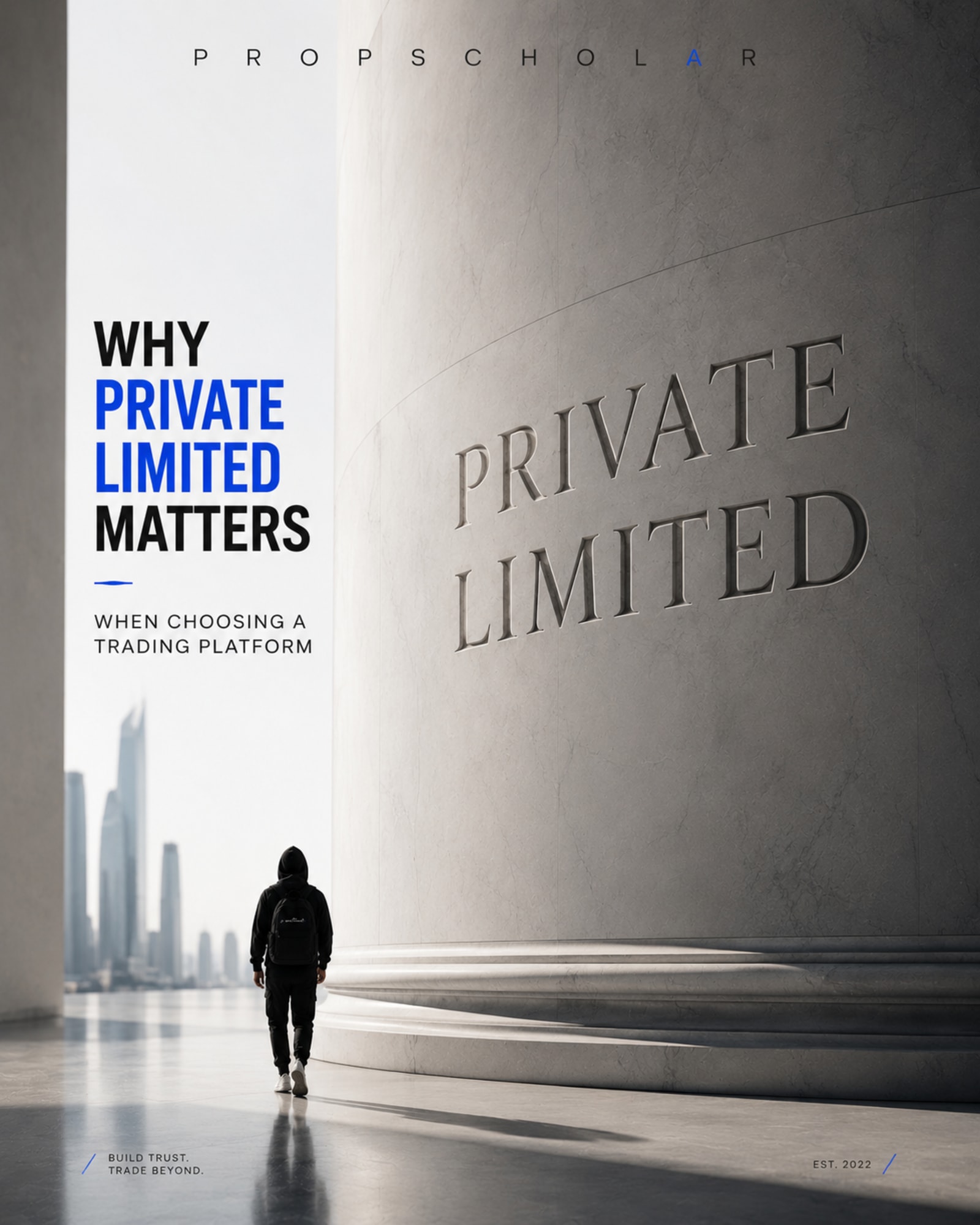
Before you pay a single dollar, rupee, or naira to any trading evaluation platform, you need to know who is actually on the other side. A Private Limited company registration is one of the clearest signals of legitimacy you can verify in under five minutes — and most traders skip it entirely. Here is why that check matters, what it actually proves, and how PropScholar's registration protects you a
Start your evaluationWhy a Private Limited Registration Matters When Choosing a Trading Platform
TL;DR: A Private Limited company registration is a public, government-verified record. It means the platform has named directors, a registered address, and legal accountability — things an anonymous Discord bot or a WhatsApp group cannot fake.
Key takeaways:
- Any trader can verify a Private Limited company in minutes using a public government database.
- Registration creates real legal accountability: named directors, a registered office, annual filings.
- Unregistered platforms have no named owner and no mechanism for you to recover funds.
- PropScholar is a Private Limited company registered in India under the MCA — verifiable right now.
- Registration alone is not everything, but it is the minimum bar a legitimate platform should clear.
That question is the whole game. Because the difference between a platform that pays you and one that disappears with your money often comes down to a single, boring, completely checkable fact: is it a registered legal entity?
What a Private Limited Company Registration Actually Means
A Private Limited company is a formal legal structure recognized by governments worldwide — Ltd in the UK, Pvt Ltd in India and South Asia, and equivalent forms across Africa, Southeast Asia, and beyond. When a company registers under this structure, it files documents with a government authority (in India, that's the Ministry of Corporate Affairs, or MCA) that include the company name, the names of its directors, a registered address, and its stated purpose.
This information becomes public record. Anyone can look it up.
That is the point. Registration is not just a legal technicality — it is a public commitment. The directors have attached their real names and identities to the business. The company must file annual returns. If it does something illegal or fraudulent, there is a traceable entity to hold accountable. There are real people on record who cannot simply delete their profile and start over.
Compare that to an unregistered platform. No named owner. No registered address. No filing obligations. The entire operation might be run from a single laptop, and if it shuts down overnight, you have nothing — no company number, no director name, no legal trail to follow.
Why This Matters More in Emerging Markets
Traders in India, Nigeria, the Philippines, Indonesia, South Africa, Pakistan, and similar markets face a specific problem: global prop firms with clean registration records often charge fees in USD and accept only international cards. That pricing excludes most beginners.
So the budget-conscious trader looks for local or cheaper alternatives. And that's exactly where unregistered platforms prey. They show up on YouTube ads, in trading Facebook groups, in Telegram channels with 50,000 followers. They use the right buzzwords. They post payout screenshots. They accept local payment methods.
But none of that tells you who is running it.
A registered company can be checked. An unregistered one cannot. That asymmetry is dangerous when you're a student in Lagos or a part-time trader in Manila who can only afford a $10 evaluation. You cannot afford to lose even that to a vanishing act.
How to Actually Verify a Company Registration
For an India-registered company, the MCA21 portal (mca.gov.in) lets you search by company name or CIN (Corporate Identification Number). You can see the date of incorporation, the registered state, the directors' names, and the company's filing status — all free, all public.
For platforms registered elsewhere, equivalent registries exist: Companies House in the UK, CAC in Nigeria, SEC in the Philippines, and so on. The principle is the same. You type in the name, you get the record, you verify it matches what the platform claims.
If you search and find nothing — or if the platform refuses to share its company name and registration number when you ask — that tells you something important. Legitimate companies do not hide their incorporation details. There is no reason to, unless the details do not exist.
Our guide on how to check if a prop firm is registered and trustworthy walks through this step by step with specific databases for different countries. Pair it with the red flags of trading evaluation scams and you've covered most of your due diligence in under 20 minutes.
Registration vs. Regulation: Understanding the Difference
Here's where some traders get confused. Company registration is not the same as financial regulation.
Registration means the company legally exists, has named directors, and files with a government authority. It's the baseline. Regulation — like being licensed by the FCA, SEBI, or similar bodies — means the company is authorized to conduct specific financial activities and is subject to ongoing oversight, capital requirements, and conduct rules.
A scholarship-based evaluation platform like PropScholar does not manage client trading funds in the way a licensed broker does — you pay an entry fee, prove your trading skills in an evaluation, and claim a scholarship payout based on that performance. That model does not require a broker license. But it absolutely should require company registration, because that's what creates the legal identity and accountability that protects you.
When a platform is both registered AND transparent about its model — clear rules, published payout mechanics, no retroactive rule changes — that combination is your real signal of trustworthiness.
PropScholar's Registration and What It Means for You
PropScholar is a scholarship-based trading evaluation platform operated by a Private Limited company registered in India under the MCA. That registration is not a marketing claim — it is a public government record with a CIN you can look up.
The platform has been running for over 1.5 years. The evaluation rules have never been changed retroactively. Payouts go out within 4 hours of verification. Entry starts from $5 (or roughly Rs.400 via UPI for Indian traders), and internationally the platform accepts crypto — so traders in Nigeria, the Philippines, Indonesia, and everywhere else can access it without needing USD cards.
None of that operational track record matters as much as one thing: there are real, named people behind PropScholar who are legally attached to its operations. That accountability is what makes the rest of those facts worth trusting.
If you want to verify the registration before you pay anything — you should. That is exactly the right approach, and it is the same check we would tell any trader to run on any platform, including ours.
The Short Version for Anyone in a Hurry
You're about to pay money to a platform you found online. Before you do, spend three minutes answering these questions:
Is there a company name and registration number publicly listed? If yes, look it up. If no, stop.
Do the rules exist in writing and stay fixed? Platforms that change rules mid-evaluation have no accountability mechanism to stop them. A registered company at least has legal exposure if it acts deceptively.
Is there a real support channel with real response times? PropScholar runs 24/7 support in Hindi and multiple languages with a 3,000-member Discord. That level of infrastructure does not exist on a scam operation.
Registration is not a guarantee of a great experience. But the absence of registration is a near-guarantee of risk. It is the first filter, not the last — and it takes less time than reading this article.
For Pakistani traders specifically, the article on why certain 'instant fund release' prop challenges fail shows exactly how unregistered platforms exploit payment urgency. The pattern repeats across every market.
PropScholar is a scholarship-based trading evaluation platform operated by a Private Limited company registered in India. We are not a prop firm and do not manage or allocate institutional capital. Our model rewards proven trading skill with scholarship grants upon successful evaluation completion.
Related reading
- The Safest Way for a College Student to Start Trading and Not Lose Money
- Is PropScholar Legit or Fake? The Honest 2026 Review Every Trader Should Read Before Paying
- Is Online Prop Trading Legit or a Scam? A Complete Trust Guide
- Are Free Funded Accounts Real? What 'Free' Prop Offers Actually Cost You
- Cheap Prop Firms Are a Scam: How PropScholar Gives You the Easiest Evaluation and a Real Path to Reliable Funded Trading
- Which Trading Platforms Actually Pay Fast: What to Verify First
Ready to Prove Your Edge?
Join 500+ traders. Start from just $5. Get funded within days.
Frequently Asked Questions
A Private Limited registration is a public government record that attaches real director names, a registered address, and legal accountability to the platform. Without it, there is no traceable entity if the platform disappears with your funds. It is the minimum verifiable signal that the people running the platform are real and legally identifiable.