
I Want to Start Trading But Don't Know Where to Begin: A Step-by-Step Roadmap
Feeling overwhelmed about starting trading? This step-by-step roadmap breaks down exactly what to learn first, what to ignore, how to practice without losing real money, and when you're actually ready to trade for real rewards — including how a scholarship-based evaluation platform like PropScholar lets beginners start for as little as $5.
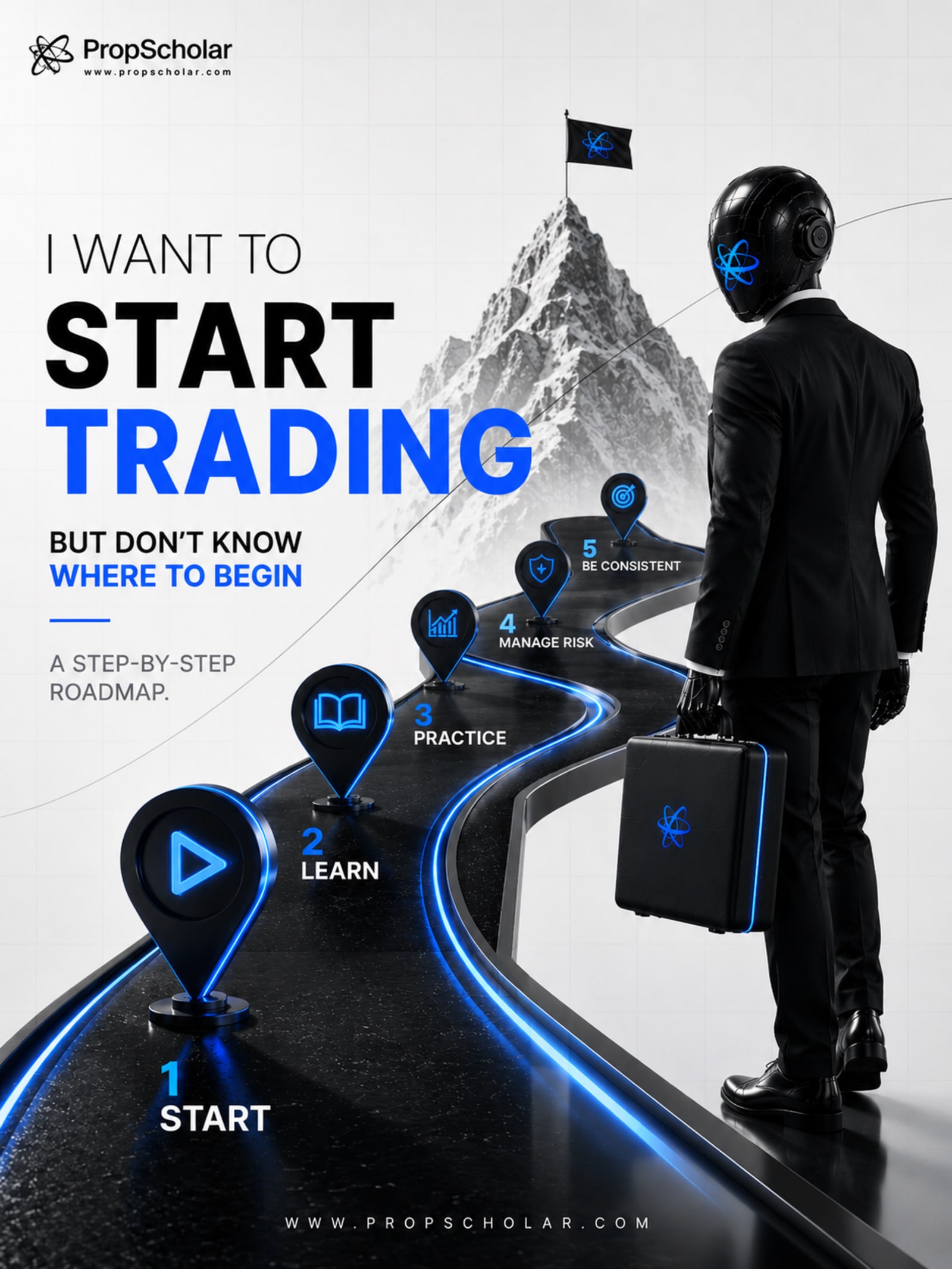
Feeling overwhelmed about starting trading? This step-by-step roadmap breaks down exactly what to learn first, what to ignore, how to practice without losing real money, and when you're actually ready to trade for real rewards — including how a scholarship-based evaluation platform like PropScholar lets beginners start for as little as $5.
Start your evaluationI Want to Start Trading But Don't Know Where to Begin: A Step-by-Step Roadmap
TL;DR: Trading looks complicated until you break it into stages. Learn the basics, practice on a demo, build a simple strategy, manage your risk ruthlessly, and only then put real money (or a real evaluation) on the line. This roadmap tells you exactly what to do at each stage.
Key takeaways:
- Most beginners fail not because trading is impossible, but because they skip stages — especially the practice stage.
- You need to understand four things before your first real trade: basic market mechanics, one strategy, risk management, and your own emotional triggers.
- Demo trading for 30-60 days is not optional. It's the stage that separates the traders who survive from the ones who blow accounts in week two.
- When you're ready to trade with real stakes, you don't need tens of thousands of dollars. Scholarship-based evaluation platforms like PropScholar let you start an evaluation from just $5.
- Payouts of up to 400% are possible through PropScholar's scholarship model — and they pay within 4 hours of verification.
You've watched the YouTube videos. You've seen the screenshots of people making money from a laptop in a coffee shop. And now you're sitting there thinking: okay, but where do I actually start?
That confusion is completely normal. The trading industry is full of noise — courses promising six-figure returns, influencers with rented Lamborghinis, and platforms that seem designed to take your money before you know what you're doing. It's hard to know what's real.
This guide cuts through all of that. I'm going to give you a real, sequential roadmap — not the "motivational" version, not the one that glosses over the hard parts. The one that actually works.
Step 1: Understand What Trading Actually Is (and What It Isn't)
Trading is the act of buying and selling financial instruments — currencies, indices, commodities, stocks — with the goal of profiting from price movements. That's it. The instrument goes up, you profit if you bought it. It goes down, you profit if you sold it short. Simple concept. The execution is where it gets difficult.
What trading is NOT: a get-rich-quick scheme, a guaranteed income, or something you master in a weekend. Studies consistently show that a majority of retail traders lose money in their first year, not because the market is rigged against them, but because they come in underprepared. The good news is that preparation is entirely within your control.
Before anything else, get clear on why you want to trade. Is it for extra income? To replace a salary eventually? For the intellectual challenge? Your answer affects the time commitment, the instruments you focus on, and the strategy that suits you. Someone trading for 30 minutes a day during a lunch break needs a completely different approach from someone who can watch charts for three hours.
Step 2: Learn the Non-Negotiable Basics
You don't need to know everything before you start. But there are five fundamentals you genuinely cannot skip.
What is a pip, and why does it matter?
A pip is the smallest standard price movement in a currency pair. For most major forex pairs like EUR/USD, one pip is a move of 0.0001. If EUR/USD moves from 1.0800 to 1.0850, that's a 50-pip move. Why does this matter? Because it's how you measure profit, loss, and risk before entering any trade. You can't set a sensible stop-loss without understanding pips.
Bid, ask, and the spread
Every market quote has two prices: the bid (what the market will buy from you) and the ask (what you pay to buy). The spread is the difference. A 1.2-pip spread on EUR/USD is standard. A 15-pip spread on a minor pair can eat your profits before you even start. Always check spreads before trading a new instrument.
What is a lot size?
A standard lot is 100,000 units of the base currency. A mini lot is 10,000. A micro lot is 1,000. For beginners, micro lots are your best friend — they let you practice with real mechanics without catastrophic losses. Most retail brokers and evaluation platforms work in micro lots for smaller accounts.
Support and resistance
Price doesn't move randomly. It tends to bounce at certain levels where buyers and sellers repeatedly show up. A support level is a price floor where buying pressure historically emerges. Resistance is a ceiling where selling pressure appears. Learning to identify these on a chart is the single most transferable skill in trading — it works across every instrument and every timeframe.
Candlestick charts
Every candle on a price chart tells you four things: the opening price, the closing price, the highest price reached, and the lowest price reached during that period. A green (or white) candle means price closed higher than it opened. A red (or black) candle means the opposite. Before you read a single strategy, make sure you can look at any candlestick chart and immediately understand what price has done.
Spend one week just on these five basics. Free resources on YouTube, Investopedia, and BabyPips (for forex specifically) cover all of this in detail.
Step 3: Choose One Market and Stick to It
Forex, stocks, crypto, commodities, indices — all of these are tradable markets. The mistake almost every beginner makes is trying to trade all of them at once.
Choose one. For most beginners globally, forex is the most accessible starting point: it trades 24 hours a day, five days a week; the minimum capital requirements are low; and the major pairs (EUR/USD, GBP/USD, USD/JPY) have tight spreads and deep liquidity.
For traders in emerging markets — Nigeria, India, the Philippines, Indonesia, South Africa — forex is also the most relevant market because currency movements directly affect your local economy. Understanding why the Naira or Rupee or Peso moves against the dollar isn't just an academic exercise; it connects your trading to the world you already live in.
Once you can trade one market consistently, adding another is straightforward. Until then, splitting your attention between forex and crypto and indices just means learning all of them slowly instead of learning one of them well.
Step 4: Open a Demo Account and Trade It Seriously
A demo account gives you real market prices, real charting tools, and simulated money — typically $10,000 or $50,000 of virtual capital. It costs nothing to open. Most forex brokers (MetaTrader 4 and MetaTrader 5 are the most common platforms) offer demo accounts with no expiry.
Here's what most guides won't tell you: demo trading only works if you treat it exactly like real trading. That means setting a stop-loss on every single trade. That means not risking more than 1-2% of your demo account on any single position. That means keeping a trading journal.
If you blow your demo account in three days because "it's not real money anyway," you've learned nothing useful. The whole point of demo trading is to burn in the habits that will save you when real money is on the line.
How long should you demo trade? A minimum of 30 days. Ideally 60. The goal isn't time — it's consistency. Before you go live, you should have at least 50-100 recorded trades with a positive expectancy. That means your average winning trades outnumber or outsize your average losing trades over a statistically meaningful sample.
If you check out the Forex trading for complete beginners guide on PropScholar you'll find more detail on setting up MetaTrader and reading your first charts.
Step 5: Build a Simple, Written Trading Plan
A trading plan is not complicated. It's a document — even a notes app note — that answers these questions before you sit down to trade each day.
What will I trade?
Specify the instruments. EUR/USD and GBP/USD only? Gold? One index? Pick your list and don't deviate because you saw someone else tweet about a different pair.
What is my strategy?
You don't need an advanced system. A moving average crossover, a simple support-and-resistance bounce setup, or a basic trend-following approach is enough to start. What matters is that you can describe your entry and exit conditions in one or two sentences. If you can't explain why you're entering a trade, you shouldn't enter it.
What is my risk per trade?
Set a number and write it down. Most professional traders risk between 0.5% and 2% of their account per trade. If your account is $500, that's $2.50 to $10 per trade. This sounds small. It's not. Over 100 trades, disciplined 1% risk management is what separates traders who are still trading two years later from those who aren't.
What sessions will I trade?
Forex has three main sessions: London (07:00-16:00 GMT), New York (13:00-22:00 GMT), and Tokyo/Asian (00:00-09:00 GMT). The highest volatility and tightest spreads happen during the London-New York overlap (13:00-16:00 GMT). For most beginners, focusing on this window gives you the best conditions.
What will make me stop trading today?
Set a daily loss limit. If you lose 3% in a day, close the platform and step away. No exceptions. This single rule will save your account more times than any strategy.
Step 6: Understand Risk Management — This Is the Job
Everybody wants to talk about entries. Where to buy, where to sell, which indicator to use. But the traders who make money long-term — and this is something we see consistently from the trading patterns across PropScholar's evaluation data — are the ones who survive losing streaks, not just the ones who have big winning days.
Risk management has three core components.
Position sizing. Calculate your lot size based on your stop-loss distance and your risk percentage, not based on a gut feeling. There are free position size calculators online. Use them every single time.
Stop-loss placement. Your stop-loss should be placed where your trade idea is proven wrong — not where you feel comfortable psychologically. A stop-loss placed 5 pips away on a volatile pair will get hit repeatedly. Place it beyond a logical structure level.
Risk-to-reward ratio. Only take trades where the potential reward is at least 1.5 to 2 times your risk. A 1:2 risk-to-reward ratio means you can be wrong 40% of the time and still be profitable. This math is your safety net.
If you want to go deeper on starting with limited capital, this guide on trading with no experience and no money covers the money management side in detail.
Step 7: Keep a Trading Journal (Almost Nobody Does This)
A trading journal is the highest-ROI habit in trading, and the vast majority of beginners ignore it entirely.
After every trade, record: the instrument, the entry and exit price, the reason you entered, the result in pips and in money, and a short note on how you felt during the trade. That last part sounds strange but it's crucial. Trading decisions made while you're fearful look different from decisions made when you're calm. Your journal reveals that.
After 50-100 trades, review the data. You'll see patterns: maybe you lose money consistently on Monday mornings. Maybe your best trades are clean trend setups and your worst are counter-trend gambles. Maybe you cut winning trades too early when your screen time is short. The journal shows you what to fix. Without it, you're just guessing.
Digital spreadsheets work fine. Notion, Google Sheets, or a dedicated app like Edgewonk — all of these do the job.
Step 8: Work on Trading Psychology Before It Works on You
Fear, greed, revenge trading, overconfidence after a winning streak — these aren't character flaws. They're predictable human responses to financial uncertainty. Every trader deals with them. What separates consistent traders is that they've built systems to contain these responses.
A few things that actually work:
Trade smaller than feels necessary when you're starting out. The emotional weight of a losing position is directly proportional to its size relative to your account. Trade micro lots until the losses feel inconsequential.
Never move a stop-loss further away to avoid a loss. This is the fastest way to turn a manageable losing trade into an account-wrecking one.
Take breaks. If you've had three losing trades in a row, step away. Come back the next session. The market will still be there.
A rule that experienced traders live by: the best trades feel boring. You see the setup, the conditions match your plan, you execute, you set your stop and target, and you close the trade. No excitement. No story. Just process.
Step 9: Know When You're Actually Ready to Trade for Real Stakes
There's no universal countdown clock. But there are concrete signals that you're ready to move beyond demo trading.
You've completed at least 50-100 demo trades with a documented positive expectancy — meaning your average win is larger than your average loss, or you win often enough that the math works out. You can explain your strategy entry and exit conditions in two sentences. You've experienced a losing streak of five or more trades and didn't change your strategy in a panic. Your position sizing is always calculated, never guessed.
If you can check all four of those boxes, you're ready.
Now the question becomes: how do you trade for real stakes without needing to deposit thousands of dollars?
How PropScholar Fits Into Your Trading Journey
Here's where most trading roadmaps stop — they tell you to "open a live account" without addressing the fact that funding a live trading account with meaningful capital is simply not realistic for most beginners globally. A standard $10,000 funded account through most evaluation platforms costs hundreds of dollars just to attempt the challenge.
What PropScholar actually is
PropScholar is a scholarship-based trading evaluation platform — not a prop firm. The model works like this: you pay a small entry fee, you pass the trading evaluation by meeting the performance targets, and you claim a scholarship payout of up to 400% of your entry fee, paid within 4 hours of verification.
Entry fees start from $5 (around 400 Indian Rupees, roughly 8,000 Nigerian Naira, or about 200 Philippine Pesos). That's the lowest barrier to a real-stakes trading evaluation that exists anywhere in the market right now.
Why this is the right step after demo trading
Demo trading gives you the mechanics. But there's one thing demo trading cannot replicate: the psychological weight of a real financial outcome. When money is genuinely on the line — even a small amount — your brain behaves differently. The evaluation framework gives you that real-stakes environment at a cost that's accessible to beginners.
The rules are public and have never been changed retroactively. That matters. One of the most common complaints about evaluation platforms globally is that rules shift after traders start performing well. At PropScholar, you know exactly what you're being evaluated on before you pay a single cent.
Payments that work globally
This is a genuinely global platform. Traders in India can pay via UPI through PhonePe, Razorpay, or Cashfree. Traders everywhere else — Nigeria, Philippines, Indonesia, South Africa, Pakistan, Kenya, Egypt, Vietnam — can pay with crypto. You don't need an international credit card or a wire transfer. You just need a wallet.
The FIFA World Cup 2026 discount
Right now, PropScholar is running a free penalty game at app.propscholar.com/fifa. Score one goal out of five kicks and you get a mystery discount code — anywhere from 22% to 25% off an evaluation entry fee, or up to 15% extra on your payout. You can retry every 4 hours. At $5 entry, even a 22% discount makes a noticeable difference. It's free to play, so there's no reason not to try it before you register.
What the PropScholar community looks like
The Discord has more than 3,000 traders in it. Payout proofs are posted regularly. There's 24/7 support in Hindi and multiple other languages. For a beginner who's never been part of a trading community, this is one of the most underrated resources available — you can ask questions, watch how experienced traders talk about their setups, and see that real payouts actually happen.
You can check out PropScholar's evaluation options at the shop and see the current pricing for yourself.
Common Beginner Mistakes (That This Roadmap Helps You Avoid)
After watching thousands of beginners come through the evaluation system and the Discord community, a few patterns show up constantly.
Skipping demo trading entirely and going straight to a live evaluation. This is the single most common mistake. The evaluation has specific drawdown rules. You need to have practiced staying within drawdown limits before those limits have real financial consequences.
Choosing too many pairs. Beginners who trade eight different currency pairs in their first month almost always perform worse than beginners who focused on two. The math on spreads, the chart-reading pattern recognition, the understanding of how a specific pair moves — all of this compounds with focus, not breadth.
Treating a strategy like a lottery ticket. One setup doesn't work? Ditch it after five trades and try something else. This cycle repeats until the account is gone. Strategy evaluation requires at least 30-50 trades. Anything less is noise.
Ignoring the time zone their broker's charts are set to. This sounds trivial but it affects where daily candles open and close, which affects support-resistance levels. Know your chart timezone.
Your 90-Day Trading Roadmap at a Glance
Days 1 to 14: Foundation
Learn the five basics in Step 2. Open a demo account on MetaTrader 4 or 5. Spend 30-60 minutes per day watching price move and practicing chart reading without placing any trades. Your only job is to understand what you're looking at.
Days 15 to 45: Practice with intention
Start placing demo trades using one simple setup — a support-and-resistance bounce, a moving average crossover, or a basic trend continuation. Record every trade in your journal. Risk no more than 1% of your demo balance per trade. Aim for 50 trades in this window.
Days 46 to 75: Review and refine
Analyze your journal data. What's your win rate? What's your average risk-to-reward? Where are your recurring mistakes? Adjust your approach based on data, not emotion. Keep trading the demo.
Days 76 to 90: Prepare for real stakes
If your demo results show positive expectancy across at least 50-100 trades, you're ready. Review the PropScholar evaluation rules. Try the FIFA penalty game for a discount. Start your evaluation with the smallest available entry fee and treat it exactly like your demo — same rules, same discipline, same journal.
For a more detailed look at the starting-with-limited-resources angle, this guide on how to start trading with no experience and little money covers some specific tools and broker setups worth knowing.
Frequently Asked Questions
How long does it take to learn trading as a complete beginner? Most beginners need 3-6 months of consistent practice before they're ready for a real-stakes environment. The 90-day roadmap above is realistic for someone putting in 30-60 minutes per day. The key markers of readiness are: 50-100 demo trades with documented positive expectancy, the ability to explain your strategy in two sentences, and having survived a losing streak without changing your approach in a panic.
What is the best market for beginners to start with? Forex is generally the most accessible starting point for beginners globally. Major currency pairs like EUR/USD and GBP/USD have tight spreads, high liquidity, and trade 24 hours a day five days a week. This flexibility makes it easier to find trading time around a job or studies. Once you're consistently profitable on one forex pair, adding other markets becomes straightforward.
Do I need a lot of money to start trading? Not to start learning. A demo account is completely free. When you're ready for real stakes, scholarship-based evaluation platforms like PropScholar offer entry fees from as low as $5. You don't need thousands of dollars sitting in a brokerage account to begin gaining real-stakes experience.
What is a trading evaluation and how does it work? A trading evaluation is a structured challenge where you trade under specific rules — typically a profit target combined with maximum drawdown limits — over a set number of days. If you meet the targets, you pass the evaluation. At PropScholar, passing the evaluation qualifies you for a scholarship payout of up to 400% of your entry fee, paid within 4 hours of verification.
Is PropScholar a prop firm? No. PropScholar is a scholarship-based trading evaluation platform, not a prop firm. It doesn't manage or allocate institutional capital. The model is: pay a small entry fee, pass the evaluation by trading within defined rules, and receive a scholarship grant of up to 400%. It's operated by a Private Limited company registered in India and has been running for over 1.5 years.
What is a stop-loss and why is it non-negotiable? A stop-loss is an automatic order that closes your trade if price moves against you to a specified level. It caps your maximum loss on any single trade. Without a stop-loss, one bad trade can wipe out weeks of gains. Setting a stop-loss on every trade is the most important habit you can build as a beginner. The size of your stop-loss also determines your position size — which means it's the foundation of your entire risk management system.
How do I know if my trading strategy is actually working? A strategy requires at least 30-50 trades to generate meaningful data. After that sample, calculate your win rate (percentage of winning trades) and your average risk-to-reward ratio (average win size divided by average loss size). If your win rate is 40% but your average win is twice your average loss, you're profitable. Use your trading journal to track this. Don't judge a strategy on 5 trades — that's just noise.
Can I trade forex from Nigeria, Philippines, or Indonesia? Yes. Forex trading is accessible from virtually every country through online brokers. PropScholar's evaluation platform is also globally accessible and accepts crypto payments for traders outside India. There are no country restrictions on joining the evaluation or the Discord community.
What is risk-to-reward ratio and what should it be for beginners? Risk-to-reward ratio compares how much you risk on a trade to how much you stand to gain. A 1:2 ratio means you risk $1 to potentially make $2. For beginners, a minimum of 1:1.5 is recommended — meaning your target must be at least 1.5 times the distance to your stop-loss. At 1:2, you only need to win 34% of your trades to break even. This mathematical buffer gives beginners room to learn without immediate account depletion.
What is demo trading and how long should I do it? Demo trading is practice trading with simulated money on real market prices. It costs nothing and carries no financial risk. You should demo trade for a minimum of 30 days, ideally 60, and complete at least 50-100 trades before considering a real-stakes evaluation. Treat every demo trade exactly as you would a live trade — same risk rules, same stop-loss discipline, same journal entries.
What trading platform should a beginner use? MetaTrader 4 (MT4) and MetaTrader 5 (MT5) are the most widely used platforms globally and are available for free on desktop and mobile. They support both demo and live accounts, have extensive charting tools, and work with thousands of brokers. Most evaluation platforms, including PropScholar, are compatible with MetaTrader. TradingView is also excellent for chart analysis, though it requires a separate broker connection for execution.
What is the PropScholar FIFA World Cup discount and how do I get it? During the FIFA World Cup 2026, PropScholar is running a free penalty game at app.propscholar.com/fifa. Score one goal out of five attempts and you receive a mystery discount code worth 22-25% off an evaluation entry fee, or up to 15% extra on your scholarship payout. The game is completely free to play and you can retry every 4 hours. At a $5 entry fee, even a 22% discount saves you over $1 — which at that price point is meaningful.
What are the most common reasons beginners fail at trading? The most consistent patterns are: skipping demo practice and going live too early; risking too much per trade (5-10% instead of 1-2%); trading too many instruments at once; abandoning a strategy after a small losing streak before it has enough data to evaluate; and not keeping a trading journal. None of these failures are about intelligence. They're all about process. Follow a structured roadmap and most of them are avoidable.
How do I join PropScholar's trader community? The PropScholar Discord has over 3,000 traders and is free to join. You'll find payout proofs, strategy discussions, 24/7 support in Hindi and multiple languages, and a community of beginners and experienced traders from around the world. It's one of the most useful free resources available to anyone starting their trading journey. You can join at discord.com/invite/propscholar.
PropScholar is a scholarship-based trading evaluation platform operated by a Private Limited company registered in India. We are not a prop firm and do not manage or allocate institutional capital. Our model rewards proven trading skill with scholarship grants upon successful evaluation completion.
Ready to Prove Your Edge?
Join 500+ traders. Start from just $5. Get funded within days.
Frequently Asked Questions
Most beginners need 3-6 months of consistent practice before they're ready for a real-stakes environment. The key markers of readiness are: 50-100 demo trades with documented positive expectancy, the ability to explain your strategy in two sentences, and having survived a losing streak without changing your approach in a panic. Someone putting in 30-60 minutes per day can reach this point within a structured 90-day roadmap.
More From PropScholar

Beginner Trading
Best Prop Firm for Indian Students: Start Trading With ₹999 on UPI
5 min read

Beginner Trading
Best Prop Firm for Beginners 2026: Safest, Easiest & Smartest Way to Start Trading
10 min read

Beginner Trading
Start Prop Trading with Just $5 in 2026: How PropScholar Makes It Possible
6 min read