
How to Start Trading With No Experience and Little Money
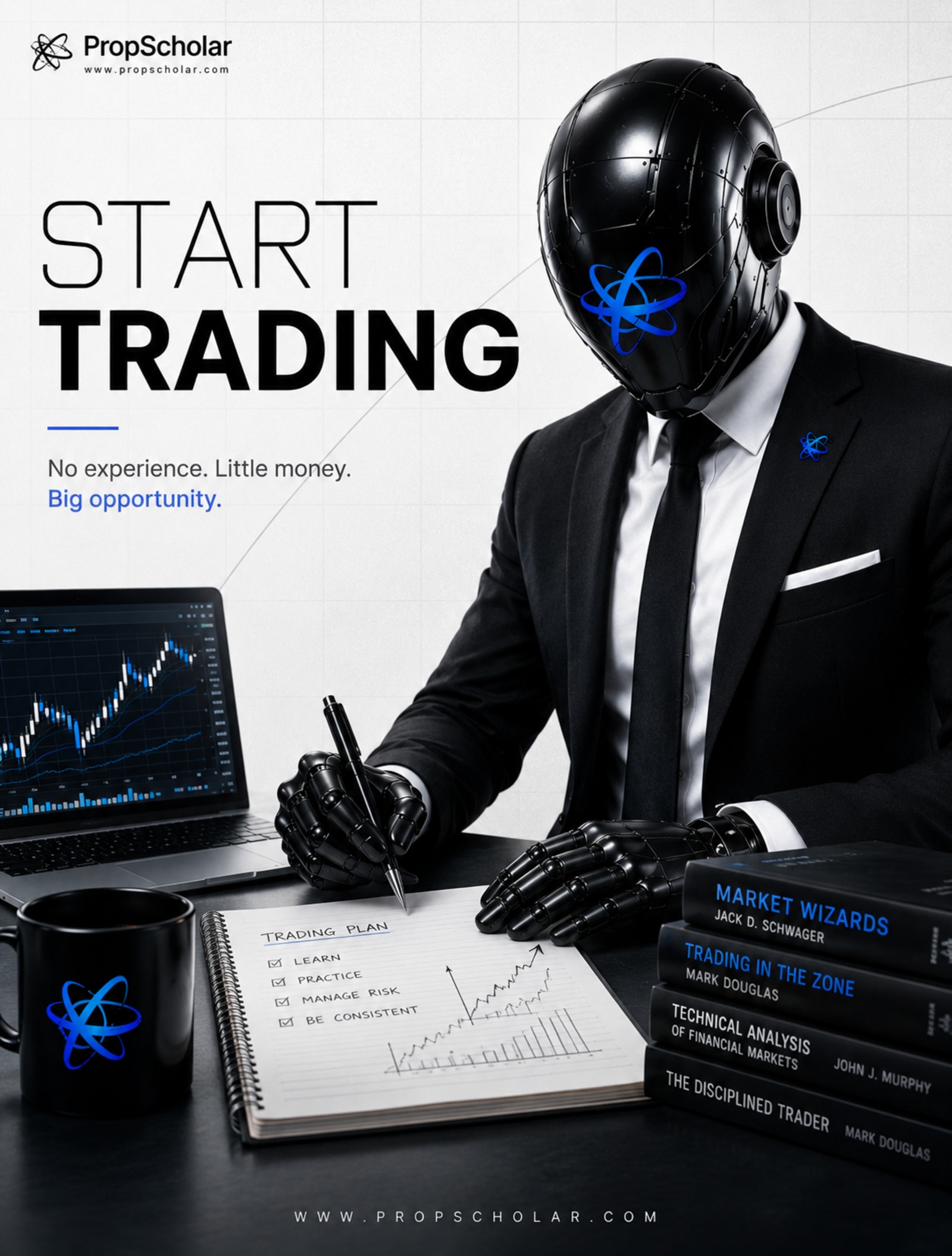
You want to start trading but you have no experience and barely any money to risk. This guide walks you through the exact steps — from learning the basics for free, to practicing without losing real money, to earning a real scholarship payout through PropScholar's evaluation for as little as $5. No fluff, no false promises.
You want to start trading but you have no experience and barely any money to risk. This guide walks you through the exact steps — from learning the basics for free, to practicing without losing real money, to earning a real scholarship payout through PropScholar's evaluation for as little as $5. No fluff, no false promises.
Start your evaluationHow to Start Trading With No Experience and Little Money
TL;DR: You do not need thousands of dollars or a finance degree to start trading. You need a structured learning path, a way to practice without destroying savings, and a realistic first goal. This guide gives you all three.
Key takeaways:
- Most beginner traders fail not because they lack talent, but because they skip fundamentals and risk real money too soon.
- Free tools — price charts, demo accounts, YouTube channels, and trading communities — can take a complete beginner to a competent one in weeks, not years.
- Practicing on a demo account is essential, but it pays nothing; you need a real next step that bridges the gap between practice and a real payout.
- PropScholar is a scholarship-based evaluation platform where you pay an entry fee from $5, prove your skill on simulated markets, and claim a scholarship of up to 400% — paid within 4 hours of verification.
- The FIFA World Cup 2026 Penalty Game at app.propscholar.com/fifa currently offers mystery discount codes (22–25% off or up to 15% extra payout) every 4 hours, which means your $5 entry could cost even less right now.
You opened a trading app once, watched a candle move, and thought: "I could do this." Then you saw that most platforms want you to deposit $200 minimum, and most funded trader programs charge $100+ just to attempt an evaluation. You closed the tab.
That moment — the one where the cost of entry kills the ambition before it starts — is where most beginner traders get stuck. It is not a lack of skill. It is a structural problem: the trading world was built for people who already have money, and it has been slow to change.
But the structure is changing. Demo accounts are free. Trading education on YouTube, Reddit, and Discord is better than it has ever been. And scholarship-based evaluation platforms like PropScholar now let you prove your skill for as little as $5, with a scholarship payout of up to 400% if you pass. That means a beginner in Nigeria, Indonesia, the Philippines, South Africa, or anywhere else in the world now has a realistic on-ramp — not just a dream.
This guide is the exact roadmap you need. We will go step by step: what to learn first, how to practice without losing real money, when you are actually ready to enter a real evaluation, and how to pick the right platform without getting trapped by expensive or dishonest programs.
Step 1: Understand What Trading Actually Is Before You Touch a Chart
Trading is the act of buying and selling financial instruments — currencies, indices, commodities, stocks — to profit from price movements. That definition sounds simple. The application is not.
Before you open a chart, you need to understand three foundational concepts that no amount of "just start trading" motivation will replace.
Price moves because of supply and demand. When more buyers want an asset than sellers are willing to supply, price goes up. When sellers outnumber buyers, price goes down. Every strategy, every indicator, every trading system is ultimately an attempt to predict which force will dominate next.
Risk management is more important than picking direction. Beginners think trading is about being right. Professionals know it is about surviving long enough to be right often enough. A trader who wins 40% of trades but cuts losses quickly and lets winners run will outperform one who wins 70% of trades but holds losers hoping they recover. Understanding this single concept separates beginners who eventually succeed from those who blow up their accounts.
Leverage is a tool, not a shortcut. Most retail trading platforms offer leverage — the ability to control a position much larger than your account balance. This amplifies both gains and losses. A beginner who uses leverage without understanding it is not trading; they are gambling. Learn what leverage means before you use it.
You can learn all three of these concepts for free. Babypips.com has a structured course that covers forex basics in plain language. YouTube channels from independent traders walk through chart reading, risk management, and live trade analysis. The PropScholar Discord community has over 3,000 active traders, many of them beginners, who share learning resources and answer questions daily. Use these before you put a single dollar on the line.
Step 2: Choose One Market and One Style — Not Five
One of the most common beginner mistakes is trying to trade everything at once: forex today, crypto tomorrow, US stocks on Wednesday, gold on Thursday. This produces noise, not skill.
Choose one market when you start. For most traders in emerging markets, forex is the natural starting point. It is open 24 hours a day, five days a week. It requires no broker that restricts non-US residents. Spreads are low on major pairs. And the learning resources specifically for forex beginners are the most abundant of any market. If you want a structured introduction, the guide on how to start forex trading as a complete beginner in 2026 covers the setup from scratch.
Once you pick a market, pick a style that matches your life.
Scalping means taking many small trades throughout the day, sometimes holding positions for seconds or minutes. It requires focus, fast reflexes, and a lot of screen time. It is not beginner-friendly.
Day trading means opening and closing all trades within a single session. You never hold positions overnight, which limits overnight risk. It requires a few hours of focused attention each day.
Swing trading means holding trades for one to several days, capturing larger price moves. It is more forgiving for beginners because you have time to think before acting. It suits people who have jobs, school, or other commitments during market hours.
For most beginners with no experience, swing trading on the forex market is the most forgiving starting point. Choose it, commit to it for at least two to three months, and only revisit this decision once you have consistent demo results.
Step 3: Open a Demo Account and Treat It Like Real Money
A demo account is a simulated trading environment where you trade with virtual money at real market prices. Every reputable broker offers one for free. MetaTrader 4 and MetaTrader 5 are the most widely used platforms and both offer demo accounts with no time limit.
The purpose of a demo account is to build mechanical skill without financial risk: learning how to open and close orders, how to set stop losses and take profit targets, how to read a chart in real time, and how to follow a plan under market pressure.
Here is the critical warning: most beginners use demo accounts wrong. They take positions 10 times larger than they would with real money. They do not track their trades. They restart the account every time they lose. This produces false confidence, not real skill.
To use a demo account correctly:
Trade the same position sizes you would use if the money were real. If your real budget is $50, demo as if you have $50. Keep a simple trade journal — the date, the pair, the entry, the stop loss, the take profit, the result, and one sentence about why you took the trade. Review it weekly. After 30 to 50 trades, you will see patterns: the setups you execute well, the ones you rush, the times you move your stop loss when you should not.
When your demo results show a positive expectancy over at least 30 trades — meaning your average winning trade is larger than your average losing trade, and you are not losing more than a few percent per week — you are ready for the next step.
Step 4: Understand Why Demo Trading Is a Dead End Without a Real Next Step
Demo trading is necessary. It is also insufficient on its own, and this is something most beginner guides never say clearly.
The problem is psychological. When no real money is at risk, your brain does not process the situation the same way. You hold losers longer than you should because there is no pain. You take oversized risks because the loss feels abstract. The moment real money enters the picture, even a small amount, the emotional dynamics change completely.
This is why the gap between demo success and live trading success is so large for most beginners. You need a bridge — an environment that creates real stakes without requiring you to risk capital you cannot afford to lose.
This is precisely the problem that scholarship-based evaluation platforms were designed to solve. Instead of depositing your own money into a live brokerage account where every loss comes directly out of your pocket, you pay a small entry fee to an evaluation platform, trade on a simulated account with real market conditions, and earn a scholarship payout if you prove consistent skill.
For a deeper look at why practice apps alone are not enough, the article on why practice apps pay nothing and PropScholar pays up to 400% explains the psychology and economics in detail.
Step 5: Learn the Key Rules That Any Evaluation Will Test
Whether you eventually enter PropScholar's evaluation or any other structured program, evaluations test a specific set of behaviors. Knowing these before you start is a major advantage.
Daily drawdown limit. Most evaluations cap the maximum amount you can lose in a single trading day, usually expressed as a percentage of your starting balance. Blow through it once and the evaluation ends. Beginners who do not use stop losses almost always fail here.
Maximum drawdown limit. This is the total loss from peak balance allowed over the entire evaluation. It is typically larger than the daily limit but still finite. Risk management is not optional; it is the evaluation.
Profit target. You need to reach a specified profit percentage within the evaluation period. This tests that you can generate returns, not just avoid losses.
Consistency. Some evaluations check that you do not generate all your profits from a single lucky trade. They want to see steady, repeatable performance across multiple trades.
The key insight here, drawn from watching thousands of beginner traders attempt evaluations: traders who fail almost always break the daily drawdown rule, not the profit target. They come close to their target, then revenge-trade a bad day and blow the account in hours. Discipline around losses is the actual skill being tested.
Step 6: Build a Simple Trading Plan Before You Risk Anything
A trading plan is a written document that answers six questions before you open any live or evaluated trade:
What market and timeframe am I trading? For example: EUR/USD on the 4-hour chart.
What setup do I need to see before entering? Be specific. "The market looks good" is not a setup. "Price has pulled back to a previous support level and formed a bullish engulfing candle after a downtrend" is a setup.
Where is my stop loss? It must be placed before you enter, not after the trade moves against you.
Where is my take profit? Your take profit should be at least 1.5 times your stop loss distance. This means even if you are wrong half the time, you still make money overall.
How much am I risking per trade? For beginners, 1% of account balance per trade is a standard and sensible rule. On a $1,000 simulated account, that is $10 per trade maximum.
What will I do if I lose three trades in a row? Have a rule. Many traders take a one-day break after three consecutive losses. This prevents the emotional spiral of revenge trading.
Write this plan down. Follow it. When you break it, note why in your journal. Over time, the plan will evolve — but only because the evidence from your own trades tells you something needs to change, not because a YouTube video told you to chase a new strategy.
Step 7: Pick the Right Evaluation Platform — What to Look For and What to Avoid
Once your demo trading shows consistent results and you understand evaluation rules, the next step is choosing where to attempt your first real evaluation. This decision matters more than most beginners realize.
What a trustworthy platform looks like
The rules are published clearly before you pay. The payout history is verifiable — either through community testimonials or public records. The company is registered and identifiable. The entry fee is proportionate to what you might earn. Support is reachable, not just a bot.
What a problematic platform looks like
Rules that change after you pay. Vague terms about what triggers disqualification. No evidence of actual payouts to real traders. Entry fees that are "free" or "just $1" but layer subscription charges on top. No identifiable legal entity behind the platform.
The industry has patterns worth knowing. Some platforms charge very low entry fees but require monthly subscriptions that add up to more than a standard evaluation fee within a few months. Some add fine-print rules — like "consistency scores" — that are calculated in ways that make it nearly impossible to pass even with good trading. Others run promotions that feel attractive but delay or deny payouts through bureaucratic friction.
Being aware of these patterns — without needing to name any specific company — is your protection.
How PropScholar compares
PropScholar is a scholarship-based trading evaluation platform registered as a Private Limited company in India under the Ministry of Corporate Affairs. It has been operating for over 1.5 years. It is not a prop firm and does not claim to manage institutional capital.
The model works like this: pay an entry fee starting from $5 (approximately Rs. 400 in India, or the local-currency equivalent via crypto for global traders), complete a trading evaluation on simulated markets, and claim a scholarship of up to 400% of your entry fee, paid within 4 hours of verification.
The rules are public and have never been changed retroactively — a fact that matters enormously because several industry players have changed evaluation rules mid-challenge after traders paid. PropScholar's 3,000-member Discord community is the easiest place to verify the experience of other traders before you commit a single dollar.
For traders in India, UPI payment is available through PhonePe, Razorpay, and Cashfree. For traders globally — in Nigeria, the Philippines, Indonesia, South Africa, Vietnam, Kenya, Egypt, Pakistan, Bangladesh, and everywhere else — crypto payments are accepted, making access genuinely borderless without requiring a specific local payment method that may not be available. You can browse current evaluation options at PropScholar's shop.
How the entry fee compares to the alternative
The alternative to an evaluation platform is opening a live brokerage account with your own money. A realistic live forex account that gives you meaningful learning requires at least $100–$500, and most of that capital is at direct risk every time you trade. A PropScholar evaluation starts at $5. If you fail the evaluation, you learn something and can re-enter. If you had put that $5 equivalent into a live brokerage account and traded without enough skill, you would likely lose significantly more.
For student traders who want a full breakdown of how to approach this on a genuinely small budget, the article on prop trading for students and college traders covers the progression in detail.
The FIFA World Cup 2026 Promotion: How to Pay Even Less Right Now
For traders who want to reduce their entry cost further, PropScholar is currently running a FIFA World Cup 2026 Penalty Game at app.propscholar.com/fifa. Score one goal in five penalty attempts and you receive a mystery discount code — typically 22 to 25% off your evaluation fee, or up to 15% extra scholarship payout on top of the standard amount. You can retry every 4 hours.
This is not a gimmick. It is a direct way to reduce the cost of your first evaluation, which already starts at $5. On the lowest tier, a 22% discount brings that entry cost down further, making this one of the most accessible entry points in the industry.
There is no obligation. You play, you either get a code or you do not, and you retry in 4 hours if needed. The promotion is live during the World Cup 2026 period.
What Happens After You Pass: Understanding the Scholarship Payout
Passing the evaluation is the goal, but understanding what happens next is important before you enter.
Once you complete the evaluation and meet the required criteria, you submit verification. PropScholar processes the scholarship payment within 4 hours of verification. The scholarship is a multiple of your entry fee — up to 400% — which means your $5 entry can generate a $20 scholarship, and higher-tier evaluations scale proportionally.
This is not a guarantee of income. Passing requires demonstrating consistent, rule-compliant trading over the evaluation period. The scholarship is a reward for proven skill, not a participation prize. But the model is transparent: the rules are the same for everyone, the payout timeline is specific (4 hours, not "up to 30 business days"), and the company is legally registered and identifiable.
If you have questions before purchasing, the team is reachable at business@propscholar.com and support operates in Hindi and multiple other languages, 24 hours a day.
The Realistic Timeline: What Your First Three Months Should Look Like
One of the most damaging myths in trading education is that you can go from zero to profitable in a weekend. You cannot. But three months of structured work can genuinely transform your capability.
Month one is for fundamentals and observation. Work through Babypips or an equivalent structured resource. Watch charts without trading. Start a demo account and journal every simulated trade. Do not rush. The goal of month one is not profit — it is understanding.
Month two is for building consistency. By now you have a setup, a trading plan, and a journal. Execute your plan for 30 to 50 demo trades. Track your win rate, average win size, and average loss size. Calculate your expectancy. If the number is positive and your drawdown behavior is controlled, you are demonstrating real readiness.
Month three is where you consider a real evaluation. Your demo data gives you actual evidence — not hope, not feeling, but data — that you can execute a plan consistently. Enter a PropScholar evaluation at the tier appropriate for your skill level. Treat it with the same discipline as your demo journal. A structured approach to your first real evaluation, backed by two months of documented practice, is fundamentally different from entering with two weeks of practice and enthusiasm.
One insight from PropScholar's experience running evaluations across thousands of traders: the traders who pass on their first or second attempt almost always have kept a trade journal. The ones who fail repeatedly almost never have. The journal is not optional if you want to improve at a speed that justifies the cost of re-entries.
Common Beginner Mistakes That Kill Trading Careers Early
Knowing what to do is half the picture. Knowing what to avoid is the other half.
Trading without a stop loss. This single habit causes more blown accounts than any other. A stop loss is not pessimism; it is the mechanism that keeps you alive to trade tomorrow. Set it before you enter, never move it further against you.
Switching strategies every week. Every strategy goes through losing periods. Beginners interpret a losing week as evidence the strategy is broken, switch to something new, experience another losing week, and repeat. You need at least 30 trades on any strategy before you can evaluate it meaningfully.
Overleveraging. Many platforms offer 100:1 or even 500:1 leverage. Using it fully on a small account means a 0.2% move against you wipes out your entire balance. Use leverage conservatively, especially as a beginner.
Learning from people who sell courses, not results. The trading education space has more bad actors than good ones. Before following anyone's advice, ask: does this person have verifiable, audited trading results? Or are they making money by selling education rather than by trading?
Chasing losses. You lose three trades in a row and decide to make it back in one big trade. This is the fastest path to a blown account. Your trading plan should include a rule for consecutive losses. Follow it without exception.
FAQ
1. How do I start trading with no experience and little money?
Start with free education resources — Babypips for forex fundamentals, YouTube for chart reading, and active trading communities like the PropScholar Discord for peer learning. Open a free demo account on MetaTrader 4 or 5 and practice for at least 30 to 50 trades while keeping a journal. Once your demo results show positive expectancy, enter a structured evaluation. PropScholar's scholarship-based evaluation starts at $5, making it one of the most accessible real-stakes environments for beginners globally.
2. How much money do I need to start trading?
For educational purposes, you need zero — demo accounts are free. For your first real-stakes evaluation on PropScholar, entry fees start from $5 (approximately Rs. 400 in India, payable by UPI; or crypto equivalent for international traders). Traditional live brokerage accounts typically require $100 to $500 to trade meaningfully, making evaluation platforms a significantly cheaper starting point for beginners.
3. Which market is best for a complete beginner?
Forex — specifically major currency pairs like EUR/USD, GBP/USD, or USD/JPY — is generally the most beginner-friendly starting point. The market is open 24 hours on weekdays, requires no US-regulated broker for most international traders, has low spreads on major pairs, and has the largest library of free educational resources of any asset class.
4. How long does it take to become a consistently profitable trader?
Most traders who eventually become consistently profitable report a learning period of six months to two years. The wide range depends on how structured their learning is, whether they keep a trade journal, and whether they are honest with themselves about mistakes. Beginners who skip fundamentals and jump straight to live or evaluated trading typically take longer and spend more money on failed attempts.
5. Is PropScholar legitimate?
Yes. PropScholar is a scholarship-based trading evaluation platform registered as a Private Limited company in India under the Ministry of Corporate Affairs. It has been operating for over 1.5 years, has a public Discord community of 3,000+ traders, processes scholarship payouts within 4 hours of verification, and has never changed its evaluation rules retroactively. It is not a prop firm and does not claim to manage institutional capital.
6. What is a trading evaluation and how does it work?
A trading evaluation is a structured test where you trade on a simulated account under real market conditions, following a set of defined rules — typically a profit target, a daily loss limit, and a maximum drawdown limit. If you meet the criteria within the evaluation period, you qualify for a scholarship or funded account. PropScholar's evaluations start at $5 and offer scholarships of up to 400% of your entry fee, paid within 4 hours of passing verification.
7. Can I start trading from Nigeria, the Philippines, Indonesia, or other emerging markets?
Yes. PropScholar accepts crypto payments globally, making it accessible to traders in Nigeria, the Philippines, Indonesia, South Africa, Vietnam, Kenya, Egypt, Pakistan, Bangladesh, and everywhere else. You do not need a specific local payment method — crypto works universally. Indian traders can also pay by UPI through PhonePe, Razorpay, or Cashfree. The platform is not India-only; it was built for traders worldwide who face the common barrier of expensive, USD-only entry costs.
8. What is the difference between demo trading and an evaluation?
Demo trading is completely risk-free and reward-free — you practice with virtual money and gain nothing tangible if you succeed. An evaluation introduces real stakes: you pay an entry fee, and if you prove your skill, you receive a real scholarship payout. This financial consequence changes the psychological experience in ways that improve how you trade. It is the bridge between practice and real performance.
9. What is the biggest reason beginners fail trading evaluations?
Based on patterns observed across thousands of evaluation attempts: traders fail evaluations most commonly by breaking the daily drawdown rule through revenge trading after a losing session. They come close to their profit target, have one bad day, abandon their plan, overtrade to recover, and exceed the daily loss limit. The solution is a pre-committed rule in your trading plan that stops trading after a defined daily loss, with no exceptions.
10. What is the FIFA World Cup 2026 Penalty Game on PropScholar?
It is a promotional game currently running at app.propscholar.com/fifa during the FIFA World Cup 2026 period. Score one goal in five penalty attempts and receive a mystery discount code — typically 22 to 25% off your evaluation entry fee, or up to 15% extra scholarship payout. You can retry every 4 hours. It is a direct way to reduce the already low cost of entering a PropScholar evaluation.
11. Do I need a finance degree or background to start trading?
No. Trading skill is acquired through structured practice, consistent self-review, and disciplined execution of a plan — not through academic credentials. Many successful traders in the PropScholar community started with no financial background. What matters is whether you are willing to learn the fundamentals, track your own performance honestly, and follow rules under pressure.
12. How do I know when I am ready to enter a real evaluation?
You are ready when your demo trading data — across at least 30 to 50 trades — shows three things: a positive expectancy (average wins larger than average losses), daily drawdown behavior that stays within evaluation limits, and a trading plan you actually follow rather than improvise around. Feeling ready is not the same as having data that shows readiness. The journal is what converts feeling into evidence.
13. What should I look for in a trading course or mentor?
Look for verifiable, independently audited trading results — not screenshots, which can be fabricated. Look for specific rules and frameworks rather than vague concepts. Look for transparency about losses, not just wins. Be skeptical of anyone whose primary income appears to be selling education rather than trading. Free resources — Babypips, community Discord servers, and structured YouTube channels with strategy breakdowns — are often more honest and more useful than paid courses for beginners.
14. Can I do this while working a job or attending school?
Yes, and swing trading is specifically designed for this situation. Swing trades are held for one to several days, which means you do research and set orders in the evening, let the market do its work during the day, and review results when you have time. You do not need to watch charts for eight hours. Many successful PropScholar evaluation participants are students or full-time employees who trade on a part-time basis.
15. Where can I get help if I have questions before starting?
The PropScholar Discord community has 3,000+ active traders and is the fastest place to get peer answers. For direct platform questions, the support team is available 24/7 in Hindi and multiple languages and can be reached at business@propscholar.com. Current evaluation options are listed at propscholar.com/shop.
PropScholar is a scholarship-based trading evaluation platform operated by a Private Limited company registered in India. We are not a prop firm and do not manage or allocate institutional capital. Our model rewards proven trading skill with scholarship grants upon successful evaluation completion.
Ready to Prove Your Edge?
Join 500+ traders. Start from just $5. Get funded within days.
Frequently Asked Questions
Start with free education resources — Babypips for forex fundamentals, YouTube for chart reading, and active trading communities like the PropScholar Discord for peer learning. Open a free demo account on MetaTrader 4 or 5 and practice for at least 30 to 50 trades while keeping a journal. Once your demo results show positive expectancy, enter a structured evaluation. PropScholar's scholarship-based evaluation starts at $5, making it one of the most accessible real-stakes environments for beginners globally.
More From PropScholar

Beginner Trading
Best Prop Firm for Indian Students: Start Trading With ₹999 on UPI
5 min read
Beginner Trading
Best Prop Firm for Beginners 2026: Safest, Easiest & Smartest Way to Start Trading
10 min read
Beginner Trading
Start Prop Trading with Just $5 in 2026: How PropScholar Makes It Possible
6 min read