
Is Pay After Pass Legit or Not? The Honest Answer for 2026
Pay after pass sounds like the perfect deal for traders who can't afford upfront fees. But is it actually legit? This guide breaks down exactly how these models make money, the fees that appear after you pass, a checklist to spot red flags, and a genuine low-cost alternative that pays out within 4 hours with public proof.
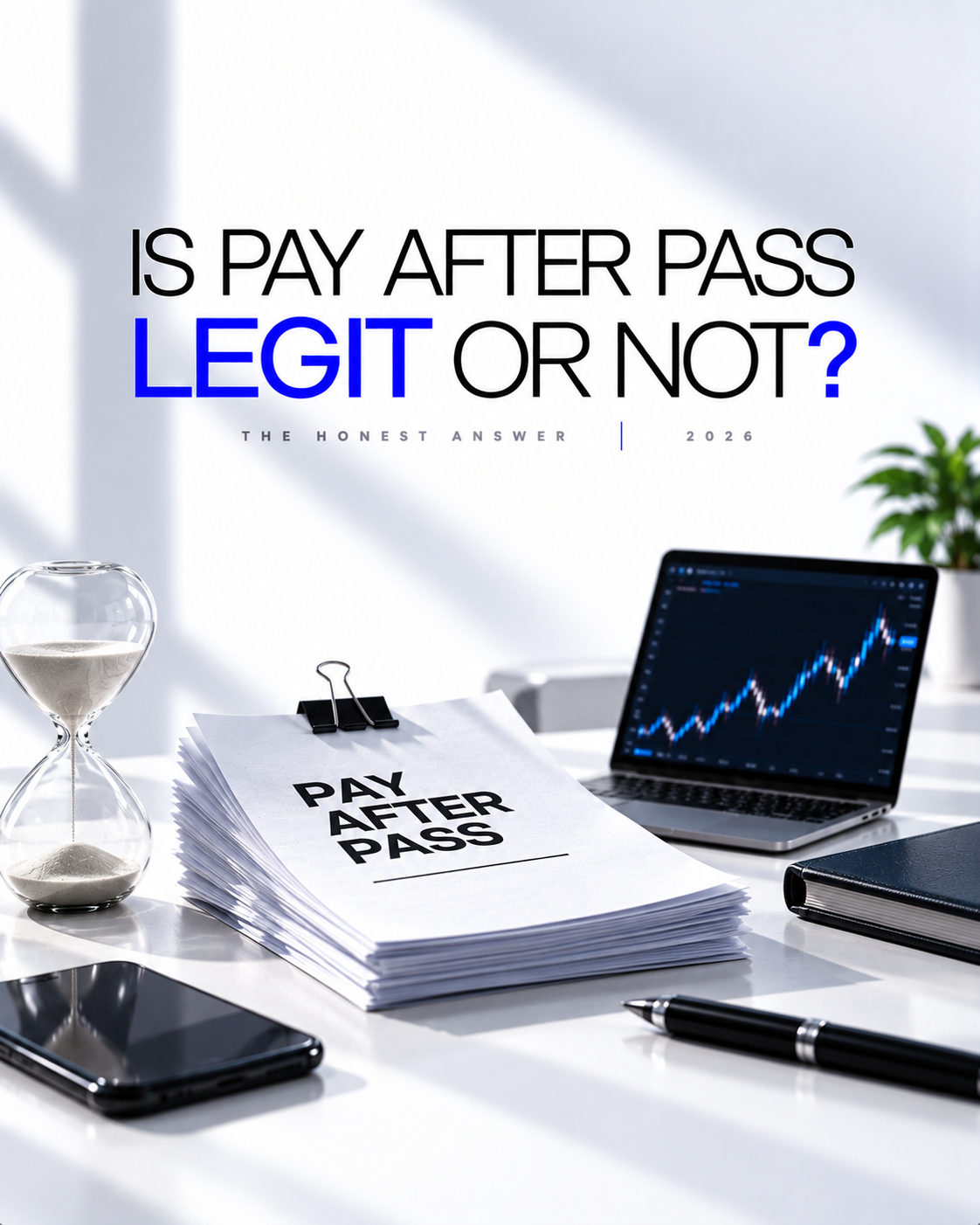
Pay after pass sounds like the perfect deal for traders who can't afford upfront fees. But is it actually legit? This guide breaks down exactly how these models make money, the fees that appear after you pass, a checklist to spot red flags, and a genuine low-cost alternative that pays out within 4 hours with public proof.
Start your evaluationIs Pay After Pass Legit or Not? The Honest Answer for 2026
TL;DR: Some pay-after-pass offers are structured legitimately, but many generate revenue through fees that appear only after you pass. Before trusting one, check their activation fee policy, payout proof, and fee history. If you want a genuinely low-cost starting point with no post-pass fees and public payout records, PropScholar's $1 Trial is worth knowing about.
Key takeaways:
- Pay after pass is a real model, but the phrase itself tells you nothing about hidden fees after passing
- Activation fees, software fees, and "live account" fees can appear at the point of payout or funding
- The right checklist catches problems before you spend time trading
- PropScholar charges upfront (from $1), has no activation fee, and every payout is publicly verifiable at propscholar.com/payout-proof
- Trading is genuinely risky. No evaluation model changes that. There is no guaranteed income from trading.
You've seen the ads. "No upfront cost. Pay only when you pass." It sounds like the prop firm industry finally figured out how to serve traders who don't have spare money sitting around. And in a world where evaluation fees can run into hundreds of dollars, the idea of paying nothing until you've already proven yourself feels fair.
But the question that actually matters is not whether the model exists. It does. The question is whether the specific platform offering it will actually pay you after you pass, without adding new costs you weren't told about when you signed up.
Let's go through this properly.
How Pay After Pass Firms Actually Make Money
Every evaluation platform has to generate revenue somewhere. If they're not charging you upfront, the money comes from somewhere else. Understanding the mechanics protects you.
Option one: activation fees. You pass the evaluation, then get an invoice before your funded account goes live. The fee is framed as an "account activation" or "live environment" charge. This is the most common structure. The evaluation was technically free, but accessing what you passed for is not.
Option two: platform or software fees. A monthly charge to keep your funded account active. Sometimes disclosed clearly, sometimes buried in the terms.
Option three: pass rates and resale. If the evaluation is genuinely hard and most people fail a paid retake, the initial free entry is a customer acquisition strategy. The revenue is in retakes, not the first pass.
Option four: legitimate upfront profit sharing. Some platforms that call themselves pay-after-pass do charge nothing at all, ever, and take a split of profits instead. These exist. They're also harder to find and usually have strict consistency rules, minimum trading days, or specific instruments.
None of these is automatically dishonest. But you need to know which model you're actually in before you spend weeks trying to pass.
The Fees That Show Up After You Pass
This is the part that genuinely catches traders off guard. You pass. You're ready to trade live. Then a fee appears that wasn't front and center when you registered.
The most common ones to watch for:
Activation or "onboarding" fees. Typically in the range of the cost of a normal evaluation. You've effectively paid for the evaluation after all, just later.
Compliance or KYC fees. Identity verification costs passed to the trader in some models.
Minimum withdrawal thresholds that require further trading. Not technically a fee, but if you can't withdraw until you've made a specific percentage in profit and that target is set after you pass, you're locked in longer than advertised.
Profit split structures that change. The split you were shown during the "free" evaluation period might differ from the split applied once you're live.
Again: some platforms are transparent about all of this from the start. Transparent is fine. The problem is when the post-pass costs are not visible until you've already committed your time.
The Checklist: How to Evaluate Any Pay After Pass Offer
Before you trade a single session on a pay-after-pass platform, work through this.
Check 1: What happens the moment you pass? Is there any charge at the point of account activation? Read the terms-of-use page, not the marketing page.
Check 2: Is payout proof public? Any platform processing real payouts can show them. Look for a public payout record with verifiable certificates or unique codes. Generic testimonials don't count.
Check 3: How long has the platform operated? A platform with no track record before six months ago, offering free evaluations, has not yet proven it pays out at scale.
Check 4: Are the rules written before you register? Rules that appear only after payment, or that can change retroactively, are a serious red flag. The full ruleset should be on the website, publicly, before you commit.
Check 5: Is there a consistency rule or minimum profitable days requirement? These aren't automatically bad, but they change the difficulty of passing. If a platform says "pay after pass" but requires ten consecutive profitable days, you need to factor that in.
Check 6: What does the community say? A real trading community with verifiable members and active discussion is harder to fake than a review page. Discord communities with thousands of members who can answer your questions directly are more useful than aggregated star ratings.
If a platform passes all six checks cleanly, the model may be legitimate. If any check raises a question the platform won't answer directly, walk away.
Why PropScholar Does It Differently
PropScholar is a scholarship-based trading evaluation platform, not a prop firm. It charges upfront. That's worth being direct about. The entry fee for the Trial is $1 (roughly Rs.90 in India, paid by UPI; everywhere else by USDT or PayPal). There is no activation fee after you pass, no monthly software charge, no surprise invoice.
Passing the $1 Trial pays a $6 scholarship. That's six times the entry. It's one account per user, it's the entry point, not a recurring income product.
Why does this matter in a conversation about pay-after-pass?
Because the reason traders are attracted to pay-after-pass is cost. A $1 entry fee solves the same problem without requiring you to trust that no fees will appear later. You know the cost before you start. You know what passing pays. You can verify every payout that's ever been processed at propscholar.com/payout-proof, each with a scannable certificate and a unique code.
The rules are public at propscholar.com/terms-of-use and have never been changed retroactively after a trader passed. PropScholar Private Limited is a registered Indian company (CIN U85499JH2026PTC027330). That's not a marketing claim, it's a verifiable fact.
From our experience running this platform, the traders who get burned most often are not the ones who paid high fees. They're the ones who spent three or four weeks genuinely trying to pass an evaluation, then found out the payout process had a step nobody mentioned. Time is the real cost.
For a deeper look at why payout speed and proof matter, read why prop firms promise instant payouts but PropScholar publishes 4-hour proof instead.
What Happens When You Pass the Trial: The Next Step
The Trial account is the starting point. Once you've passed it, the platform opens up fully: Scholaris AI assistant, the trading journal with MT5 auto sync, Trade Map, analytics, and the wider community.
The flagship account is the Freedom Account, starting at $5 for a $5,000 evaluation. The lot limits are published openly: on the $10,000 account, for example, you're allowed a maximum of 4.00 open lots on forex, 0.40 on gold, and 0.20 on BTCUSD, among others. Those limits are per asset class, independent, and non-transferable between classes. They're stated up front, before you pay.
That's the pattern. Everything disclosed before the fee. No surprises after the pass.
For traders in Nigeria, Pakistan, the Philippines, Bangladesh, and elsewhere who are figuring out the USDT payment path, see the USDT and local wallet payment guide for Nigeria, Kenya, and Bangladesh and the note on proving trading income without employment records for Instagram resellers in Nigeria.
The Straight Verdict on Pay After Pass in 2026
Pay after pass as a phrase is not legit or not legit. It's a marketing description that can cover very different underlying models. The phrase tells you only that no upfront fee is charged. It tells you nothing about what happens after you pass.
Some platforms using this label are honest and pay cleanly. Some add activation costs that effectively recreate the upfront fee at a later stage. The checklist above is the only way to tell them apart.
If your underlying goal is to start evaluating your trading skill with minimal financial risk, a $1 fully-transparent evaluation with public payout proof achieves that goal more directly than a "free" evaluation where you can't verify what happens next.
Trading carries real risk. Passing any evaluation doesn't guarantee you'll trade profitably. No platform can change that. What a good platform can do is be honest with you about every rule, every fee, and every payout, before and after you pass.
That's the standard to hold any offer to, whether it calls itself pay after pass or anything else.
Frequently Asked Questions
Is pay after pass legit?
Pay after pass as a model can be legitimate, but the phrase alone doesn't guarantee it. Some platforms charge activation or software fees after you pass, which effectively recreate the upfront cost at a later stage. Use a checklist: look for public payout proof, transparent terms before registration, and a verifiable operating history. The model is real; the specific platform has to prove it.What fees can appear after you pass a pay-after-pass evaluation?
The most common are activation fees, account onboarding charges, monthly platform fees, and profit splits that differ from what was shown during the evaluation stage. These are not always disclosed prominently on the marketing page. Read the terms-of-use carefully before you start trading, not after you pass.How is PropScholar different from pay after pass platforms?
PropScholar charges a small upfront fee, starting from $1 for the Trial account. There is no activation fee after passing. Every payout is publicly verifiable at propscholar.com/payout-proof with a scannable certificate. Rules are published before you pay and have never been changed retroactively. The cost is known from the start, not revealed later.How does PropScholar process payouts?
Payouts are processed within 4 hours of a payout request. Every payout is publicly listed at propscholar.com/payout-proof with a unique verification code. PropScholar Private Limited is a registered Indian company, and the payout record is available to anyone, not just account holders.What is the $1 Trial on PropScholar?
The Trial is a $1 one-step trading evaluation on a $1,000 account (roughly Rs.90 in India, paid by UPI; elsewhere by USDT or PayPal). Passing pays a $6 scholarship payout. One per user. It's the entry point to the platform, which includes the Scholaris AI assistant, MT5-synced trading journal, Trade Map, and analytics. It's not a get-rich product; it's a low-risk way to start.Can traders outside India use PropScholar?
Yes. Traders in Nigeria, Pakistan, the Philippines, Bangladesh, South Africa, Kenya, Egypt, Indonesia, Vietnam, and everywhere else can use PropScholar. Payment outside India is by USDT (via a crypto exchange) or PayPal. UPI is for Indian traders only. The evaluation rules, payout process, and fee structure are the same regardless of location.What should I check before trusting any funded trading platform?
Verify that payout proof is public and verifiable, not just testimonials. Confirm the full rules are published before registration. Check whether any fee appears after passing, including activation, onboarding, or software fees. Look for a real, active community where existing traders discuss their experience. And confirm the platform has a verifiable operating history, not just a launch announcement.PropScholar is a scholarship-based trading evaluation platform operated by a Private Limited company registered in India. We are not a prop firm and do not manage or allocate institutional capital. Our model rewards proven trading skill with scholarship grants upon successful evaluation completion.
Related reading
- Are Free Funded Accounts Real? What 'Free' Prop Offers Actually Cost You
- Is PropScholar Legit or Fake? The Honest 2026 Review Every Trader Should Read Before Paying
- Is PropScholar Legit? An Honest Review With Payout Proof
- The Safest Way for a College Student to Start Trading and Not Lose Money
- How to Check If a Prop Firm Is Registered and Trustworthy
- Prop Firm Shut Down or Stopped Paying? Do This First
Ready to Prove Your Edge?
Join 500+ traders. Start from just $5. Get funded within days.
Frequently Asked Questions
Pay after pass as a model can be legitimate, but the phrase alone doesn't guarantee it. Some platforms charge activation or software fees after you pass, which effectively recreate the upfront cost at a later stage. Use a checklist: look for public payout proof, transparent terms before registration, and a verifiable operating history. The model is real; the specific platform has to prove it.
More From PropScholar

Trader Safety
Why $1 Trading Challenges Fail for Beginners in Emerging Markets
12 min read
Trader Safety
7 Red Flags in Fake Trading Challenge Payout Screenshots
10 min read
Trader Safety
How to Spot Fake Payout Proof in Trading Discord Servers
12 min read
Prop Trading Education
Best Pay After Pass Prop Firm 2026 — And Why You Should Skip Them
11 min read
Beginner Trading
Prop Trading Evaluations Explained: What Beginners Actually Pay to Start
14 min read
Trader Safety
Verify Prop Firm Payouts Without a Lawyer: 3 Free Methods
11 min read