
Pay After Pass Fine Print: What Beginners Miss in 2025
Pay after pass fine print hides fees most beginners never notice. See exactly what to check before signing up and why transparent alternatives exist.

Pay after pass fine print hides fees most beginners never notice. See exactly what to check before signing up and why transparent alternatives exist.
Start your evaluationIs Pay After Pass Too Good to Be True? How the Model Really Works
TL;DR: Pay after pass sounds risk-free, but the real mechanics usually involve hidden fees, strict fine print, or a cost structure that shifts the risk without eliminating it. Here's exactly how the model works — and what a transparent scholarship evaluation actually offers instead.
Key takeaways:
- "Pay after pass" doesn't mean you pay nothing upfront in most cases — there's almost always a catch.
- Common hidden mechanics include non-refundable activation fees, minimum profit splits taken as fees, and short refund windows that most traders miss.
- The scholarship evaluation model is structurally different: you pay a small, transparent entry fee from $5, pass the evaluation, and claim a scholarship payout.
- PropScholar pays verified scholarship claims within 4 hours of verification — that specific number matters because most platforms don't commit to one.
- Knowing which model you're actually signing up for before you fund your account is the single most important step.
You've seen the ads. "Pass first, pay later." "Zero upfront cost." "We only make money when you do." It sounds almost too fair — like the platform is finally on your side. And for traders in India, Nigeria, the Philippines, Indonesia, and everywhere else where a $100 evaluation fee is genuinely a lot of money, the appeal is obvious.
But after 1.5 years of operating a scholarship-based evaluation platform and watching thousands of traders across our 3,000-member Discord community navigate these decisions, I can tell you: the pay-after-pass model is not what most people think it is. That doesn't mean every platform using it is dishonest. It means the marketing language is doing a lot of heavy lifting that the actual terms don't support.
Let's look at the real mechanics.
What "Pay After Pass" Actually Means in Practice
At face value, pay after pass means you don't pay the evaluation fee unless or until you pass. That's the promise. The execution varies widely, and that variation is where things get complicated.
In the most straightforward version, you trade a demo evaluation for free, hit the profit target without breaching any drawdown rules, and then pay a fee to "activate" your funded account. The fee is real — it just comes after the pass rather than before it. You haven't avoided paying. You've deferred it.
In a slightly different version, the activation fee is presented as refundable on your first profit split. So technically you do get it back — if you trade profitably on the funded account, if you reach the minimum payout threshold, and if you do so within whatever window the platform specifies. Miss any of those conditions and the fee doesn't come back.
Then there's the more aggressive version: a nominal "registration" or "access" fee charged upfront, which the platform doesn't classify as an evaluation fee. The evaluation itself is "free," but you've already paid something to get through the door.
None of these are necessarily scams. But none of them are actually free.
The Fine Print That Changes Everything
The structural problem with pay-after-pass models isn't always the fee itself. It's what surrounds the fee.
Consider the refund condition. Many platforms promise to refund the activation fee on your first payout. What they don't emphasize: that payout might require you to generate a profit of, say, 5% on a $10,000 account, withdraw before a 30-day window closes, and maintain a minimum number of trading days. If you earn 4.8%, you're close — but the refund doesn't trigger. You've paid the fee, traded real capital risk, and walked away without the refund.
Or consider the profit split structure. Some pay-after-pass platforms offer 50-60% splits to funded traders, compared to the 80-90% splits you'll find elsewhere. The lower split is, in effect, the platform's ongoing fee — just extracted from your earnings rather than charged upfront. Over time, that costs more than a one-time evaluation fee would have.
There's also the question of what happens if you fail the funded account after passing. With a traditional evaluation you've already paid for, you usually just buy another attempt. With some pay-after-pass models, failing the funded account means restarting the whole process, sometimes including paying the activation fee again. The loss stacks.
This isn't about naming names or calling any specific platform dishonest. It's about recognizing that the structure creates misaligned incentives: the platform benefits most when you pass the free evaluation (because now you pay the activation fee) and then fail the funded account (because you pay again). Compare this to a scholarship evaluation vs pay-after-pass model where the platform's incentive is simply for you to pass and get paid, then tell other traders about it.
Why "We Only Make Money When You Do" Is Almost Never Literally True
This phrase gets used a lot. It's compelling because it implies perfect alignment — if you don't profit, neither does the platform.
But think through the math. If a platform offers a free evaluation and only charges after you pass, they have operating costs: servers, staff, customer support, compliance, payment infrastructure. Those costs exist regardless of whether any particular trader passes. So the platform is taking on real expense with every free evaluation attempt.
The economics work in one of two ways. Either the platform knows that a very small percentage of traders will pass (and those few activation fees need to cover everyone's costs), or the platform makes money from failure in some other way — data licensing, partnerships, or structured products built around the trader's activity.
Neither of those is inherently wrong. Running a business costs money. But the marketing phrase "we only make money when you do" isn't really accurate to how the business operates. Someone is paying for the evaluation infrastructure. Either it's the traders who pass and pay activation fees, or it's subsidized by something else. There is no free evaluation business model that somehow runs on air.
The more honest framing — and the one we use at PropScholar — is: you pay a small, transparent entry fee from $5 (or from Rs.400 if you're in India paying via UPI), you attempt the evaluation under clear published rules, you pass, and you claim a scholarship of up to 400%. The cost is real and known upfront. The potential reward is also real and specific. No hidden activation fee waiting at the finish line.
How the Scholarship Evaluation Model Is Structurally Different
PropScholar is a scholarship-based trading evaluation platform, not a prop firm and not a pay-after-pass platform. The distinction matters.
When you enter a PropScholar evaluation, you pay the entry fee before you start trading. That fee is small by design — starting at $5 globally, accessible via crypto (USDT) for traders in Nigeria, South Africa, the Philippines, Indonesia, Egypt, Pakistan, Kenya, Vietnam, and everywhere else. If you're in India, UPI payments through PhonePe, Razorpay, or Cashfree bring it down to around Rs.400 at the entry level.
The fee covers access to the evaluation environment. When you pass, you claim a scholarship — up to 400% of your entry fee. That scholarship is paid within 4 hours of verification. Not "within a few business days" or "subject to review periods" — 4 hours from when verification completes. We've built the payout infrastructure specifically to make that commitment real, not just a marketing line.
The rules are published and don't change retroactively. If you pass under the rules that existed when you entered, those are the rules that apply to your payout claim. That matters more than it might seem. Several traders in our Discord have shared experiences with other platforms where rules were amended mid-cycle in ways that affected their already-in-progress evaluations. That doesn't happen here because the rules are locked at the point of purchase.
For a deeper look at how this model compares to traditional funded routes, the article on trading scholars vs prop firm traders breaks down the structural logic in detail.
What the Real Risk Is (and Who's Carrying It)
Every trading evaluation model has a risk structure. Understanding who carries which risks is more useful than any marketing promise.
In a pay-after-pass model, the platform carries the cost of processing your free evaluation attempt. You carry the time cost and the opportunity cost of the evaluation period. If you pass and pay the activation fee, you now carry both the activation fee risk and the performance risk on the funded account. The fee might come back. It might not.
In a small-fee scholarship evaluation model, you carry the entry fee from the start. That's a real cost — but it's declared and small. If you fail, you've lost $5 to $50 depending on which evaluation tier you chose. If you pass, you claim a scholarship payout that's a multiple of what you paid. The platform carries the payout obligation. The alignment is cleaner: PropScholar only pays out when traders actually perform, which means the platform genuinely benefits from having traders who can pass, not from having a large pool of failing attempts subsidizing a small pool of activations.
This is also why comparing the absolute entry cost matters less than understanding the full cost structure. A "free" evaluation that leads to a $75 activation fee, a 55% split, and a 30-day refund window might cost more in total than a $15 entry fee with an 80% scholarship rate paid within 4 hours.
For more on what the alternative really looks like in practice, the pay-after-pass prop firms explainer goes into more detail on the specific cost structures you'll encounter.
PropScholar as a Marketplace: Another Option Worth Knowing
Beyond its own scholarship evaluations, PropScholar also runs a marketplace where you can purchase challenges from established prop firms at INR or UPI-friendly pricing. This matters because one of the biggest barriers for traders in India, Nigeria, the Philippines, and similar markets isn't just the cost — it's the foreign exchange friction of paying in USD for something that might cost 50-80% more in real terms once conversion and payment fees land.
Through the marketplace, you can access top-tier prop firm challenges without the currency conversion headache. That's a separate product from the scholarship evaluations, but it's part of how PropScholar serves traders who have different needs or experience levels.
If you're newer, the $5 scholarship evaluation is the lower-risk starting point. If you've already passed evaluations elsewhere and want access to a specific prop firm's funded account at better pricing, the marketplace is worth exploring at the PropScholar shop.
Red Flags to Watch For in Any Evaluation Model
Whether you end up choosing a pay-after-pass platform, a scholarship evaluation, or something else entirely, a few patterns should make you pause.
The rules aren't public before you pay
If you can't read the full evaluation rules — profit targets, drawdown limits, minimum trading days, payout conditions — before you hand over any money or personal information, that's a problem. Legitimate platforms publish their rules openly. PropScholar's rules are public and haven't been changed retroactively since launch.
The payout timeline is vague
"Fast payouts" without a specific number tells you nothing. "Within 4 hours of verification" tells you exactly what to expect. Ask any platform you're considering for a specific, committed payout timeline and see what they say.
The company structure is unclear
A platform taking your money should be verifiable as a registered entity. PropScholar is a Private Limited company registered in India under the MCA. That registration is checkable. If a platform can't tell you what legal entity it operates under, that's worth noting. The article on why private limited registration matters goes into why this specific detail changes your recourse if something goes wrong.
Support disappears when you need it
PropScholar offers 24/7 support in Hindi and multiple other languages. That's not just a feature — it's a signal of how seriously a platform takes its ongoing relationship with traders. A platform that's hard to reach before a problem arises will be harder to reach after one.
The Honest Answer to Whether Pay After Pass Is Too Good to Be True
Here it is: in most implementations, pay after pass is not exactly too good to be true — but it is more complicated than the phrase suggests. The cost gets deferred, restructured, or embedded in other terms rather than eliminated. Some traders will come out ahead with certain pay-after-pass structures. Others will pay more in total than they would have with a straightforward evaluation fee, especially if they fail the funded account after paying the activation fee.
The right question isn't "is pay after pass real?" It's "what is the total cost structure, including what happens if I fail the funded stage?" And then compare that full picture to alternatives — including the scholarship model where the entry fee is small, the rules are clear, and the payout happens within 4 hours of passing.
If you want to see real payout proof and talk to traders who've been through the PropScholar evaluation, the Discord community has 3,000+ members doing exactly that. And if you have specific questions, reach us directly at business@propscholar.com.
The model that works best for you depends on your budget, your risk tolerance, and how much fine print you're willing to read. But you should be reading the fine print either way — because "pay after pass" and "free evaluation" are marketing descriptions, not legal guarantees.
PropScholar is a scholarship-based trading evaluation platform operated by a Private Limited company registered in India. We are not a prop firm and do not manage or allocate institutional capital. Our model rewards proven trading skill with scholarship grants upon successful evaluation completion.
Related reading
- Best $1 Trading Challenge 2026: Why 1K 1-Step Wins
- Cheapest Prop Firm in 2026: The Complete Price Comparison Guide (From ₹300 With FIFA Discount)
- Cheapest Legit Way to Access a Funded-Style Trading Account From $5
- Cheapest Prop Trading Evaluation in 2026 Ranked by Real Total Cost
- How to Start a Trading Evaluation for Under ₹500 or Under $10
- Pay-After-Pass Prop Firms: What the Alternative Actually Is
Ready to Prove Your Edge?
Join 500+ traders. Start from just $5. Get funded within days.
Frequently Asked Questions
Not exactly, but it's rarely as simple as the marketing suggests. Most pay-after-pass models involve an activation fee charged after you pass, or a lower profit split that amounts to an ongoing fee. The evaluation access might be free, but you'll almost always pay something — the question is when, how much, and under what conditions you get it back.
More From PropScholar
Trader Safety
Is Pay After Pass Legit or Not? The Honest Answer for 2026
11 min read
Trading Comparison
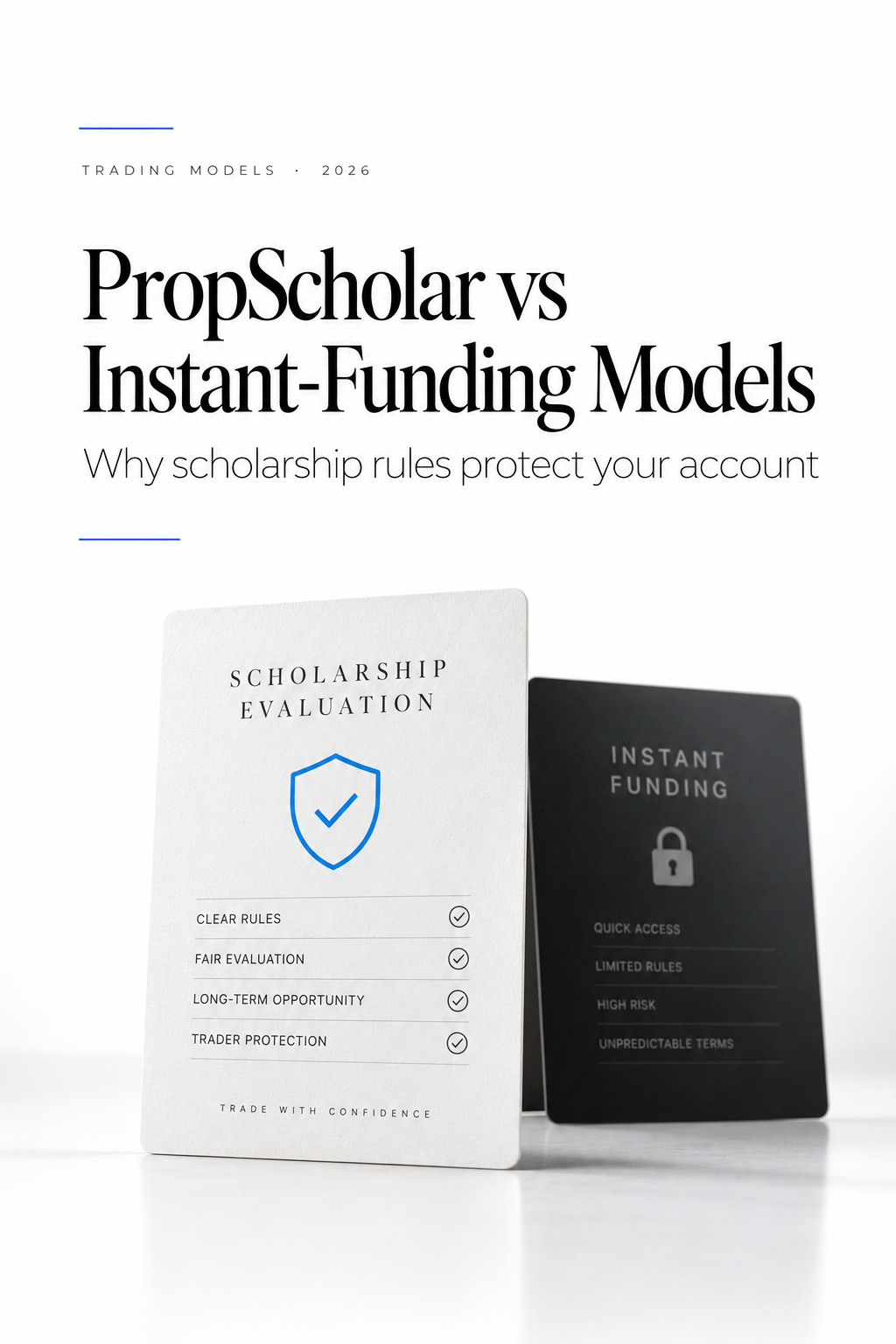
Instant Funding vs Evaluation: Which Protects Beginner Traders More?
11 min read
Trading Comparison
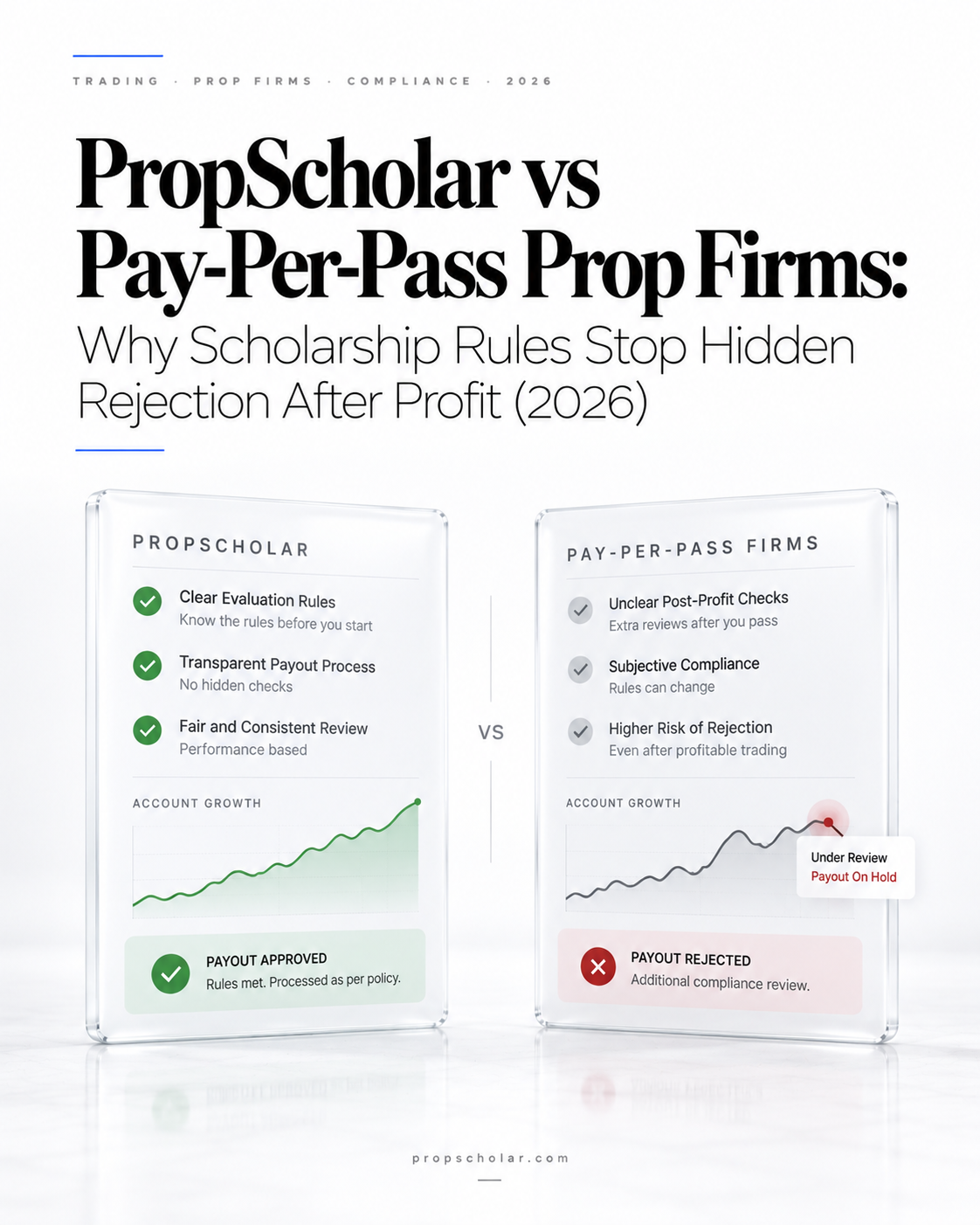
Post-Profit Rejection Explained: Scholarship Rules vs Prop Firms
11 min read
Trading Comparison
Best Low-Cost Trading Evaluation for Beginners Worldwide 2026
12 min read
Trading Comparison
Prop Firm Fees in INR, Naira & Crypto: Real Costs Explained
12 min read
Trading Comparison
How to Choose the Right Trading Evaluation in 2026
14 min read