Demo Trading vs Funded Evaluation: Which Actually Builds a Trading Career
Stuck in demo trading loops but not moving forward? This guide breaks down exactly why demo trading alone won't build a real trading career, what funded evaluations actually teach you, and how PropScholar's scholarship-based evaluation platform gives you a real path forward from as little as $5.
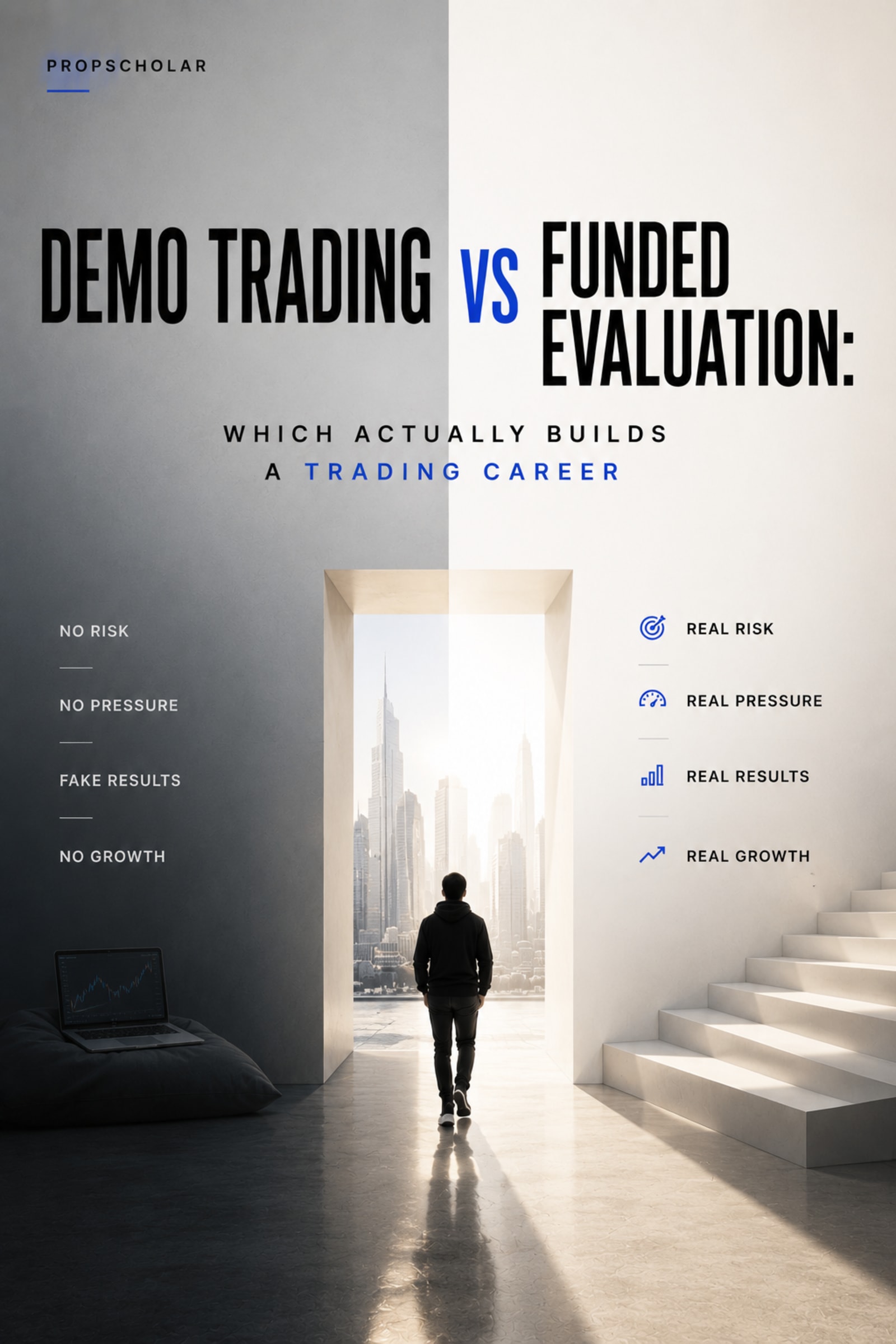
Stuck in demo trading loops but not moving forward? This guide breaks down exactly why demo trading alone won't build a real trading career, what funded evaluations actually teach you, and how PropScholar's scholarship-based evaluation platform gives you a real path forward from as little as $5.
Start your evaluationDemo Trading vs Funded Evaluation: Which Actually Builds a Trading Career
TL;DR: Demo trading is a useful starting tool, but it won't build your trading career. A funded evaluation puts real stakes on your decisions, builds the discipline the markets actually demand, and pays you for proving skill. From $5, you can start that process today.
Key takeaways:
- Demo trading builds mechanical knowledge but removes the psychological pressure that separates profitable traders from losing ones.
- Funded evaluations create real accountability — rules, targets, drawdown limits — that mirror actual trading conditions.
- PropScholar is a scholarship-based evaluation platform (not a prop firm) that starts at around $5, accepts crypto globally and UPI in India, and pays out scholarships up to 400% within 4 hours of verification.
- Staying in demo mode indefinitely is one of the most common ways traders stall their careers without realising it.
- The path from beginner to funded isn't about more screen time on a demo account — it's about trading with real consequences attached to your decisions.
You've probably been on a demo account for weeks. Maybe months. You're profitable there — sometimes very profitable. Fifty percent up in a month on a demo account feels real. It feels like progress. But then you open a small live account, and suddenly your risk management disappears. You freeze on entries you'd have taken without thinking on demo. You revenge trade a loss you never would have cared about in paper money. And you wonder what went wrong.
Nothing went wrong with your strategy. What happened is that demo trading was never designed to build a career. It was designed to teach you how the platform works. That's it. The gap between "profitable on demo" and "profitable when it counts" is the entire game of trading — and it's a gap that only one of these two paths actually closes.
This is the honest, complete comparison of demo trading versus funded evaluations. Not a cheerleading piece. A real breakdown of what each one does, what each one doesn't do, and which one actually moves your trading forward.
What Demo Trading Is Actually Good For
Demo trading is genuinely valuable — for exactly one stage of your development. That stage is learning mechanics: how to place orders, how to set stop losses, how the bid-ask spread works on your broker, how leverage calculations function, what a margin call looks like before it happens to you in real life.
If you've never opened a chart before, you absolutely should spend time on demo first. Getting wiped out because you accidentally entered 10 lots instead of 0.1 on a live account is not a learning experience — it's just an expensive typo. Demo accounts eliminate that. And for pure strategy backtesting, a demo or sim environment is perfectly appropriate.
But here's the honest ceiling: those benefits plateau very fast. Most traders hit the mechanical learning limit of demo trading within four to eight weeks of consistent practice. After that, staying on demo doesn't make you better. It makes you comfortable with a version of trading that doesn't exist.
The numbers tell the story. Research consistently shows that traders who are profitable on demo accounts fail at high rates when they transition directly to live trading without any intermediate accountability structure. The reason isn't strategy. It's that demo trading conditions out the exact psychological responses — fear, greed, hesitation, ego — that real trading depends on you managing.
Why Demo Trading Alone Won't Build a Real Career
Here's the core problem. On a demo account, losses are free. That sounds like an advantage, and mechanically it is. Psychologically, it's a disaster.
When you lose $500 on a demo account, you close the browser and make a coffee. When you lose $500 of money that took you two weeks to earn, something completely different happens in your body and your brain. Your hands move differently on the mouse. Your breathing changes. You start second-guessing setups you've taken a hundred times. Or you do the opposite — you overtrade trying to claw it back. Either way, your behaviour changes. And that changed behaviour is the actual trading skill you need to develop. Demo trading never triggers it.
There's also the time problem. Traders on demo accounts often run multiple accounts simultaneously, reset when things go badly, and trade sizes that would be completely unrealistic with their actual capital. These habits don't just fail to transfer to live trading — they actively create bad ones. The trader who resets their demo account after a drawdown has practiced the wrong response to a drawdown hundreds of times.
And perhaps the biggest issue: demo trading has no endpoint. There's no target to hit, no rule to follow, no payout waiting on the other side. Which means you can stay there indefinitely, feeling productive, while your actual trading career never starts.
What a Funded Evaluation Actually Does to Your Trading
A funded evaluation is a completely different structure. You pay an entry fee, you're given a set of rules — a profit target, a maximum daily loss, a maximum total drawdown — and you either pass or you don't. The rules are clear from the start. The outcome is binary. There's real money involved, even if the entry fee is small.
That structure does something demo trading cannot: it creates genuine accountability on every single trade.
When you're four trades into a session and you've hit 70% of your daily loss limit, and you know that breaching it ends your evaluation, you find out very quickly whether your discipline is real or theoretical. You discover how you actually respond to pressure. You learn whether your position sizing is genuinely systematic or whether you size up emotionally when you're chasing. These aren't lessons you can read in a book. They're lessons that only come from having something real at stake.
The evaluation rules themselves are also educational. Maximum drawdown limits teach capital preservation in a way that no demo environment can. Profit targets teach consistency — you can't spike your way through a reckless trade; you need to build toward a target sustainably. Daily loss limits force you to develop session discipline, to recognize bad trading days early and step away before they compound.
Traders who go through evaluation processes report that the rules, more than anything else, are what restructured their trading. Not because someone told them to follow rules — they'd heard that on YouTube a thousand times — but because breaking a rule had an immediate, real consequence.
The Psychology Gap: Why This Is the Whole Game
Anyone experienced in trading will tell you the same thing: strategy is maybe 30% of the job. The other 70% is psychological. How you manage a losing streak. Whether you can hold a winner long enough. How you behave when you've just had your worst week of the year.
Demo trading doesn't touch any of that. Evaluations touch all of it.
The moment you pay an entry fee — even a small one like $5 or Rs.400 — you've introduced stakes. Small stakes, yes, but real ones. And the progression matters too: if you pass and earn a scholarship payout, that money is real. When PropScholar pays out scholarships of up to 400% of the evaluation fee within 4 hours of verification, the upside is real. That asymmetry — small downside, meaningful upside — is exactly the structure that trains your psychology properly.
You stop gambling on demo-style moonshot trades because you actually want to pass. You start respecting your daily loss limit because you've worked for three days on this evaluation and you don't want to blow it in one bad session. You start journaling, reviewing trades, identifying patterns in your mistakes — things almost no trader does seriously on a demo account, but nearly every funded trader does by necessity.
That behavioural shift is not a side effect of the evaluation process. It is the point of it.
How PropScholar Bridges the Gap for Traders on a Tight Budget
One of the real objections to funded evaluations has historically been cost. If you're trading from Nigeria, the Philippines, Indonesia, South Africa, or anywhere that a $150 evaluation fee represents a week's earnings, you simply can't access the traditional evaluation model. Demo trading wasn't your preference — it was your only option.
PropScholar is a scholarship-based evaluation platform that was built specifically for this reality. Evaluations start at around $5 (roughly Rs.400 for Indian traders), paid by UPI in India through PhonePe, Razorpay, or Cashfree, or by crypto anywhere in the world. There's no bank transfer required, no USD wire, no credit card from a country where international payments get declined.
The scholarship payout on a successful evaluation can reach up to 400% of the entry fee, paid within 4 hours of verification. The rules are published and have never been changed retroactively — which matters more than it might sound. Some evaluation platforms have quietly adjusted rules after traders started passing at higher rates. PropScholar's rules are fixed and public.
The platform has been operating for over 1.5 years as a Private Limited company registered in India under the MCA, with a 3,000+ trader Discord community where payout proof is posted regularly. You can look at the evidence before you spend a rupee.
For traders who genuinely cannot afford a $100+ evaluation, this is the bridge. Not a replacement for skill-building, but an entry point that makes the funded evaluation model accessible at a price that fits an emerging-market budget.
What PropScholar Is (and Isn't)
PropScholar is not a prop firm. It doesn't manage or allocate institutional capital. It's a scholarship-based evaluation platform: you pay a fee, you complete the evaluation under published rules, and if you pass, you receive a scholarship grant — up to 400% of your entry fee — paid within 4 hours of verification. It also runs a marketplace where you can buy challenges from real prop firms at INR/UPI pricing, which means global evaluation access without the currency conversion friction.
What the Evaluation Rules Actually Look Like
The specifics of PropScholar's evaluation rules are published publicly on the platform, so there's no mystery. You have a profit target to hit, a maximum daily loss to stay within, and an overall drawdown ceiling. These mirror the structure of professional evaluation programs at a fraction of the cost. For a trader who's spent months on demo wondering what real accountability feels like — this is where you find out.
Demo Forever vs. Progressing: The Real Cost of Staying Stuck
Here's something we see in trading communities constantly: traders who have been "almost ready" for years. They'll move to a funded evaluation "after one more month on demo". They'll apply for a challenge "when their win rate is a bit higher". That month becomes six months becomes two years, and at the end of it, they're no closer to a trading income because they've been optimising for demo performance, which doesn't transfer.
The actual cost of this isn't just time. It's the compounding psychological habits built from demo trading. The position sizing that's too large because demo capital feels fake. The tendency to let losing trades run because there's no daily loss limit enforcing discipline. The complete absence of pressure-testing for your strategy.
A $5 evaluation fee buys you something a demo account literally cannot provide: a real test of whether your trading holds up when something is on the line. That test, passed or failed, gives you more actionable information in two weeks than six months of demo trading typically does.
And if you fail? You've spent $5 and learned exactly where your discipline broke down, under what market conditions, after how many consecutive losses. That information is worth more than any demo account month.
Building a Trading Career: The Actual Path
A real trading career doesn't get built by demo trading until you feel confident enough. Confidence built on demo is a fiction — it evaporates the moment real money is involved. The path that actually works looks more like this:
First, you learn the mechanics. Four to eight weeks on demo, focused on understanding your platform, your instruments, and basic order management. You're not trying to build a track record here — you're learning the tools.
Second, you introduce real stakes at the lowest possible level. Not a $10,000 live account that you'll blow up. A $5 or $10 evaluation where the rules force you to confront your own psychology without catastrophic downside. This is where the real learning begins.
Third, you iterate on feedback. You review why you failed evaluations (and you may fail a few — that's normal and part of the process). You identify the specific moments where your discipline cracked. You adjust not your strategy but your behaviour.
Fourth, you build a verified track record. Passing evaluations and receiving scholarship payouts creates a documented history of disciplined trading under defined rules. That track record is real — more real than any demo account screenshot ever could be.
Fifth, you scale. PropScholar's marketplace also connects traders to larger challenges at INR/UPI pricing for those who want to progress to larger account sizes. The path from $5 evaluation to meaningful trading income is incremental, documented, and achievable — not a leap of faith.
None of these steps involve spending endless months on demo feeling ready but never actually testing yourself.
The Honest Answer: When to Use Each One
Do both — in sequence, not simultaneously.
Use demo trading to learn mechanics, test a new strategy before risking any fee, or practice on a new instrument you've never traded. It's a tool, and it's a genuinely good one for those specific purposes.
Use a funded evaluation when you're ready to find out whether your trading holds up under real accountability. Which, for most traders, is much sooner than they think. You don't need a 70% win rate to start an evaluation. You need basic risk management and a strategy that's been tested enough to know it has an edge. The evaluation itself will develop everything else.
If budget is the obstacle, PropScholar's entry point at around $5 removes it. You're not betting the rent. You're paying for a real, structured test of your trading ability, with a scholarship of up to 400% if you prove that ability meets the standard.
One thing we've seen across thousands of traders in our community: the traders who progress fastest aren't the ones who spent the longest on demo. They're the ones who got into real accountability structures early, iterated on real feedback, and stopped waiting to feel ready.
Feel ready is demo thinking. Be accountable is career thinking.
PropScholar is a scholarship-based trading evaluation platform operated by a Private Limited company registered in India. We are not a prop firm and do not manage or allocate institutional capital. Our model rewards proven trading skill with scholarship grants upon successful evaluation completion.
Ready to Prove Your Edge?
Join 500+ traders. Start from just $5. Get funded within days.
Frequently Asked Questions
A funded evaluation is significantly better for building a real trading career. Demo trading teaches you platform mechanics and lets you test strategies without financial risk, but it removes the psychological pressure that defines real trading. Funded evaluations create genuine accountability through rules, profit targets, and drawdown limits — and because real money is on the line, they develop the discipline and emotional control that actually separate profitable traders from losing ones. Use demo to learn mechanics, then move to an evaluation as soon as you have a basic edge.