
Trading Scholar vs Prop Firm: Which Risks Less for Beginners?
Trading scholar vs prop firm compared for first-time traders: what you actually risk, evaluation fees, payout speed and which model suits a tight budget.
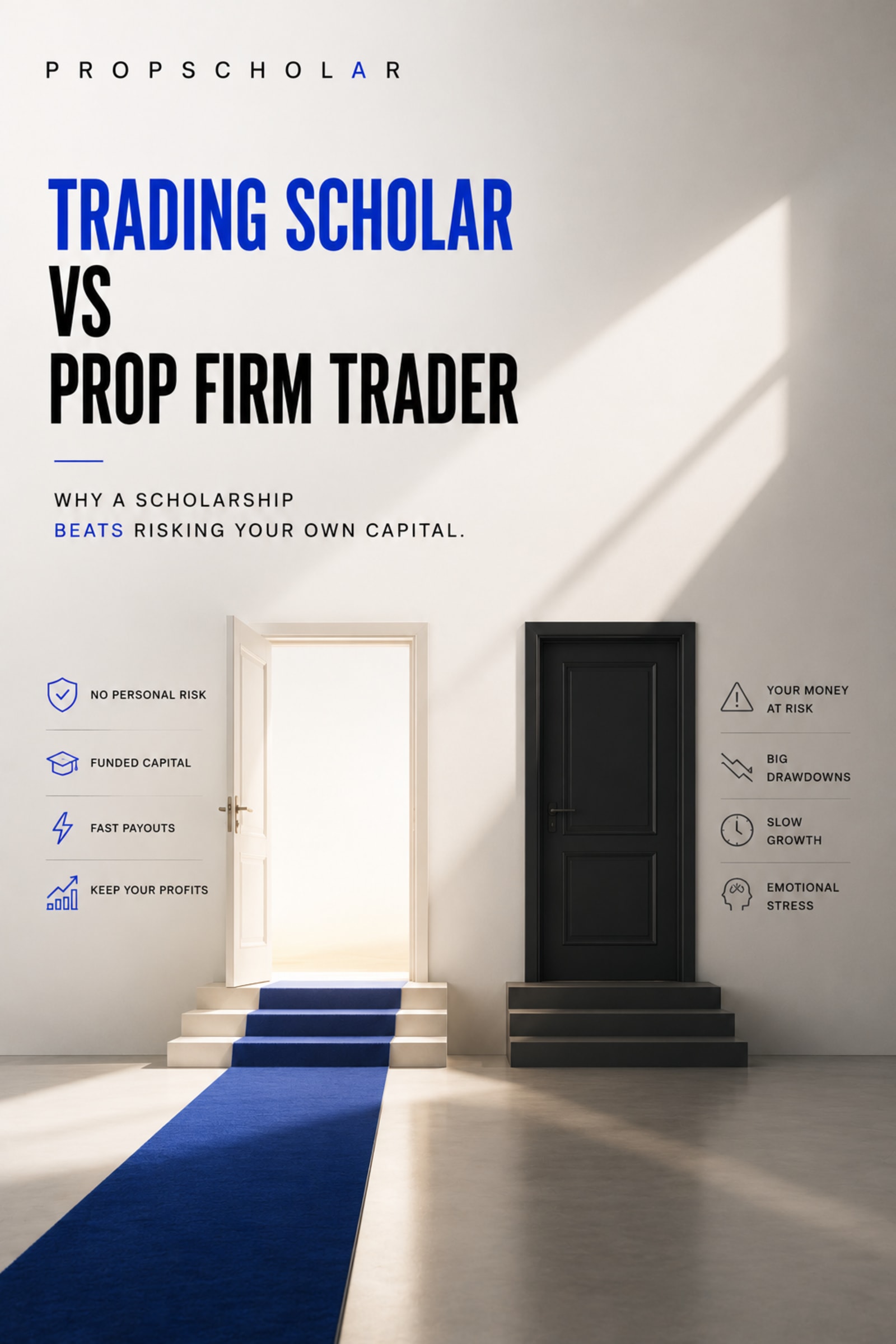
Trading scholar vs prop firm compared for first-time traders: what you actually risk, evaluation fees, payout speed and which model suits a tight budget.
Start your evaluationTrading Scholar vs Prop Firm Trader: Why a Scholarship Beats Risking Your Own Capital
TL;DR: A trading scholar pays a small evaluation fee, passes a skill test on a simulated account, and earns a real cash scholarship payout — publicly verifiable. A prop firm trader either deposits real money or pays large challenge fees with no guaranteed scholarship return. The risk profile is completely different.
Key takeaways:
- Scholar trading replaces capital-at-risk with a skill evaluation fee starting from $1
- PropScholar's scholarship payouts are processed within 4 hours of passing and every one is publicly verifiable
- Traditional prop models put your own money on the line — the scholarship model does not
- A trading scholarship that PAYS YOU is fundamentally different from a course discount labeled a scholarship
- PropScholar is a registered Private Limited company (India), serving traders worldwide via UPI, PayPal, and crypto
This isn't a theoretical distinction. It's the difference between losing money you can't afford and paying a small evaluation fee you can.
What a Prop Firm Trader Actually Risks
The traditional prop firm model comes in two flavors, and both carry real downside for the trader.
The first is the deposit model. You put in your own capital — sometimes $500, sometimes $5,000 — and trade a live account. If you breach drawdown limits or lose consistently, that capital is gone. You bear the loss directly.
The second is the challenge model. You pay a fee (often $100–$300 for a mid-tier account) to trade a simulated evaluation. Pass and you get access to a funded account. Fail and you've lost the fee. Most platforms let you retry, but at full cost again. There's no scholarship at the end — there's a profit-split arrangement where you trade on the firm's capital and take a percentage of profits.
Neither model is inherently dishonest. But both put you in a position where failure means losing money, and success means entering an ongoing arrangement that can be terminated at any time by the firm. Your earnings depend on continued compliance with rules that occasionally shift.
For traders in emerging markets — Nigeria, the Philippines, Indonesia, India, South Africa — that $150 challenge fee isn't a minor inconvenience. In many of these countries, it's a week's income or more.
How the Trading Scholar Model Works Instead
A trading scholar operates under a completely different structure. Here's the exact sequence at PropScholar:
Step 1: Pay a small evaluation fee. This starts from $5 for standard evaluations, and there's a $1 / approximately ₹90 trial called the 1K 1-Step for anyone who wants to test the process before committing more. You're not depositing tradable capital. You're paying for access to an evaluation.
Step 2: Trade a simulated account. You receive a demo account with defined rules — profit targets, drawdown limits, lot size constraints. You trade your own strategy. No real market money moves.
Step 3: Pass the evaluation. If your trading meets the criteria — hitting the profit target without breaching drawdown — you've demonstrated verifiable skill.
Step 4: Receive a scholarship payout. PropScholar pays out scholarships of up to 400% of the evaluation fee, processed within 4 hours of passing verification. Every single payout has a scannable certificate with a unique code, published at propscholar.com/payout-proof.
That's it. You don't enter a profit-split arrangement. You don't trade the firm's live capital. You passed a skill evaluation and earned a scholarship reward. The model is transparent about what it is.
The One Distinction That Changes Everything: A Scholarship That Pays You
Before going further, there's a critical clarification worth making because it affects how you search for this.
Search "trading scholarship" in 2026 and you'll find course providers — Elearnmarkets, ICFM, HICM — offering fee discounts on their training programs. They call it a scholarship. What they mean is: our ₹15,000 course now costs ₹10,000 for qualifying students.
That is not what scholar trading means at PropScholar.
A PropScholar trading scholarship PAYS you. You pass an evaluation, and money goes to your wallet — within 4 hours, with a scannable certificate as proof. You are not receiving a discount on something you buy. You are receiving a cash payout for demonstrated trading skill. The direction of the money is the opposite.
This distinction matters enormously for how you should compare your options. A discounted course scholarship reduces your costs. A funded trading scholarship increases your balance. They are not remotely the same thing, despite sharing a word.
For more on this distinction with Indian-specific context, the article on Trading Scholarship India 2026: Funded Payouts vs Course Discounts goes deeper.
Side-by-Side: Scholar Trading vs Prop Firm Challenge
What You Pay Upfront
A mainstream prop firm challenge for a $10,000 account typically costs $80–$150. For a $100,000 account, expect $400–$700. PropScholar evaluations start at $1 for the 1K 1-Step trial and scale up from $5 for standard accounts. The entry cost for scholar trading is 10 to 50 times lower.
What You Risk Losing
In a prop firm challenge, if you fail, you lose the full fee. You can retry but at full cost again. In the scholar trading model at PropScholar, the fee is the maximum you can lose on any given attempt. There's no capital at risk beyond that entry cost — because you're never depositing tradable money.
What You Get If You Pass
Prop firm: access to a profit-split arrangement. You trade their capital and take a percentage — typically 70–90% — of any profits you generate. The arrangement can end if you breach rules.
PropScholar scholar trading: a scholarship payout of up to 400% of your evaluation fee, paid within 4 hours, with a public verifiable certificate. You also get access to Scholaris AI, the trading journal at app.propscholar.com/journal with MT5 auto-sync, Trade Map analytics, and the community.
How Transparent the Rules Are
Prop firm rules are sometimes buried in terms documents and occasionally updated without clear trader notification. PropScholar publishes its full rules at propscholar.com/terms-of-use and does not change them retroactively. Traders in the 3,000+ Discord community at discord.gg/uTU85z4hft consistently reference this as a reason they stayed.
Payout Verification
Most prop firms display testimonials or screenshots. PropScholar publishes every payout with a scannable certificate and unique code at propscholar.com/payout-proof. You can independently verify any claimed payout before you even sign up.
Why Scholar Trading Makes More Sense for Emerging Market Traders
This is where the model difference becomes very practical.
If you're in Lagos, Manila, Jakarta, Nairobi, or Karachi, the financial stakes of a failed $150 prop challenge are different from what they'd be for a trader in London or New York. PropScholar was designed with this reality in mind.
The entry at $5 — roughly equivalent to a bus fare or a meal in most of these markets — means the downside of a failed attempt is genuinely manageable. You learn something, you understand your weak points, you try again. The scholarship model treats the evaluation fee as the cost of a skill test, not a bet.
Payment access matters too. Indian traders pay in INR via UPI — GPay, PhonePe, Paytm — directly at checkout. Traders everywhere else can pay with USDT, BTC, or LTC. There's no requirement to hold USD or route through international bank transfers.
For context on how to think about evaluation cost vs return: the Best Value Trading Evaluation for Traders on a Tight Budget article works through the math in detail.
The Psychological Difference Between the Two Models
This part doesn't get talked about enough.
When you're trading a prop firm account with real capital at stake — either your own deposit or a firm arrangement you paid $200 to access — the psychological weight changes your decision-making. You hold trades too long because you don't want to crystallize a loss. You hesitate on valid setups because you're afraid of a drawdown. Emotional capital management replaces objective trading.
The trading scholar model removes that particular pressure. You're passing a skill evaluation on a simulated account. Yes, the rules are real and the evaluation is real — but you're not watching your rent money move tick by tick. Most experienced traders will tell you that their best performance came when they weren't trading scared.
This is one of the reasons the scholar trading model has attracted traders who've blown prop firm accounts or live accounts before. They come in with a $5 or $10 evaluation, trade the strategy they've been refining, and perform closer to their actual capability — because the stakes are proportionate.
PropScholar as the Trading Scholarship Platform
PropScholar is the platform that has actually built the trading scholar model into a structured, registered, verifiable product. It's operated by PropScholar Private Limited (CIN U85499JH2026PTC027330), registered in India — not a loosely organized online service but a company with a formal corporate structure and public filings.
It's been running for over 1.5 years. The rules haven't changed retroactively in that time. Payouts are public. Support runs 24/7 in Hindi and multiple languages. The Discord community is 3,000+ traders who can tell you their own experience directly.
This doesn't mean it's for everyone or that every evaluation attempt succeeds — evaluation rules exist precisely to filter for genuine skill, and that's the point. But if you're comparing a $150 prop firm challenge to a $5 trading scholarship evaluation with a 4-hour payout and public proof, the risk calculus isn't really close.
If you're still weighing the scholarship evaluation approach against pay-after-pass alternatives, the comparison at Pay After Pass vs Scholarship Evaluation: Which Is Safer? covers that angle specifically.
The trading scholarship model isn't a workaround or a gimmick. It's a structurally cleaner way for traders who have skill — or are building it — to access meaningful capital rewards without putting their own money on the line. That's what being a trading scholar actually means in 2026.
Frequently Asked Questions
What is a trading scholar and how is it different from a prop firm trader?
A trading scholar pays a small evaluation fee — starting from $1 at PropScholar — passes a skill-based trading evaluation on a simulated account, and earns a real cash scholarship payout, up to 400% of the fee, within 4 hours of passing. A prop firm trader either deposits real capital or pays a larger challenge fee to access a profit-split arrangement. The core difference is risk exposure and how you're rewarded: scholarship payout vs ongoing profit-split.
Is scholar trading legitimate or just another funded account scam?
PropScholar's scholar trading model is operated by a registered Indian Private Limited company. Every scholarship payout is publicly verifiable at propscholar.com/payout-proof with a unique scannable certificate. The rules are published at propscholar.com/terms-of-use and have not been changed retroactively. These are the kinds of structural safeguards that separate legitimate platforms from those displaying only unverifiable testimonials.
How much can I lose as a trading scholar if I fail the evaluation?
Your maximum loss is the evaluation fee you paid — starting from $1 for the 1K 1-Step trial. You are never depositing tradable capital. There is no margin call, no account liquidation, and no ongoing loss exposure. The simulated account means market losses stay in the simulation; only the entry fee is real money paid.
How does PropScholar pay out the trading scholarship?
Once you pass the evaluation and verification is complete, PropScholar processes your scholarship payout within 4 hours. Each payout generates a certificate with a unique code, published at propscholar.com/payout-proof for independent verification. Scholarships can reach up to 400% of the original evaluation fee depending on the account tier.
Can traders outside India access the scholar trading model?
Yes. PropScholar accepts USDT, BTC, and LTC via crypto for traders worldwide. Indian traders pay in INR via UPI. The platform is global, with 24/7 multilingual support and a 3,000+ Discord community. Evaluations start at $5 for international traders, or $1 for the 1K 1-Step trial at propscholar.com/trial.
What tools does a trading scholar get beyond the evaluation?
Buying an evaluation unlocks Scholaris AI, PropScholar's AI-assisted trading support; the trading journal at app.propscholar.com/journal with MT5 auto-sync; Trade Map analytics; and community access. These aren't paywalled extras — they're included with every evaluation purchase. Most prop firms charge separately for any analytics tools.
Is PropScholar a prop firm?
No. PropScholar is a scholarship-based trading evaluation platform, not a prop firm. It does not manage or allocate institutional or real investor capital. The model works by evaluating trading skill on simulated accounts and rewarding successful traders with scholarship grants, not by allocating real trading capital from a firm's balance sheet.
PropScholar is a scholarship-based trading evaluation platform operated by a Private Limited company registered in India. We are not a prop firm and do not manage or allocate institutional capital. Our model rewards proven trading skill with scholarship grants upon successful evaluation completion.
Related reading
- Cheapest Prop Firm in 2026: The Complete Price Comparison Guide (From ₹300 With FIFA Discount)
- Cheapest Legit Way to Access a Funded-Style Trading Account From $5
- Best $1 Trading Challenge 2026: Why 1K 1-Step Wins
- Cheapest Prop Trading Evaluation in 2026 Ranked by Real Total Cost
- How to Start a Trading Evaluation for Under ₹500 or Under $10
- How to Get a Cheap Funded Trading Account Without Falling for Traps
Ready to Prove Your Edge?
Join 500+ traders. Start from just $5. Get funded within days.
Frequently Asked Questions
A trading scholar pays a small evaluation fee — starting from $1 at PropScholar — passes a skill-based trading evaluation on a simulated account, and earns a real cash scholarship payout, up to 400% of the fee, within 4 hours of passing. A prop firm trader either deposits real capital or pays a larger challenge fee to access a profit-split arrangement. The core difference is risk exposure and how you're rewarded: scholarship payout vs ongoing profit-split.
More From PropScholar
Trading Comparison
Instant Funding vs Evaluation: Which Protects Beginner Traders More?
11 min read
Trading Comparison
Best Low-Cost Trading Evaluation for Beginners Worldwide 2026
12 min read
Trading Comparison
Post-Profit Rejection Explained: Scholarship Rules vs Prop Firms
11 min read
Trading Comparison
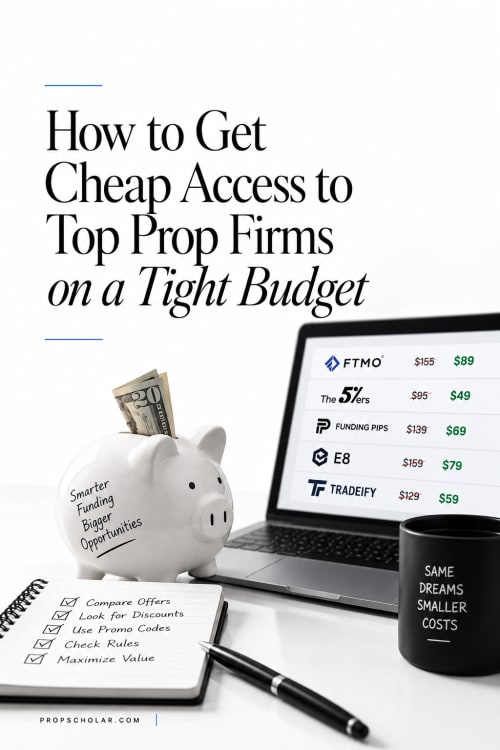
Prop Firm Fees in INR, Naira & Crypto: Real Costs Explained
12 min read
Trading Comparison
How to Choose the Right Trading Evaluation in 2026
14 min read

Trading Comparison
Buy FTMO & Funding Pips Challenges at INR Pricing: Full Guide
10 min read