
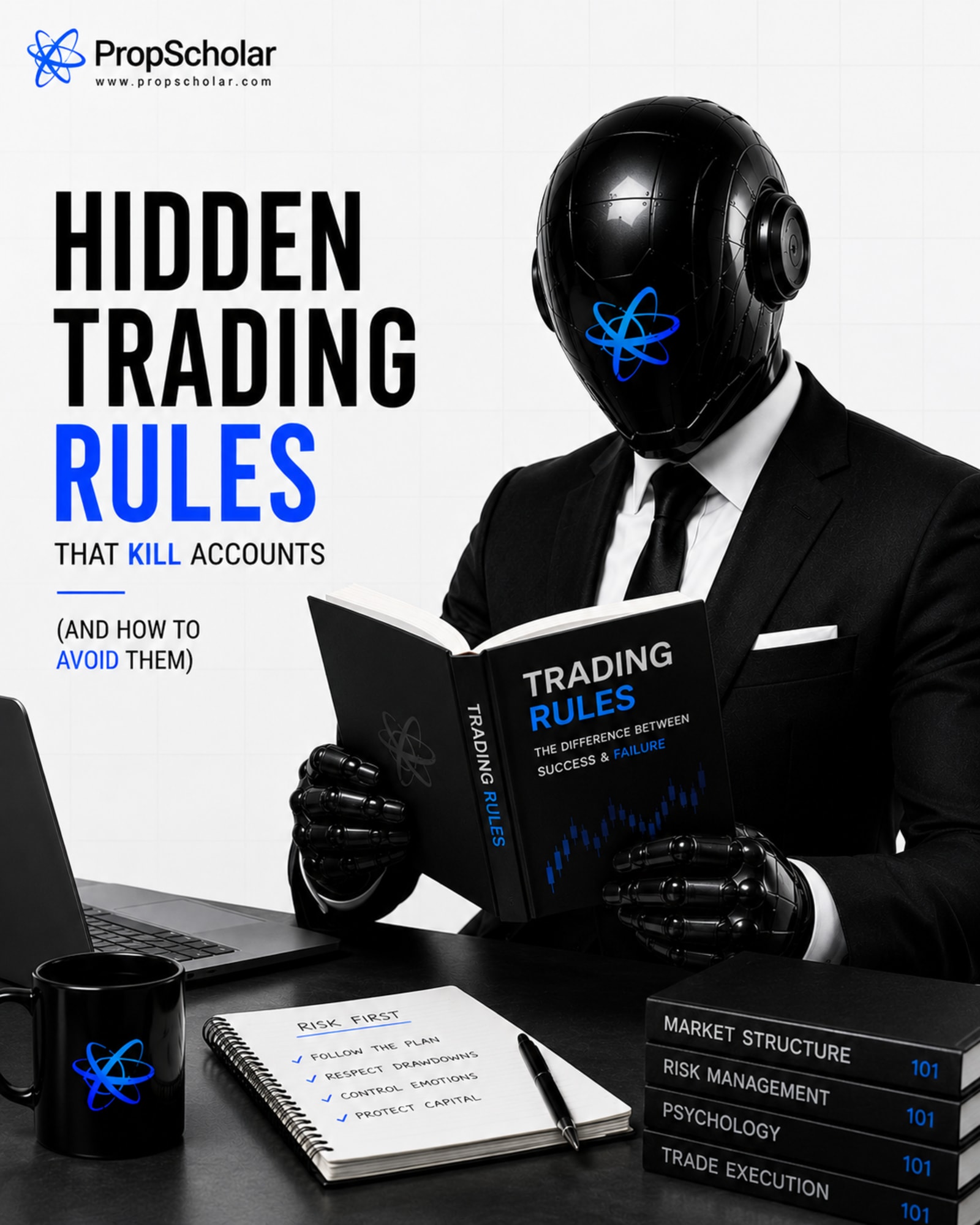
Hidden Trading Rules That Kill Accounts (And How to Avoid Them)
Most traders don't blow accounts because they can't trade. They blow them because they broke a rule they didn't know existed. This guide exposes the most dangerous hidden evaluation rules — consistency clauses, time limits, news restrictions, lot-size traps — and shows you exactly how to read the fine print before it costs you your account.
Most traders don't blow accounts because they can't trade. They blow them because they broke a rule they didn't know existed. This guide exposes the most dangerous hidden evaluation rules — consistency clauses, time limits, news restrictions, lot-size traps — and shows you exactly how to read the fine print before it costs you your account.
Start your evaluationHidden Trading Rules That Kill Accounts (And How to Avoid Them)
TL;DR: Traders lose funded accounts not because they trade badly, but because they violate rules buried in the fine print. Know what those rules are before you start.
Key takeaways:
- The consistency rule is the single most misunderstood clause in the industry — it can disqualify you even when you hit your profit target.
- Trailing drawdown is different from fixed drawdown and far more dangerous if you don't understand it.
- News trading bans, minimum day requirements, and lot-size caps are commonly enforced without warnings.
- PropScholar is a scholarship-based evaluation platform with publicly posted, never-retroactively-changed rules — a direct response to the opacity that breaks most traders.
- Evaluations start from $5 / Rs.400, and scholarships of up to 400% are paid within 4 hours of verification.
You traded well. You hit the profit target, stayed under the drawdown limit, and felt confident clicking the payout request. Then you get an email: account terminated. Violation of Rule 4.2(b). You go back and find 4.2(b) hidden in a PDF you were never asked to read.
This happens to thousands of traders every month. The frustrating part isn't losing — traders accept losses. The frustrating part is that you followed your strategy, managed your risk, and still got disqualified because of a clause that wasn't clearly explained when you paid your entry fee.
This guide is about those clauses. We're going to walk through the seven most dangerous hidden rules in trading evaluations, explain exactly why each one kills accounts, and show you what to look for before you hand over a single dollar, naira, peso, or rupee.
Why Most Traders Get Disqualified on Rules, Not Trading Skill
The evaluation industry has a dirty secret: disqualification is more profitable than passing. When you fail and repurchase, revenue continues. When you pass and get paid out, it costs the platform money. This economic reality shapes how some platforms write their rulebooks — lots of ambiguous language, lots of edge cases, lots of traps that look like fairness but function as exits.
That's not a conspiracy theory. It's just incentive alignment. And the best defense is understanding the specific mechanisms they use.
Let me walk through each one.
The Consistency Rule: The One That Catches the Most Traders
The consistency rule, when it exists, typically states something like: "No single trading day can account for more than X% of your total profits." Common thresholds are 30%, 40%, or 50%.
Here's why it kills accounts: imagine you trade a two-week evaluation and have one excellent day where you catch a perfect setup and make $600 of your $1,000 profit target. You grind the rest out over the following days, hit the target, stay under drawdown. Done, right?
Not if 60% of your profit came from one day. You just failed the consistency rule. The account is void.
Some platforms don't disclose this rule upfront at all. Others mention it in a secondary FAQ page that nobody reads at 2am when you're excited about a setup. The practical impact is that your best trading days — the ones where your edge fires perfectly — can become your worst enemy.
Before entering any evaluation, search the rulebook for the words "consistency," "single day," and "percentage." If you find a consistency clause, reverse-engineer what it means for your actual strategy. A news trader who catches one big move is particularly vulnerable here.
Trailing Drawdown vs. Fixed Drawdown: Not the Same Thing
Most beginners hear "5% max drawdown" and think: as long as my account doesn't fall 5% from where it started, I'm fine. That's how fixed drawdown works. Trailing drawdown works completely differently and is significantly more punishing.
With trailing drawdown, the maximum allowed loss threshold follows your account balance upward as you make profits — but never comes back down when you lose. So if you start with a $10,000 account with a $500 trailing drawdown:
- You start: drawdown limit is $9,500.
- You profit $300: now your balance is $10,300, so the limit moves up to $9,800.
- You then lose $400: your balance is $9,900, which is above $9,800. Safe — barely.
- You profit another $200: balance is $10,100, limit is now $9,600.
- Wait, that math seems off. The point is: the floor keeps rising with your peak balance, so even a brief drawdown after a good run can disqualify you.
Always ask: is this drawdown fixed from starting balance, or does it trail from peak equity? That single distinction changes everything about how you should trade the evaluation.
The Daily Loss Limit That Resets at Midnight (Your Platform's Midnight, Not Yours)
Most evaluations include a daily loss limit — commonly 4% to 5% of account balance. But here's the part nobody tells you: "daily" usually means the platform's server time, which might be UTC, UTC+2, or New York time. If you're trading from Lagos, Manila, Jakarta, or Karachi, the reset time is not midnight for you.
This has caused accounts to get flagged in a scenario like this: a trader hits 90% of their daily loss limit near the end of their local day, stops trading, goes to sleep. Their platform resets at midnight UTC. Three hours later, some open positions continue running and breach the daily limit in what the platform considers a new trading day — but what the trader considered the same session.
The fix is simple but easily overlooked: check your platform's server time before you start, and build your daily loss ceiling around server-day boundaries, not your local clock.
News Trading Restrictions: The Invisible No-Go Zone
Many evaluation platforms prohibit trading within a window around major news events — typically 2 to 5 minutes before and after a high-impact news release. This includes NFP, FOMC decisions, CPI prints, central bank rate announcements, and similar events.
The problem isn't the restriction itself. The problem is when traders don't know it exists. You see a clean setup forming right before a news release, you enter, price spikes your way, you profit — and then your account is flagged for news trading. The trade itself was profitable. The account still gets terminated.
Some platforms extend this prohibition to holding any position through a major news event, not just trading into one. That's a meaningful difference if you entered a position several hours earlier and planned to hold it through the announcement.
Always check: does your evaluation have a news trading rule? If yes, what is the window? Does it apply to entering trades, to holding trades, or both? Get that answer from the official rulebook, not from a Discord member who thinks they know.
Minimum Trading Days: You Can't Just Win Fast
Some evaluations require you to trade for a minimum number of days before you can claim a pass — typically somewhere between 5 and 10 trading days. The logic is to prevent someone from getting lucky on one or two volatile sessions.
Traders miss this because they're focused on the profit target. You hit 10% profit in 3 days, you feel like you've won. You have not. If the minimum is 5 days, you need to keep trading — or just wait out the time requirement without touching anything and hoping the positions you hold don't reverse.
Worse, some platforms combine this with a maximum trading day limit. You have to trade between 5 and 30 days, for example. Come in under 5, you fail. Go over 30, you fail. This creates a relatively narrow window that catches traders on both ends.
Check both the minimum and maximum before you start the evaluation. If there's a maximum, plan your calendar accordingly.
Lot Size and Scaling Restrictions: The Cap You Didn't Account For
Most evaluations set a maximum lot size per trade or per instrument. This is standard. What catches traders is when the cap is set relative to account balance and they don't recalculate after drawdowns.
For instance: maximum lot size might be 2% of current account balance expressed as standard lots. If your account drops 10% from its starting point, your maximum permitted lot size just dropped too. A trader who set up a trading plan based on starting balance and doesn't update it as the account shrinks is gradually moving toward a lot-size violation without realizing it.
Some platforms also prohibit using certain lot-size strategies entirely — specifically martingale, where you double position size after a loss. If your strategy involves any form of progressive sizing, read the rules carefully. "Prohibited strategies" sections often list martingale, grid trading, and high-frequency EA patterns.
Copy Trading and EA Restrictions Nobody Mentions in the Sales Page
Automated trading (EAs, bots, algorithms) and copy trading are handled very differently across platforms. Some allow EAs entirely. Some allow EAs but not ones commercially available to multiple accounts. Some prohibit copy trading between accounts on their platform. Some prohibit using any signal service.
The distinction between "using an EA" and "copy trading" matters legally and practically. If you're using the same EA that 500 other people on the platform are using, some platforms consider that coordinated trading and will flag all accounts running the strategy simultaneously, even if you coded it yourself and independently landed on the same logic.
If you use any form of automation or signals, get a direct written answer from the platform's support about what's allowed before you start. A screenshot of a support agent saying "EAs are fine" is not worth much if the rulebook says otherwise — but it's better than nothing.
How PropScholar Handles Rules Differently
PropScholar is a scholarship-based trading evaluation platform — not a prop firm, and not a company managing institutional capital. The model is: pay an entry fee starting from $5 (roughly Rs.400), pass the evaluation, receive a scholarship of up to 400% paid within 4 hours of verification.
We've been running for 1.5 years. In that time, we've made one deliberate choice that matters more than any feature: our rules are publicly posted and have never been changed retroactively. You can read them before you pay. You can ask about them. We don't hide them.
What PropScholar's rules do
The rulebook is designed to test genuine trading skill rather than trap traders on technicalities. The core metrics are things you'd track anyway if you were managing risk properly: drawdown limits, consistency of approach, not taking reckless position sizes. These are real risk criteria, not gotchas.
What PropScholar's rules don't do
We don't change rules after you've paid. We don't add clauses mid-evaluation. If you started your evaluation under a specific ruleset, that's the ruleset that applies to your account — full stop. This is worth stating plainly because it's not universal in this industry.
Payments and who can participate
In India, payments go through UPI via PhonePe, Razorpay, or Cashfree. Globally, PropScholar accepts crypto — which means traders in Nigeria, the Philippines, Indonesia, South Africa, Kenya, Pakistan, Bangladesh, Vietnam, and everywhere else can participate without needing a foreign payment card or a PayPal account. The $5 floor makes the entry point genuinely accessible.
PropScholar also runs a marketplace selling real prop firm challenges at INR/UPI pricing, so if you want to access a global prop firm evaluation but paying in USD or GBP is a barrier, that's a route worth exploring.
The FIFA World Cup 2026 promotion
Through the end of the FIFA World Cup 2026, PropScholar's penalty game at app.propscholar.com/fifa gives you a free shot at a mystery code worth 22% to 25% off an evaluation, or up to 15% extra payout on a scholarship you've already earned. You get 5 penalty attempts, and you can retry every 4 hours. It costs nothing to play.
How to Actually Read an Evaluation Rulebook Before You Pay
Don't skim. Open the rulebook and run a keyword search for every one of these terms: consistency, trailing, daily loss, news, minimum days, maximum days, lot size, EA, automated, copy, martingale, grid, prohibited.
For each hit, write down in plain English what the rule means for your actual strategy. If a rule is ambiguous, send it to support in writing and ask for clarification. "Ambiguous" is not a reason to assume the favorable interpretation — it's a reason to get clarity before your entry fee is at risk.
If a platform doesn't have a public rulebook — if the full terms are only visible after payment — treat that as a red flag. There's no justification for hiding rules until after you've committed money.
Check the community too. A Discord or forum with real traders is where you find out which rules are actively enforced versus which ones are theoretical. When PropScholar's Discord community has over 3,000 traders, you can see real payout screenshots, real questions answered by real people who've been through the process. That kind of transparency compounds.
Questions About Evaluation Rules? Contact PropScholar Directly
If you have a specific question about an evaluation before you start — a strategy you want to confirm is allowed, a rule you want clarified — reach out directly at business@propscholar.com. We have 24/7 support in Hindi and multiple other languages. You shouldn't be making a decision about which evaluation to enter based on guesswork.
The right way to approach any evaluation is the same way you approach a trade: know your rules, know your risk, execute with a clear head.
PropScholar is a scholarship-based trading evaluation platform operated by a Private Limited company registered in India. We are not a prop firm and do not manage or allocate institutional capital. Our model rewards proven trading skill with scholarship grants upon successful evaluation completion.
Ready to Prove Your Edge?
Join 500+ traders. Start from just $5. Get funded within days.
Frequently Asked Questions
The most common hidden rules are: the consistency clause (no single day can make up too large a percentage of total profits), trailing drawdown (the loss floor rises with your peak balance), news trading restrictions (no trading near major announcements), minimum trading day requirements (you must trade for a set number of days), daily loss limits based on server time rather than your local time, lot size caps relative to current balance, and restrictions on copy trading or automated strategies. Each one can void an account even when your overall profit and drawdown are fine.
More From PropScholar

Trading Education
Giveaways vs Trading Scholarships: How PropScholar Is Changing the Game for Traders
8 min read

Trading Education
How PropScholar Bridges the Gap Between Traders and Top Tier Prop Firms
7 min read
Trading Education
Why Capital Matters Not Just Tradable Capital but Affordable Capital
7 min read