Trading Psychology for Passing Your First Evaluation
Passing a trading evaluation isn't just about strategy — it's mostly about your mind. This guide breaks down the exact psychological traps that end first evaluations early, how to build the mental habits that get you through, and why PropScholar's low-entry model gives beginners a real shot at staying calm under pressure.
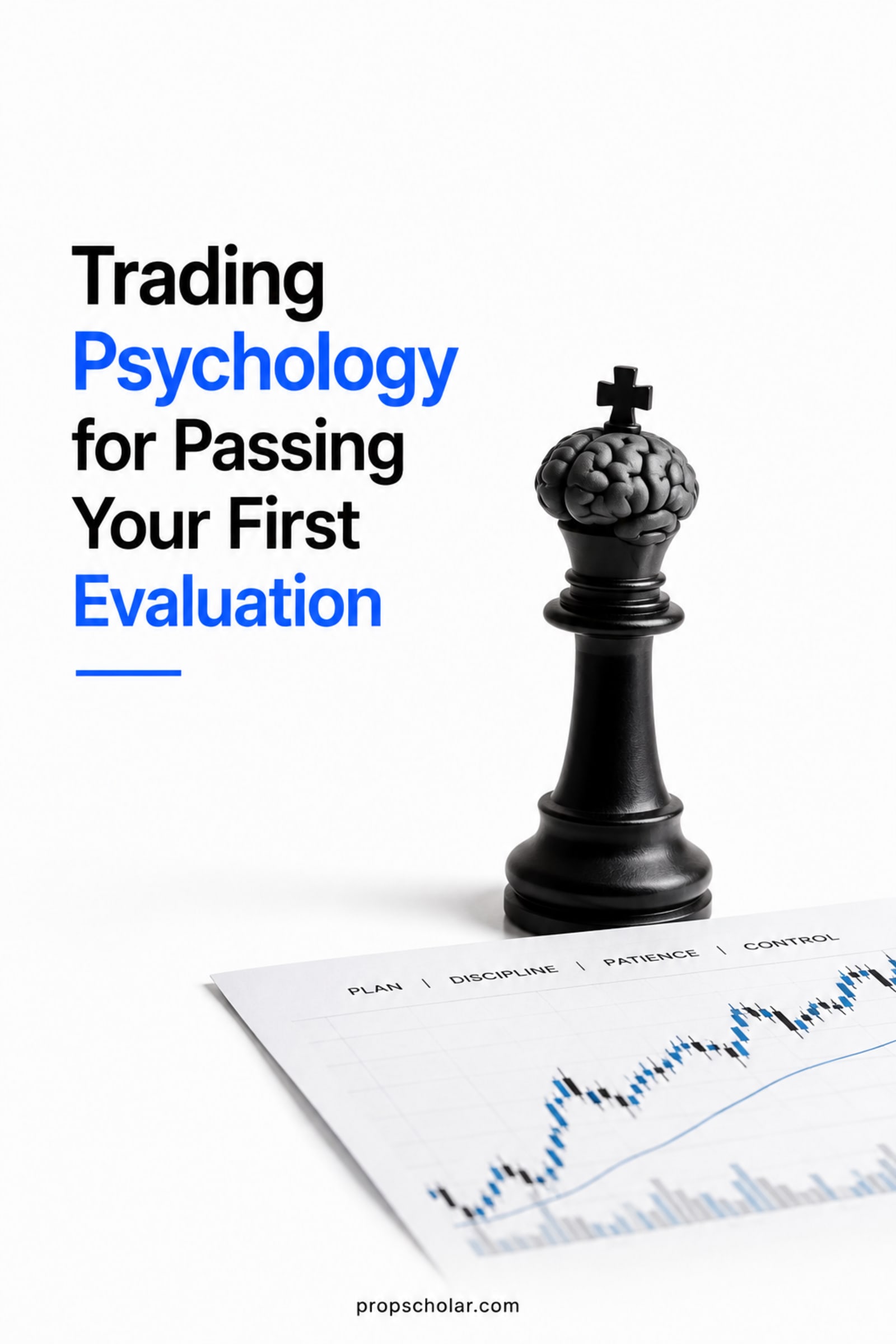
Passing a trading evaluation isn't just about strategy — it's mostly about your mind. This guide breaks down the exact psychological traps that end first evaluations early, how to build the mental habits that get you through, and why PropScholar's low-entry model gives beginners a real shot at staying calm under pressure.
Start your evaluationTrading Psychology for Passing Your First Evaluation
TL;DR: Most first evaluations aren't lost to bad strategy — they're lost to bad psychology. Fix your mental game first, and the rules become surprisingly manageable.
Key takeaways:
- Emotional reactions to small losses cause most evaluation breaches, not lack of skill
- The discipline habits that protect your evaluation account are learnable and specific
- Fear, greed, and FOMO follow predictable patterns — knowing them lets you interrupt them
- PropScholar's evaluation entry starts at $5, so the financial pressure that distorts your psychology is much lower
- Payouts of up to 400% are processed within 4 hours of verification — the goal is worth protecting
You've studied your strategy. You know your setup. You've back-tested it, maybe forward-tested it on a demo account. Then the evaluation starts, one trade goes sideways, and something shifts in your chest. Suddenly you're not trading the plan — you're trading your feelings.
That moment is where most first evaluations end. Not in a dramatic blowup, but in a slow erosion of discipline, one emotional decision at a time.
This isn't a character flaw. It's a predictable psychological response to pressure, and it happens to traders at every level. The difference between traders who pass their first evaluation and those who don't is rarely strategy. It's almost always how they manage their own mental state when things get uncomfortable.
Let's get into exactly what that looks like — and what to do about it.
Why Trading Psychology Matters More in an Evaluation Than in Normal Trading
In a regular demo account, a bad day doesn't cost you anything real. You close the platform, reopen it the next morning, and the slate is clean. Psychologically, the stakes feel low — because they are.
An evaluation changes that equation. Now there are rules attached to your trading. A daily loss limit. A maximum drawdown. A profit target you need to hit. Suddenly every trade carries a second meaning: not just "did I make money?" but "did I move closer to or further from my pass?"
That dual layer of pressure is where psychology becomes the central problem. Traders who are perfectly disciplined on a demo account find themselves doing things they'd never normally do: widening a stop loss at the last second, holding a losing trade overnight hoping it recovers, taking a position three times larger than usual to "make back" a bad day.
The evaluation environment is designed to test whether you can trade consistently under real pressure. And consistent trading is almost entirely a psychological task.
The Four Mental Traps That End Evaluations Early
These aren't abstract concepts. These are the specific patterns we see trip up traders again and again.
Revenge Trading After a Loss
A loss triggers frustration. Frustration creates the urge to "fix" things immediately. So you open another trade right away, usually bigger than your normal size, without waiting for your setup. That trade often loses too — and now you're chasing, which is how small drawdowns become account-ending ones.
If you've ever found yourself opening a trade within ten minutes of a bad loss, not because you saw a genuine setup but because you couldn't sit with the feeling of being down, that's revenge trading. It's worth reading more about how this specific pattern destroys accounts: how revenge trading ends Nigerian traders' evaluations fast is a sharp breakdown of the same dynamic.
FOMO — The Fear of Missing Out
You're sitting in cash, correctly waiting for your setup, when the market suddenly moves hard in a direction you'd predicted. But you weren't in the trade. So you jump in late — at a worse entry, with a weaker risk-reward, driven entirely by the discomfort of watching a move happen without you.
FOMO trades almost always lose. Not because the underlying idea was wrong, but because the entry timing was emotional rather than technical. And in an evaluation with a drawdown limit, a string of late FOMO entries can eat through your cushion before you realize what's happening.
Overtrading to Chase the Profit Target
Let's say your evaluation profit target is 8% and you've made 4% with a week to go. That should feel comfortable. But some traders look at the remaining target and start forcing trades — opening positions on marginal setups, increasing frequency, treating quiet market days as opportunities that need to be manufactured.
Overtrading is the enemy of evaluation success. More trades means more exposure to random variance, more transaction costs, and more opportunities for emotional decisions to creep in. The evaluation rewards patience, not activity.
Loss Aversion Paralysis
This one works in the opposite direction. After a couple of losses, some traders become so afraid of breaching their drawdown limit that they stop trading altogether, or they trade so small and timidly that they can't realistically hit their profit target in time. Fear of losing becomes a self-fulfilling prophecy — they don't breach the account, but they don't pass it either.
How to Build the Mental Habits That Actually Get You Through
Knowing the traps matters. But knowing them isn't the same as having the habits in place to avoid them. Here's what actually works.
Set Your Risk Per Trade Before the Session Starts — Not During
Decide your maximum position size and risk percentage when you're calm, before the market opens. Write it down or type it somewhere. Then commit to not adjusting it during the session.
The reason this works is simple: your pre-session self is rational. Your in-session self is not — or at least, it's more vulnerable to emotional distortion. Locking in your rules when you're thinking clearly means your emotional self can't override them in the moment.
For most evaluations, risking between 0.5% and 1% of the account per trade is a sensible range that gives you enough room to hit profit targets while keeping single-trade losses from doing serious damage to your drawdown cushion.
Give Yourself a Hard Stop After a Set Number of Losses in a Day
Decide in advance: if you take two losses in a single trading session, you close the platform and stop for the day. No exceptions.
This rule feels frustrating when you're in the middle of a bad day, because the urge to recover is strong. But the data on this is clear enough from experience: traders who continue after two consecutive losses in the same session are much more likely to make emotional decisions, not better ones. The market will be there tomorrow. Your evaluation account might not be if you keep going.
Write this rule somewhere visible. Some traders put a sticky note on their monitor. Whatever it takes to make the rule feel real and external, not just a mental intention you can quietly override.
Treat the Evaluation Like It's Already a Funded Account
The biggest psychological shift that helps first-time evaluation traders is changing how they mentally frame what they're trading. Instead of thinking "I need to pass this evaluation to get something real," think "this is already real money — I'm already accountable."
That framing sounds small but it changes behavior. It makes you respect small drawdowns. It makes you follow your rules on the boring days, not just the exciting ones. And it makes the evaluation feel less like a test you're trying to pass and more like a professional standard you're already living up to.
Build a Pre-Trade Checklist
Before every single trade, run through a short mental checklist. Yours will depend on your strategy, but the basics look something like this:
Is this setup in my trading plan? Is the risk-reward at least 1:2? Am I trading because of a real signal or because of a feeling? Have I hit my daily loss limit already?
This checklist sounds bureaucratic. It isn't. It's the difference between a trade you can review objectively afterward and a trade you can barely explain to yourself. The few seconds it takes to run through it will save you from most of the emotional trades that end evaluations early.
Keep a Trading Journal — But a Specific Kind
Most journals track entries, exits, profit and loss. That's useful but incomplete. Add a column for your emotional state before the trade and after it. Specifically: what were you feeling when you opened this position? What were you feeling when you closed it?
Patterns emerge fast. You'll notice that certain emotional states — impatience, frustration, boredom, excitement — reliably precede your worst trades. Once you see the pattern, you can start catching the feeling in real time and using it as a warning signal rather than a trigger.
The Pressure of Cost — and Why It Matters Psychologically
Here's something that doesn't get talked about enough in trading psychology content: the financial pressure of the evaluation entry fee itself distorts your psychology.
If you've paid the equivalent of a week's salary to enter an evaluation, every trade feels like it's playing with your rent money. That pressure makes you too tight on good setups and too loose on bad ones, depending on your personality. It's one of the clearest real-world examples of how financial stress affects rational decision-making.
This is part of why PropScholar's model genuinely matters from a psychological standpoint. Entry fees start at $5 — about Rs.400 at current rates, or the equivalent of a few hundred Naira, a handful of Pesos, a small amount in Rand. When the entry cost is that low, you can approach the evaluation from a position of relative calm instead of survival mode.
That's not a marketing line. It's a real psychological advantage. Traders who aren't desperate to pass because they've risked their financial security are better positioned to make rational decisions. They can follow their rules. They can stop when they should stop. They can wait for their setup instead of forcing trades.
And when they do pass, the scholarship is meaningful: PropScholar's payouts go up to 400% of the entry amount, processed within 4 hours of verification. That asymmetry — small downside, real upside — is exactly the kind of risk-reward structure that supports good decision-making.
What PropScholar's Evaluation Structure Does for Your Mental Game
PropScholar is a scholarship-based evaluation platform, not a prop firm. The distinction matters practically, not just in terminology: the evaluation is built around transparent, publicly posted rules that have never been changed retroactively. That matters for psychology too.
One of the most underrated sources of trader anxiety during evaluations is rule uncertainty. If you're not sure whether the platform might change the terms, add a hidden clause, or find a reason to deny your payout, that anxiety leaks into your trading. You second-guess decisions. You trade defensively in the wrong ways.
Knowing that the rules are fixed and public removes that layer of mental noise. You can focus entirely on the thing you actually control: your trading behavior.
Global traders pay via crypto (USDT and similar) with no country restrictions, so traders in Nigeria, the Philippines, Indonesia, Kenya, South Africa, Pakistan and elsewhere can access this without navigating complicated cross-border payments. The 24/7 support — available in Hindi and multiple languages — means you're not waiting three business days to get an answer to a rule clarification that's affecting your trading confidence.
Those aren't small things when your psychological bandwidth is already being spent on managing your trades.
Passing the Evaluation Is a Repeatable Skill
The best reframe for trading psychology isn't to try to feel less — it's to recognize that the feelings are information, not commands.
Frustration after a loss tells you something happened that mattered to you. That's useful. What you do with that information is the choice. You can act on the frustration by revenge trading, or you can note it, step away from the platform for twenty minutes, and come back when you're ready to follow your plan again.
FOMO tells you the market moved in a direction your analysis predicted. That's also useful — it means your directional read might be correct, which is worth noting for next time. What it shouldn't trigger is a panic entry at a bad level.
Every emotional signal has a rational counterpart. The skill of trading psychology is learning to hear the rational message inside the emotional noise. That's not something you develop by reading about it — it's something you develop by trading, journaling, noticing patterns, and making small adjustments over time.
PropScholar's entry model means you can do that iteration cheaply. A failed evaluation at $5 is a $5 lesson, not a devastating setback. You reload, apply what you learned, and go again. That low cost of iteration is one of the most genuine structural advantages for beginner traders trying to build this skill.
Frequently Asked Questions
What is trading psychology and why does it matter for evaluations?
Trading psychology is the study of how emotions and mental states affect trading decisions. In an evaluation, it matters enormously because the rules and pressure create emotional triggers — fear of breaching drawdown, urgency to hit profit targets — that cause traders to abandon their strategy. Managing those emotions is often the deciding factor between passing and failing.
What are the most common psychological reasons traders fail their first evaluation?
The main culprits are revenge trading after a loss, overtrading to chase profit targets, FOMO entries at bad levels, and paralysis from excessive fear of drawdown. Each of these is a predictable emotional response to evaluation pressure. Recognizing the pattern in real time is the first step to interrupting it before it costs you the account.
How do I stop revenge trading during an evaluation?
Set a hard rule before you start: two losses in a session and you close the platform for the day. Write it down before the session begins, when your thinking is clear. The emotional pull to recover a loss immediately is strong in the moment, but continuing almost always makes things worse. Removing the option entirely is more effective than trying to resist the urge trade by trade.
Does the size of the evaluation fee affect my trading psychology?
Yes, significantly. When the entry fee represents a large portion of your budget, financial stress distorts your decision-making — you trade too tight on good setups and too loose on bad ones. PropScholar's entry starts at $5, which reduces that pressure substantially and lets you focus on executing your strategy rather than managing financial anxiety.
Is PropScholar a legitimate platform for beginner traders to practice evaluation psychology?
PropScholar is a scholarship-based trading evaluation platform registered as a Private Limited company in India, operating for over 1.5 years. Its rules are publicly posted and have never been changed retroactively. Payouts of up to 400% of the entry amount are processed within 4 hours of verification. For beginners, the low $5 entry point makes it a genuinely accessible place to develop evaluation discipline without high financial stakes.
How long does it take to develop good trading psychology?
There's no fixed timeline — it depends on how actively you track your emotional patterns, how honestly you journal, and how many evaluation cycles you go through. What's clear from experience is that it develops through deliberate practice, not just time. Traders who journal emotional states alongside trade data tend to identify their specific patterns much faster than those who only track profit and loss.
Can I improve my trading psychology without paying for courses or coaching?
Absolutely. The most effective tools are free: a trading journal with an emotions column, a written pre-trade checklist, a daily loss limit rule, and honest review of your losing trades. Joining a community like PropScholar's 3,000+ trader Discord also gives you access to real traders discussing what actually works, which is often more useful than formal instruction.
PropScholar is a scholarship-based trading evaluation platform operated by a Private Limited company registered in India. We are not a prop firm and do not manage or allocate institutional capital. Our model rewards proven trading skill with scholarship grants upon successful evaluation completion.
Related reading
- Blown Trading Account Pakistan? 2-Week Recovery Plan
- Stop Revenge Trading: Filipino Beginner's Evaluation Guide 2026
- Revenge Trading on a $1 Challenge: Why Nigerian Traders Lose Fast
- What Does a $1 Prop Firm Account Actually Get You?
- Best $1 Trading Challenge 2026: Why 1K 1-Step Wins
- Best Prop Firm for Beginners in India 2026: Pay With UPI, Start Cheap, Trade Safe
Ready to Prove Your Edge?
Join 500+ traders. Start from just $5. Get funded within days.
Frequently Asked Questions
Trading psychology is the study of how emotions and mental states affect trading decisions. In an evaluation, it matters enormously because the rules and pressure create emotional triggers — fear of breaching drawdown, urgency to hit profit targets — that cause traders to abandon their strategy. Managing those emotions is often the deciding factor between passing and failing.