Is the Consistency Rule a Scam? How It's Used to Deny Payouts
The consistency rule sounds fair on paper. In practice, some platforms use vague or extreme versions of it to deny payouts to traders who genuinely passed. Here's how the math works, who it benefits, what a fair version looks like, and what PropScholar does differently.
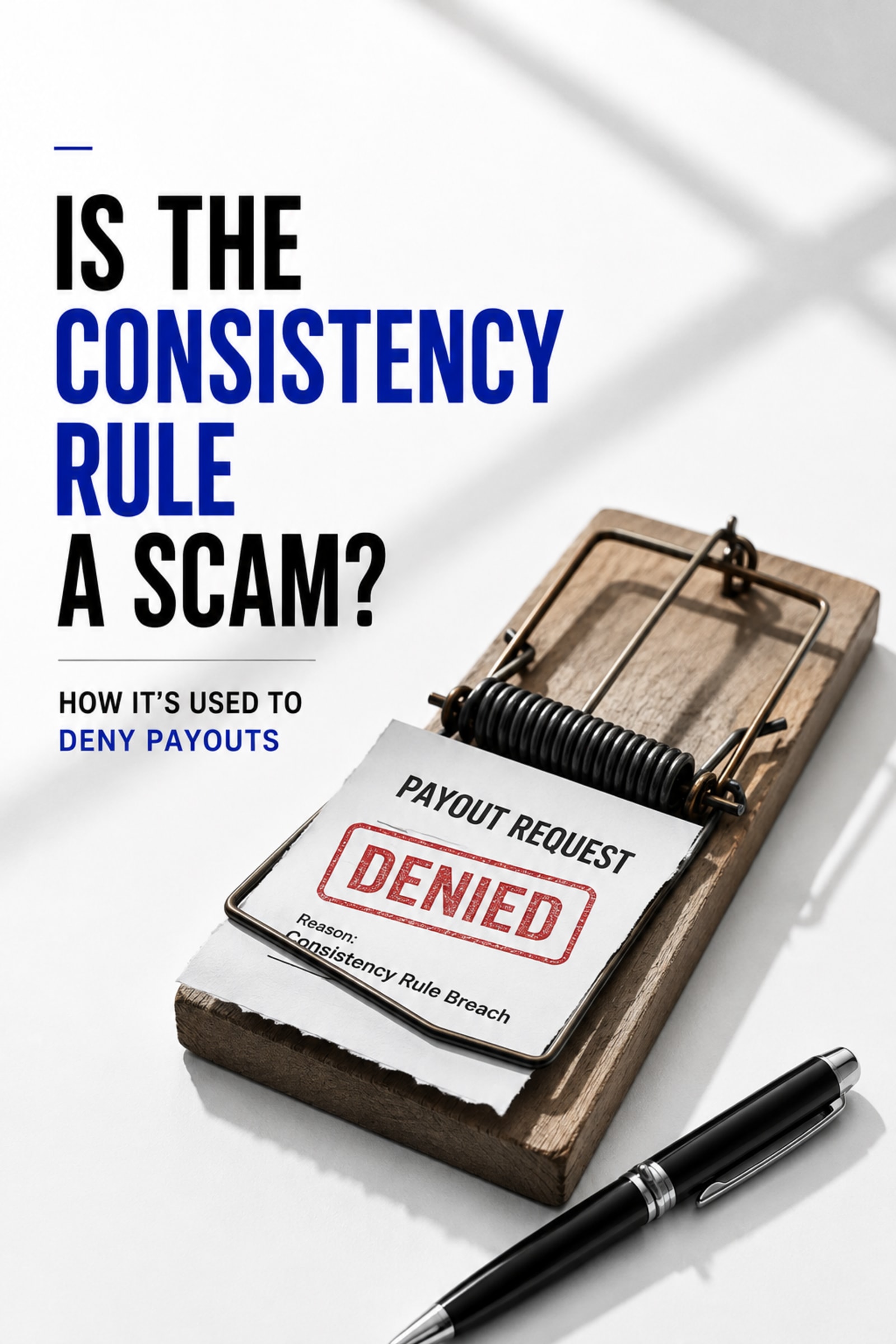
The consistency rule sounds fair on paper. In practice, some platforms use vague or extreme versions of it to deny payouts to traders who genuinely passed. Here's how the math works, who it benefits, what a fair version looks like, and what PropScholar does differently.
Start your evaluationIs the Consistency Rule a Scam? How It's Used to Deny Payouts
TL;DR: The consistency rule isn't inherently dishonest — but certain platforms design it so strictly that almost no real trader can pass it, then use it to reject payouts. This article breaks down the exact math, the legitimate version, the trap version, and what you should demand before you pay anything.
Key takeaways:
- The consistency rule limits how much of your total profit can come from a single day or trade.
- A fair version sits around 30–50% of total profit per day. Stricter versions can make passing nearly impossible.
- Some platforms use vague, retroactively applied, or hidden consistency rules specifically to deny payouts.
- The rule should protect evaluation integrity — not function as a profit-clawback mechanism.
- PropScholar publishes its rules publicly and has never changed them retroactively.
You traded clean. You hit your profit target. You respected the drawdown limits. And then, right before your scholarship gets paid out, you receive a message: your account is under review because you "breached the consistency rule."
You didn't even know exactly what that rule required — not in precise numbers, anyway. The platform's FAQ mentioned it, but the specific threshold? Buried, vague, or worse, not published at all.
This is not a hypothetical. It's a pattern traders across Nigeria, India, the Philippines, Pakistan, and dozens of other markets run into. And it's worth being blunt about: in its most predatory form, the consistency rule isn't a risk management tool. It's a payout filter.
What the Consistency Rule Actually Says
At its core, the consistency rule limits how concentrated your profits can be. Specifically, most versions say your single best trading day cannot account for more than a certain percentage of your total profits over the evaluation period.
The logic isn't unreasonable. If you made $9,800 of your $10,000 profit target in one giant lucky trade, a legitimate evaluation platform has reason to question whether that reflects real, repeatable skill. The rule is meant to filter out gamblers — traders who swing massive position sizes hoping one trade carries them over the line.
A fair consistency rule, applied honestly, serves a genuine purpose.
The problem is what happens when that rule gets weaponized.
The Exact Math That Makes It a Trap
Let's walk through how this plays out in numbers, because the devil really is in the specifics.
Say you're trading a standard evaluation. Your target is $1,000 in profit. A consistency rule set at 40% means no single day can account for more than $400 of that total. That's workable. A skilled trader managing their position size across several sessions can realistically stay within that band.
Now crank it down to 25%. Your best day can be worth no more than $250 out of $1,000. That means you need a minimum of four profitable days with no single day running hot — even legitimately, even from good setups, even from proper risk management. Markets don't cooperate with that kind of rigid distribution. A trending day can deliver outsized profits to any disciplined trader. It's not a flaw; it's how markets work.
Push the rule to 20%, and you've essentially designed an evaluation that rewards mediocrity and punishes genuine edge. You're telling a skilled trader that being too good on a single day is a failure.
And here's the cruellest part of this design: the consistency calculation is often applied retroactively to your cumulative profit at the end of the challenge. So you could be fully compliant for twenty-eight days, have one strong session on day twenty-nine, and fail the rule even though you had no way of knowing, in real time, that your running total had shifted the threshold.
Who Benefits When You Fail a Consistency Rule?
You keep your losses. The platform keeps your entry fee.
That's the economic structure. The evaluation fee — whether it's $5 at PropScholar or $500 at a traditional firm — is non-refundable in most cases. If the platform can find a legitimate-sounding rule to fail you on after you've done the hard trading work, they retain the fee with no payout obligation.
This is why a vague, extremely strict, or undisclosed consistency rule is such a convenient tool. It doesn't look dishonest on its face. It sounds like responsible risk management. But the effect — and sometimes clearly the intent — is to create a filter that triggers on performance that would otherwise require a payout.
I want to be careful here: I'm not saying every platform with a strict consistency rule is operating dishonestly. Some genuinely believe tight consistency thresholds reflect real prop trading norms. But the pattern of vague thresholds, retroactive application, and no published calculation method is a red flag that traders deserve to know about.
For more on how to separate legitimate payout proof from manipulation, the breakdown in Prop Firm Payout Proof: Real vs Fake and How to Tell the Difference is worth reading before you commit to any evaluation.
Warning Signs of a Consistency Rule Being Used as a Trap
The threshold isn't published in plain numbers
If a platform's consistency rule says something like "your trading must be consistent" without specifying a percentage or calculation method, that's not a rule. That's a discretionary judgment call the platform can apply however it wants. You can't trade to a standard you can't measure.
The calculation method is unclear
Does "best day" mean gross profit or net profit? Does it include partial closes on a trade that ran overnight? Does a trade opened on Monday and closed on Tuesday count as one day or two? These aren't pedantic questions. The answer changes whether you pass or fail.
The rule isn't mentioned until payout review
Some traders have reported only hearing about the consistency rule when they submitted for payout. The rule existed in the terms, technically, but it wasn't front-and-centre during onboarding. That asymmetry — where the platform knows and you don't — is a deliberate design choice.
The threshold is below 30%
This is a rough guide, not a hard standard. But a consistency rule below 30% is aggressive enough that it starts to conflict with normal market volatility. Trend days happen. News events happen. A rule that punishes traders for capitalising on real, high-probability setups on an active day isn't really testing skill — it's testing luck.
Rules have been changed after sign-up
This is perhaps the most serious version of the problem. If an evaluation platform can amend its consistency rule mid-challenge and apply the new version to your active account, the entire evaluation is meaningless. You're not trading to a fixed standard — you're trading to a moving target.
What a Fair Consistency Rule Looks Like
A legitimate consistency rule has three properties: it's published in precise numeric terms before you pay, it uses a clear and disclosed calculation method, and it's set at a level that a real trader using real risk management can realistically satisfy.
A threshold in the 30–50% range, with a clear definition of what counts as a "day" and whether the calculation uses gross or net profit, is something you can actually plan around. You can track it yourself in a spreadsheet as you trade. You know where you stand.
That's what a rule is supposed to do — give you a standard to meet, not a trap to stumble into.
For a broader look at how to evaluate whether a platform is operating in good faith before you commit funds, How to Verify a Prop Firm Payout Proof Before You Pay a Cent covers the due diligence process in detail.
Community Frustration Is Real — and It's Worth Paying Attention To
Anyone spending time in trading communities on Discord, Reddit, or Telegram has seen this play out repeatedly. A trader posts a screenshot of their challenge — green equity curve, profit target hit, drawdown respected — and the caption is some version of "rejected for consistency."
The frustration isn't just about losing the fee. It's about the feeling that the evaluation was never designed for them to pass. That the whole thing was built to look like an opportunity while functioning as a revenue stream for the platform.
I don't think that's true of every platform. But the pattern is common enough, and the community anger real enough, that any honest evaluation service needs to address it directly rather than hoping traders don't notice.
This is also why payout proof matters so much. Not screenshots that could be fabricated, but verifiable, community-visible proof that people are actually getting paid after passing. You can see PropScholar's payout history discussed openly in the Discord — 3,000+ traders in one place tend to make silence about payouts impossible.
How PropScholar Handles This Differently
PropScholar is a scholarship-based trading evaluation platform, not a prop firm. The distinction matters here because the incentive structure is different.
Rules are public before you pay
Every rule — including any consistency requirements — is visible in the evaluation terms before you commit a rupee, naira, peso, or cent. There's no fine print that only appears at payout review.
No retroactive rule changes
PropScholar has operated for over 1.5 years without changing its rules retroactively. That's something we're direct about because it's something traders have a right to demand from any platform.
The entry cost is low enough to test first
At $5 (around Rs.400 in India, or the crypto equivalent globally), the evaluation fee is low enough that you can run through the process, read every rule in detail, and understand exactly what you're agreeing to before you ever commit meaningful money. That's by design.
Payouts happen within 4 hours of verification
Once a scholarship is verified after a successful evaluation, payment goes out within 4 hours. Not days, not weeks, not "pending review". This is the operational standard, and it's verifiable through the community.
You can also review what honest payout proof actually looks like — and what platforms that really pay share publicly — in Payout Proof Prop Firm: Which Ones Actually Pay in 2026.
For a full independent-style breakdown of PropScholar's model, Is PropScholar Legit? An Honest Review With Payout Proof covers the platform's track record in detail.
What You Should Demand From Any Evaluation Platform
Before you pay anything — $5 or $500 — get answers to these questions:
What is the exact consistency rule percentage? How is "best day" calculated — gross or net? What time zone defines a trading day? Is the rule assessed in real time or only at payout review? Has the rule ever changed for active accounts? And can you see community-visible evidence of recent, verified payouts?
If any of those questions get vague answers, or if the platform becomes defensive when you ask, that's your answer.
The consistency rule isn't a scam by nature. But it can absolutely be designed and applied as one. Knowing the difference is what keeps your evaluation fee out of someone else's pocket.
PropScholar is a scholarship-based trading evaluation platform operated by a Private Limited company registered in India. We are not a prop firm and do not manage or allocate institutional capital. Our model rewards proven trading skill with scholarship grants upon successful evaluation completion.
Related reading
- The Safest Way for a College Student to Start Trading and Not Lose Money
- Is PropScholar Legit or Fake? The Honest 2026 Review Every Trader Should Read Before Paying
- Are Free Funded Accounts Real? What 'Free' Prop Offers Actually Cost You
- Is Online Prop Trading Legit or a Scam? A Complete Trust Guide
- Cheap Prop Firms Are a Scam: How PropScholar Gives You the Easiest Evaluation and a Real Path to Reliable Funded Trading
- Which Trading Platforms Actually Pay Fast: What to Verify First
Ready to Prove Your Edge?
Join 500+ traders. Start from just $5. Get funded within days.
Frequently Asked Questions
The consistency rule itself isn't a scam — it's a legitimate tool to verify that profits came from repeatable skill, not a single lucky gamble. But some platforms set thresholds so strict, apply them retroactively, or leave them undefined, that the rule effectively functions as a payout-denial mechanism. The rule becomes predatory when it's vague, hidden until payout review, or set below a realistic threshold.