Can You Recover After Hitting the Daily Loss Limit? PropScholar vs Traditional Prop Firms
You hit the daily loss limit. Now what? This guide explains exactly what happens next on PropScholar's Freedom Account versus traditional prop firm evaluations — the rules, the math, and the honest path forward.
You hit the daily loss limit. Now what? This guide explains exactly what happens next on PropScholar's Freedom Account versus traditional prop firm evaluations — the rules, the math, and the honest path forward.
Start your evaluationCan You Recover After Hitting the Daily Loss Limit? PropScholar Rules vs Traditional Prop Firms Explained
TL;DR: On PropScholar's Freedom Account, hitting the 3% daily loss limit ends your trading for that calendar day — not your evaluation. You come back the next day, account intact, and keep working toward the 10% profit target. Traditional prop firms often treat a single bad day as a near-total reset. That difference is worth understanding before you pick where to evaluate.
Key takeaways:
- The 3% daily loss limit on PropScholar stops your day, not your entire evaluation.
- Your maximum loss across the whole evaluation is 6% of the initial account — the daily rule sits inside that boundary.
- No time limit and no minimum trading days means you genuinely have space to recover at your own pace.
- Traditional prop firms commonly apply stricter, sometimes compounding drawdown structures that shrink your runway after one bad session.
- The Freedom Account starts at $10 for a $10,000 evaluation — recovery stakes are low enough to be realistic for traders on a tight budget.
You're three trades into the morning. The news prints wrong, price gaps through your stop, and before you've finished your coffee you're staring at a red account that's down 3% for the day. The platform locks you out.
That moment — the locked screen, the pit-in-stomach feeling — is where most beginner traders make their real mistake. Not the bad trade. The reaction to it.
Some platforms use that lock-out as a soft end to your evaluation. Others make it genuinely recoverable. Understanding which camp you're in changes how you should trade the day after. So let's be precise about what actually happens.
What the PropScholar 3% Daily Loss Rule Actually Does
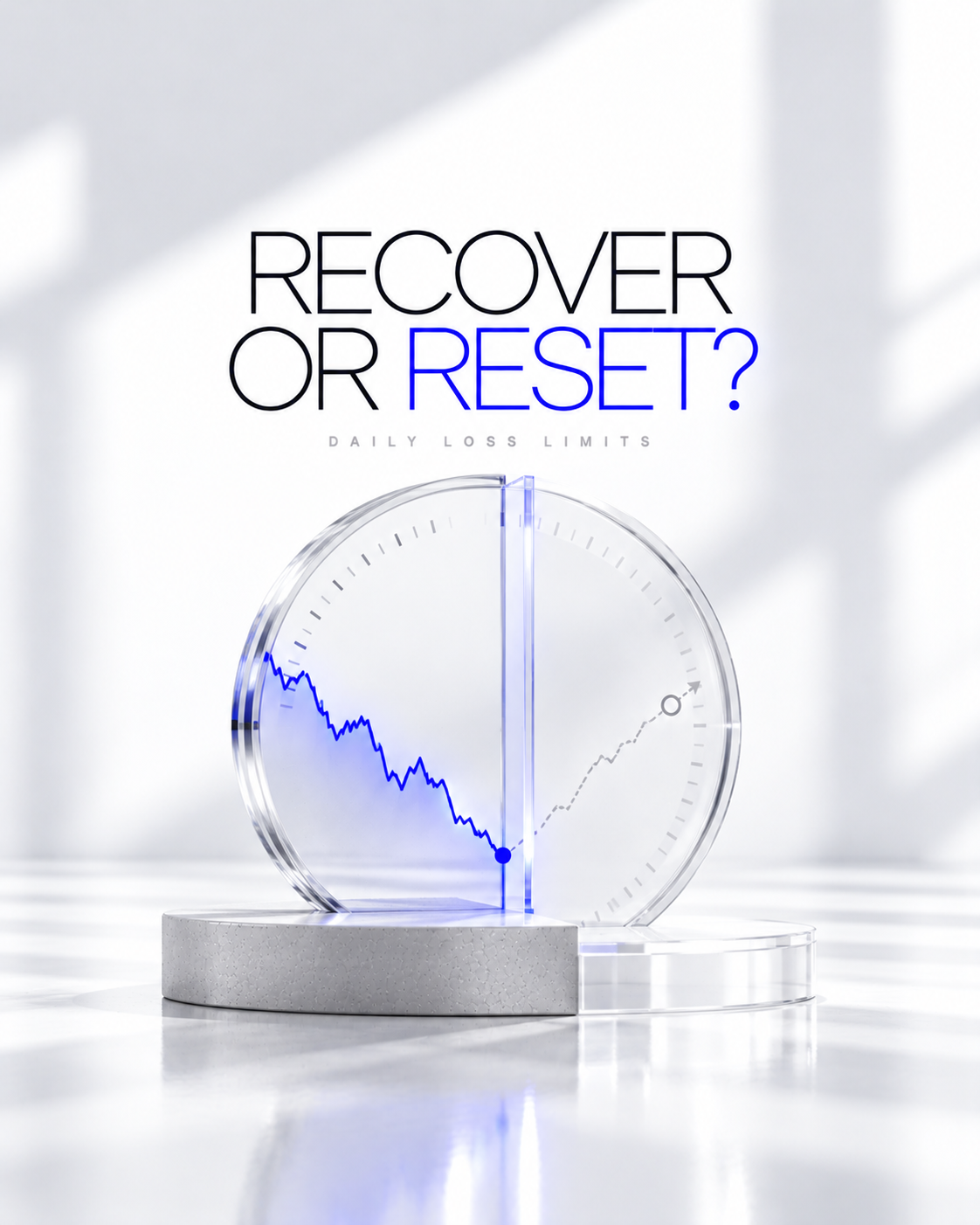
The daily loss limit on the Freedom Account is 3% of the higher of your starting equity or current balance — recalculated each day. On a $10,000 account that's a $300 daily ceiling. Once you hit it, you cannot open new trades until the next trading day starts.
That's the complete consequence: one day off the market.
Your account balance is unchanged. Your progress toward the 10% profit target is unchanged. The evaluation itself continues the moment the new day opens. There is no penalty multiplier, no forced reduction in account size, and no requirement to prove anything before you return.
This is not a mercy rule — it's a structural one. PropScholar built the daily limit to stop the specific behaviour that ends most evaluations: the revenge-trade spiral where a $200 loss becomes a $1,200 loss because you kept pushing to get it back in the same session. The rule removes that option entirely. For a deeper look at why that matters mechanically, the post on why PropScholar's 3% daily loss rule stops you blowing up before lunch break walks through the psychology behind it.
The 6% Overall Limit: Your Real Runway After a Bad Day
Here's the number that actually defines how much room you have to recover. The maximum loss across the entire evaluation is 6% of the initial account size — hard, not trailing.
On a $10,000 account, that's $600 from the starting balance. If you hit the 3% daily limit on day one, you've used $300 of that $600. The next day you have $300 of overall buffer remaining and a fresh 3% daily allowance on your current balance.
That is a real, workable situation. You haven't failed. You've used half your cushion and need to trade more carefully from here.
On a $5,000 account the numbers are $150 daily and $300 total. On a $25,000 account, $750 daily and $1,500 total. The structure scales but the logic stays identical — one bad day does not eliminate your evaluation unless you were also near the overall limit.
The interaction between the two rules is what beginner traders miss. They panic after hitting the daily limit and assume the evaluation is over. It's not. For a worked example of what happens specifically on day one, the article what happens if you trigger the 3% daily loss on day one runs through the exact arithmetic.
How Traditional Prop Firm Drawdown Rules Differ
This is where the comparison gets important — and where reading the fine print of any evaluation matters.
Many traditional prop firm evaluations use a trailing drawdown model rather than a fixed one. In a trailing structure, the maximum loss threshold rises as your equity grows. If you run your $10,000 account up to $10,800 and then pull back, your floor trails up with you — so a 5% trailing drawdown from $10,800 means you'd breach at roughly $10,260, not at $9,400 from the original balance.
That design makes a comeback after a bad run structurally harder. The better you do early, the less room you have to absorb a rough session later.
PropScholar's Freedom Account uses a fixed floor. The 6% max loss is always 6% of the initial account size — it doesn't move as your equity improves. That means a good stretch of trading doesn't tighten your risk window. You earn profit, the floor stays exactly where it started.
The second difference is the absence of a time limit. Most traditional evaluations run 30 to 60 days. If your bad day lands in week three of a 30-day window, you're doing the recovery math against a deadline. On the Freedom Account there's no deadline. You can take the day off, reassess your strategy properly, and come back when you're ready — not when the calendar forces you.
There are no minimum trading days either. That means you don't have to force trades to meet an activity quota while you're still in a poor mindset from a drawdown event.
The Lot Limits: What Changes Your Recovery Calculus More Than the Rules
If you hit the daily loss limit, the honest question on day two is: were you using appropriate position sizes, or were you maxed out?
The Freedom Account has hard lot limits per asset class. On the $10,000 account specifically: 4.00 lots forex, 0.40 lots gold, 1.00 lots silver, 0.20 lots BTCUSD, 1.00 lots ETHUSD, 0.50 lots NAS100, 0.30 lots US30, 0.75 lots US500. These are maximum open positions, not cumulative — each class is independent and you can't borrow headroom between them.
Those limits matter for recovery because they cap the damage any single trade can do. A trader who blew their daily limit on forex at 4.00 lots was already at maximum exposure. The natural recovery adjustment is obvious: trade smaller until you've rebuilt confidence and the account has some buffer.
The limits are also what makes the rest of PropScholar's model believable. Any evaluation that offers no time limit and daily-only consequences but no position constraints would be exploitable. The lot limits are the genuine restriction. They're worth understanding before you start, not after you've hit a wall. The article on why funded account lot limits beat leverage for first-time traders explains how this works in practice.
PropScholar Recovery vs Traditional Prop Firms: The Honest Comparison
Fixed Floor vs Trailing Drawdown
PropScholar's 6% max loss is fixed from the initial account size. It does not move as your equity grows. Traditional trailing drawdown structures shrink your usable buffer the more you profit, making recovery from a later bad day harder.
Time Limit Pressure
PropScholar has no time limit. Traditional evaluations typically run 30 to 60 calendar days, which adds psychological pressure during a recovery attempt. Forcing trades to stay active before a deadline is one of the most common reasons traders breach overall loss limits unnecessarily.
Minimum Day Requirements
PropScholar requires no minimum trading days. Several traditional evaluations require 10 or more. On a day when your head isn't right after a drawdown event, being forced to execute trades to meet a quota is a design that works against the trader.
Daily Reset Consequence
On PropScholar, hitting the daily limit means you stop for the day. The evaluation continues the next morning. Some traditional platforms treat two daily limit breaches as automatic failure regardless of the overall balance position.
Cost of Re-entry If You Fail
If you do breach the overall 6% maximum and the evaluation ends, a new Freedom Account entry starts at $10 for the $10,000 size. That's genuinely low re-entry friction. Traditional evaluations at similar account sizes often cost $100 to $300 to restart. The practical consequence is that PropScholar traders can afford to learn from failure — the financial cost of a failed attempt doesn't make the next attempt feel impossible.
What a Good Recovery Day Actually Looks Like
Practically: the day after hitting the daily loss limit, your only job is not to hit it again.
That sounds obvious but it isn't. The psychological pull to recoup losses quickly is real, and the worst recovery sessions are the ones where a trader comes back the next morning treating it like a revenge session by another name.
A few things that actually help:
Halve your position size for at least the first session back. If you were trading 2 lots on gold before, trade 0.20. You need to reconfirm that your setups are working before you scale back up.
Set a personal daily limit that's tighter than the platform's. The 3% rule is the hard floor — your personal rule might be 1.5% during a recovery week. You can log off voluntarily before the system forces you to.
Note which session you lost in. If you blow your daily limit in the first two hours consistently, that session is working against you. PropScholar has no minimum trading days — you can simply not trade a session and face zero consequence. Use that.
Verify you're not news-trading by accident. The Freedom Account doesn't allow news trading. If your losses are clustering around high-impact data releases, that's worth examining both for rule compliance and for pure strategy reasons.
Check the lot limits, and stay well under them. A trader working near the maximum lot ceiling has almost no room to absorb spread costs or slippage, let alone a genuine bad tick. Staying at 50-60% of the limit during recovery gives you the ability to hold a position through normal noise without triggering the daily floor.
For a more granular breakdown on how lot limits interact with overtrading specifically, why lot limits stop overtrading before it starts is worth reading alongside this.
How to Pay for a Freedom Account Outside India
For traders outside India — Nigeria, South Africa, the Philippines, Indonesia, Pakistan, Kenya, Egypt, Vietnam, Bangladesh — the payment path is USDT via crypto. Most traders in these markets buy USDT through a P2P exchange, fund it with a local bank transfer or mobile payment, and then send USDT to complete the purchase. PropScholar also accepts other crypto via NOWPayments, and PayPal is available as an alternative. The $10 entry for the $10,000 Freedom Account is a realistic amount to convert regardless of your local currency.
Payouts run through the same verified channels — every payout is publicly verifiable at propscholar.com/payout-proof, and processing happens within 4 hours of a verified request.
FAQs
Can you recover after hitting the daily loss limit on PropScholar? Yes. Hitting the 3% daily loss limit on PropScholar's Freedom Account ends your trading for that calendar day only. Your evaluation continues the next day with your balance intact. You keep all progress toward the 10% profit target. There is no time limit to the evaluation, so you have full space to recover at your own pace.
What exactly triggers the daily loss limit on the Freedom Account? The daily loss limit is 3% of the higher of your starting equity for that day or your current balance. On a $10,000 account that's $300. Open positions plus realised losses both count toward this figure. Once you hit $300 in combined drawdown for the session, no new trades can be opened until the next trading day.
How does PropScholar's drawdown structure compare to traditional prop firms? PropScholar uses a fixed floor: the 6% maximum loss is always calculated from the initial account size and never trails upward. Many traditional prop firms use trailing drawdown, which tightens your buffer as your equity grows. PropScholar also has no time limit and no minimum trading days, removing deadline pressure during recovery.
What is the maximum total loss allowed on the Freedom Account? The maximum loss across the full evaluation is 6% of the initial account size. On a $10,000 account that's $600 from the starting balance. The daily 3% limit sits inside this total — hitting it once uses half your overall buffer. Breach the overall 6% and the evaluation ends.
If my evaluation ends, how much does it cost to restart on PropScholar? The Freedom Account starts at $10 for a $10,000 evaluation. That's the re-entry cost if you breach the maximum loss and want to try again. You're limited to one active Freedom Account at a time, enforced server-side, but you can start fresh after a failed attempt.
Does news trading count toward the daily loss limit before it's banned? News trading is not allowed on the Freedom Account at all, so any losses from news events would both breach the rules and count toward the daily limit. The rule is clear: do not open or hold positions through high-impact news events on this account type.
How long does a PropScholar payout take after passing? Payouts are processed within 4 hours of a verified request. Every payout is publicly verifiable at propscholar.com/payout-proof. On the Freedom Account, the scholarship on a pass is $42 for the $10,000 account, $20 for the $5,000, and $100 for the $25,000.
PropScholar is a scholarship-based trading evaluation platform operated by a Private Limited company registered in India. We are not a prop firm and do not manage or allocate institutional capital. Our model rewards proven trading skill with scholarship grants upon successful evaluation completion.
Related reading
- Student Traders: How to Start With Pocket Money and Protect Every Rupee
- Position Sizing for $1 Challenges: Why Nigerian Traders Blow Accounts
- Risk Management Basics to Pass an Evaluation on the First Try
- Leverage Explained for Beginners: How Much Is Too Much
- Position Sizing Math for $5 Trading Evaluations Egypt 2026
- No Consistency Rule Traps: Math Proof for Indonesian Beginners
Ready to Prove Your Edge?
Join 500+ traders. Start from just $5. Get funded within days.
Frequently Asked Questions
Yes. Hitting the 3% daily loss limit on PropScholar's Freedom Account ends your trading for that calendar day only. Your evaluation continues the next day with your balance intact. You keep all progress toward the 10% profit target. There is no time limit to the evaluation, so you have full space to recover at your own pace.