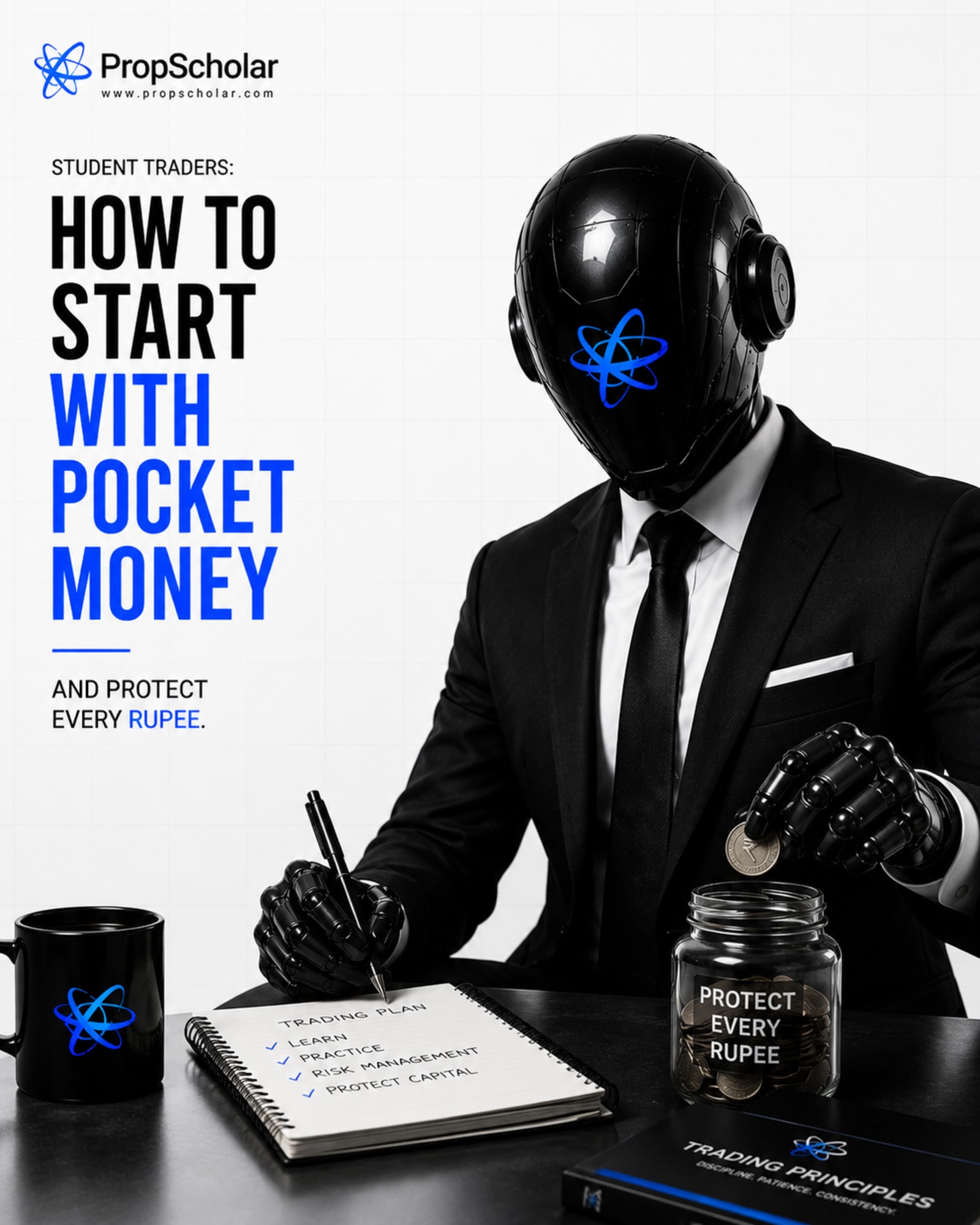
Student Traders: How to Start With Pocket Money and Protect Every Rupee
You have a small budget, a phone, and a genuine desire to learn trading. This guide shows you exactly how to stretch every rupee, avoid the mistakes that wipe beginners out, and use a scholarship-based evaluation platform like PropScholar to turn disciplined practice into real payouts — starting from as little as Rs.400.
You have a small budget, a phone, and a genuine desire to learn trading. This guide shows you exactly how to stretch every rupee, avoid the mistakes that wipe beginners out, and use a scholarship-based evaluation platform like PropScholar to turn disciplined practice into real payouts — starting from as little as Rs.400.
Start your evaluationStudent Traders: How to Start With Pocket Money and Protect Every Rupee
TL;DR: Starting with pocket money is genuinely possible — but protecting it requires a specific plan, not enthusiasm alone. With the right risk rules and a platform like PropScholar that starts from Rs.400, you can build real trading skill without burning money you can't afford to lose.
Key takeaways:
- Never risk more than 1% of your evaluation balance on a single trade — this one rule changes everything.
- The biggest danger for student traders isn't a bad market. It's overtrading after a loss.
- PropScholar's scholarship-based evaluation starts at Rs.400 (roughly $5), making it accessible without a credit card or international payment.
- Passing the evaluation earns you a scholarship of up to 400%, paid within 4 hours of verification.
- Right now, you can play PropScholar's free FIFA Penalty Game at app.propscholar.com/fifa and get up to 25% off your entry fee or 15% extra payout.
You're a student. Your budget is what's left after rent, food, and data recharge. Maybe it's Rs.500, maybe it's Rs.2,000. Whatever the number, every rupee in that amount represents something real — time spent, priorities made. And you're thinking about putting some of it into trading.
That instinct isn't wrong. Learning to trade young gives you something no MBA does: actual market experience. But the version of trading most beginners stumble into — copying signals in a WhatsApp group, depositing Rs.5,000 into a broker because an Instagram reel said to, and losing it in a week — that version doesn't build anything. It just erodes your pocket money and your confidence at the same time.
This guide is about a different approach. One where protecting your capital is the primary skill you're building, and where the evaluation structure you trade in actually forces you to develop discipline rather than just gamble it away.
Why Pocket Money Traders Lose Fast (And It's Not What You Think)
Most beginners blame the market when they lose. The honest answer is almost always that the market did exactly what markets do — move unpredictably — and the trader had no plan for that.
The pattern is almost identical every time. You start strong, hit a couple of winning trades, feel confident, increase your position size. Then one trade goes wrong. Instead of stepping back, you enter again immediately to "recover" the loss. That second trade is placed angry, without a plan, usually too large. It loses too. Now you're down significantly and emotionally off balance. By the end of the week, the account is gone.
This isn't a character flaw. It's a predictable psychological response to financial loss, and it hits hardest when the money feels personal — which pocket money always does.
The fix isn't discipline willpower. It's structure. You need rules that don't bend under pressure, and ideally a trading environment that enforces them.
The One Risk Rule Every Student Trader Needs Before Anything Else
The 1% rule is simple: never risk more than 1% of your account balance on a single trade. If you're trading a Rs.10,000 evaluation balance, your maximum loss on any single trade is Rs.100.
That sounds too conservative until you do the math. With a 1% rule, you can lose 20 trades in a row and still have 82% of your account left. Twenty straight losses, and you're still in the game. Try that with 10% risk per trade and 10 consecutive losses wipe you out completely.
For student traders, this rule does something even more important than protect capital: it removes the emotional catastrophe of any single bad trade. If Rs.100 is the worst a trade can do to you, you stop treating each trade like a life-or-death moment. You start thinking clearly. That clarity is where real learning actually happens.
The 1% rule works for any account size. Rs.400. Rs.4,000. Rs.40,000. The percentage stays fixed; the absolute amount scales. So start applying it from day one.
Position Sizing: The Math That Keeps You Alive
The 1% rule only works if you know how to size your position to actually limit the loss to that amount. This is where many beginners skip the homework.
Here's the basic formula:
Position size = (Account balance x Risk %) / Stop loss in pips (or points)
Say your evaluation balance is Rs.10,000. You're willing to risk 1%, which is Rs.100. Your stop loss is set at 20 pips. That means your position size should put you at risk of losing exactly Rs.100 if the trade moves 20 pips against you — nothing more.
Broker platforms calculate this automatically once you understand the inputs. The important part is that you calculate it before you enter the trade, not after. Entering first and thinking about risk later is exactly how you end up overexposed without realising it.
Keep a small note on your phone with your current 1% amount. Update it after every session. Make the calculation a non-negotiable step before every entry.
Stop Losses Aren't Optional
Every trade you take needs a stop loss set at the moment you enter. Not "I'll watch it and close manually if it goes wrong." An actual, placed stop loss order.
The reason is straightforward: when a trade moves against you, your brain does not want to accept the loss. It will generate reasons to wait just a little longer. "It'll probably reverse." "The news is due in 20 minutes." Before you know it, a Rs.100 planned loss has become Rs.600 because you moved the stop or never placed one.
For student traders specifically, there's another layer: you're often trading while in class, on public transport, or distracted. You cannot babysit a trade through a lecture. A hard stop loss means that even if your phone dies, the trade has a defined maximum damage amount.
One thing we've noticed across the PropScholar community — and this comes up regularly in our Discord server where 3,000+ traders share experiences — is that traders who fail evaluations almost always report the same two things: they skipped stop losses, or they moved them. Traders who pass tend to treat stop losses as completely non-negotiable.
How Many Trades a Day Is Too Many?
For a student trading on pocket money: two to three trades per day is a reasonable ceiling when you're starting out. That's not a hard rule from a textbook, it's a practical observation.
More trades doesn't mean more learning. It often means less thought per trade and more emotional noise. Each trade should come with a reason — a specific setup you've identified, a level you've been watching, a signal from your strategy. If you can't state the reason in one sentence, don't take the trade.
Overtrading is almost always a symptom of something emotional — boredom, the urge to recover a loss, the buzz of having something open. None of those are trading reasons. If you catch yourself trading for those reasons, close the platform and go do something else. The market will still be there tomorrow.
A practical limit: if you hit your 1% loss twice in one day (so 2% drawdown on the day), stop trading for the rest of that session. Hard stop. Walk away. This isn't weakness — it's the same discipline that professional traders build over years. You're building it now.
Why a Trading Journal Is Worth More Than Any Indicator
A journal doesn't need to be fancy. A notes app on your phone works fine. After every trade, write down:
- What was the setup? Why did you enter?
- Where was your stop loss and why there?
- What happened? Did price do what you expected?
- What would you do differently?
After 30 trades, you'll start seeing your own patterns. Maybe you're consistently good in the morning session and consistently bad when you trade after 8pm. Maybe your losses cluster around news events you didn't check. Maybe you're profitable on one pair and consistently lose on another.
No trading course teaches you your own patterns. Only your own data does. The journal is how you collect that data. Most serious traders we've seen develop faster with a simple journal than without one — the feedback loop is just faster.
Demo Trading: Useful for Learning, Not for Building Real Skills
Demo accounts have their place. They let you learn how to place orders, understand the platform, and experiment with a strategy without financial consequence. For complete beginners, a few weeks on demo is genuinely useful orientation.
But here's the honest truth: demo trading does not teach you how to handle the emotional reality of money at risk. You will make decisions on a demo account that you would never make with real money on the line — and you'll also avoid lessons you can only learn when consequences are real.
There's a middle ground that works well for students: trade demo to learn the mechanics, then move to a structured evaluation with a very small real entry fee as soon as you're ready. A real entry fee — even Rs.400 — creates just enough psychological skin in the game to make your practice meaningful, without exposing you to losses you can't absorb.
What a Scholarship-Based Evaluation Does That Demo Trading Can't
A scholarship-based evaluation platform like PropScholar gives you something demo trading never can: a structured framework with defined rules, real consequences for breaking them, and a genuine financial reward for succeeding.
Here's how PropScholar's model works. You pay a small entry fee — starting from Rs.400 — to access a trading evaluation. The evaluation has specific rules: drawdown limits, profit targets, and consistency requirements. If you pass, you claim a scholarship payout of up to 400%, verified and paid out within 4 hours.
The entry fee is the only money you risk. There's no live account, no institutional capital involved. PropScholar is a scholarship-based evaluation platform, not a prop firm. The scholarship is awarded based on proven performance in the evaluation.
What the structure gives you that demo doesn't: real rules you have to follow, a real cost to breaking them, and a real reward for discipline. The evaluation essentially pays you to develop the habits this article is describing — controlled risk, consistent execution, no revenge trading.
How to Actually Protect Every Rupee in Your Entry Fee
When your entry fee is Rs.400 to Rs.1,000, every trade in the evaluation genuinely matters. Here's how to approach the evaluation with the mindset that protects your entry investment.
Treat Day One Like Day Ten
The most common mistake in evaluations is entering aggressively early because "there's still plenty of buffer." Slow, steady, consistent. Aim for small daily gains — 0.5% to 1% — rather than trying to hit the target in three sessions. Evaluations are won or lost on consistency, not heroics.
Know Your Drawdown Limits Before You Place a Single Trade
Read the evaluation rules fully before opening the platform. Know your maximum daily drawdown and your maximum total drawdown. Those aren't just numbers — they're the boundaries of your entire attempt. If you don't know them cold, you'll accidentally breach them. PropScholar publishes all rules publicly and has never changed them retroactively. That's the kind of clarity you need before you trust any platform with your money.
Don't Trade Pairs You Don't Understand
Stick to one or two instruments you've studied. A student trying to trade five different currency pairs simultaneously during an evaluation is spreading their attention so thin that they're essentially guessing. Pick one pair, know its behavior, trade it well.
The Psychological Side: What Happens When You're Down
Let's be direct about this. You will have losing days. Every trader does. The question isn't whether you'll face drawdown — it's whether you have a predetermined plan for what you do when it happens.
Write this plan before you start:
- If I lose 1% today, I will take a 30-minute break before the next trade.
- If I lose 2% today, I stop trading for the rest of the session.
- If I lose 3% in the week, I review my journal before taking another trade.
This is what separates traders who last from traders who burn through evaluation after evaluation blaming the market.
PropScholar for Student Traders: The Honest Picture
PropScholar is worth mentioning specifically here because it was built with exactly this audience in mind: traders who don't have thousands to spend but want a real, structured way to prove and develop their skill.
The entry fee starts from Rs.400 (about $5), which puts it in range for most student budgets without being trivial. UPI payments work directly via PhonePe, Razorpay, and Cashfree for Indian students. Global traders can pay with crypto. There are no hidden charges after you pay.
The scholarship of up to 400% is paid within 4 hours of verification. PropScholar has been operating for over 1.5 years, is registered as a Private Limited company in India under the MCA, has more than 3,000 traders in its Discord community, and has never changed its evaluation rules after they were published. These aren't small things — they're exactly the facts you'd want verified before trusting any platform.
If you're currently watching the FIFA World Cup 2026, there's also a free penalty game at app.propscholar.com/fifa. Score one goal in five kicks and you'll get a mystery discount code — anywhere from 22% to 25% off your evaluation entry fee, or up to 15% extra on your scholarship payout. You can retry every 4 hours. For a student on a tight budget, shaving 25% off Rs.400 is genuinely useful.
You can also browse the PropScholar shop to see all available evaluations, or join the PropScholar Discord to see real payout screenshots and ask questions directly from traders who've already passed.
Building a Routine That Actually Sticks
Trading requires consistency, and consistency requires a routine you can realistically maintain around lectures, assignments, and a social life.
A practical student trading routine:
Before the session (10 minutes): Check economic calendar for major news events. Note key support and resistance levels on your chosen pair. Write down your trade criteria for today — what setup you're looking for, nothing else.
During the session (30-60 minutes max): Execute only if your setup appears. Don't force trades. Keep your maximum at two to three positions.
After the session (5 minutes): Journal every trade taken. Note one thing you did well and one thing to improve.
Five days a week, that's under 90 minutes total. Most students can fit that between classes. What you can't sustain is sitting staring at charts for four hours while half-focused on a lecture — that's where bad, impulsive trades happen.
The traders who improve fastest aren't the ones who spend the most time watching markets. They're the ones who use their time deliberately.
Questions to Ask Before You Put Any Rupee Into Any Platform
Before you pay for any evaluation or trading platform, verify these things:
Are the rules public and fixed? If a platform's rules aren't clearly published, or if you've heard they change retroactively, that's a serious warning sign. Your evaluation conditions should be set in stone the moment you pay.
Is the payout process transparent? How long does it take? What's required for verification? Are there payout screenshots from real traders available to check?
Is the company identifiable? A registration number, a real physical address, a named contact. Anonymous platforms that don't disclose their legal structure should be avoided regardless of how attractive their marketing looks.
What does the community say? Not the testimonials on the homepage — those are always positive. Look at independent communities, Discord servers, Reddit threads. Real trader experiences surface quickly in those places.
PropScholar passes all four of these checks, which is why it's the platform we recommend to student traders with limited budgets. But apply these questions to any platform you consider — including this one.
Frequently Asked Questions
How do student traders start trading with pocket money?
Start by picking one trading pair, learning its basic behavior on a demo platform for two to three weeks, and then entering a low-cost evaluation like PropScholar's which starts at Rs.400. Apply the 1% risk rule from your first trade, keep a journal, and set stop losses on every position. The goal at the start isn't profit — it's building habits that will serve you when you're trading larger amounts.What is the minimum amount needed to start trading as a student in India?
With PropScholar's scholarship-based evaluation platform, you can start with as little as Rs.400. That covers your full evaluation entry fee, paid via UPI through PhonePe, Razorpay, or Cashfree. There are no additional charges after that single payment.How do I protect my trading capital as a beginner?
The most effective protection is the 1% risk rule: never risk more than 1% of your account on a single trade. Combined with hard stop losses on every position and a daily loss limit (stop trading after losing 2% in a session), this structure prevents the kind of runaway losses that destroy beginner accounts.Is PropScholar legitimate for student traders?
Yes. PropScholar is a Private Limited company registered in India under the MCA, has operated for over 1.5 years, publishes all evaluation rules publicly and has never changed them retroactively, and has paid out scholarships within 4 hours of verification. Over 3,000 traders are active in its Discord community where payout proof is regularly shared.What happens if I fail an evaluation?
You lose the entry fee — that's the full extent of your financial exposure. PropScholar and similar platforms don't charge you beyond the initial entry fee. Failing an evaluation is a learning experience, not a financial catastrophe, especially when the entry fee is as low as Rs.400.How much can a student realistically earn from a trading evaluation?
PropScholar offers scholarships of up to 400% of the entry fee upon successful evaluation. On a Rs.1,000 entry, that's up to Rs.4,000 paid within 4 hours of verification. The amount scales with the evaluation tier you choose.What is the 1% risk rule in trading?
The 1% rule means you risk no more than 1% of your current account balance on any single trade. On a Rs.10,000 evaluation balance, that's a maximum Rs.100 risk per trade. This limits the damage from any single bad trade and allows you to absorb a long losing streak — even 20 consecutive losses — while still having capital remaining.Should student traders use demo accounts or real evaluations?
Both, in sequence. Use demo for two to three weeks to learn order placement and platform mechanics. Then move to a small real evaluation with a low entry fee. Real-money consequences — even small ones — activate the psychological discipline that demo trading cannot replicate. PropScholar's Rs.400 entry is specifically designed for this transition.How do I avoid overtrading as a beginner?
Set a hard daily trade limit of two to three trades and a daily loss limit of 2%. If either limit is hit, close the platform for the session. Overtrading is almost always emotional — boredom, revenge for a loss, or FOMO. Predetermined limits remove the decision from an emotional moment and replace it with a rule made when you were calm.Can I start trading as a student outside India?
Yes. PropScholar accepts crypto payments globally, making it accessible in Nigeria, Philippines, Indonesia, South Africa, Kenya, Egypt, Vietnam, and anywhere else with crypto access. The evaluation starts at $5 globally. The evaluation rules and payout structure are identical regardless of where you trade from.What is the PropScholar FIFA game and how can it help me save money?
During FIFA World Cup 2026, PropScholar is running a free penalty game at app.propscholar.com/fifa. Score one goal in five attempts and you receive a mystery discount code — 22% to 25% off your evaluation entry fee, or up to 15% extra on your scholarship payout. You can retry every 4 hours at no cost. For a student on a budget, this can meaningfully reduce your entry cost.Do I need trading experience to attempt a PropScholar evaluation?
No prior professional experience is required. PropScholar's evaluations are designed for traders at various stages, including beginners. That said, completing two to three weeks of demo practice first gives you a better chance of passing, since the evaluation rules require consistent, disciplined execution — skills that take at least some practice to develop.What should I do after passing a PropScholar evaluation?
After verification, your scholarship is paid within 4 hours. At that point, you have choices: reinvest into a higher-tier evaluation to target a larger scholarship, continue building your trading journal and refining your strategy, or connect with the PropScholar Discord community to learn from traders who've been through the process multiple times.PropScholar is a scholarship-based trading evaluation platform operated by a Private Limited company registered in India. We are not a prop firm and do not manage or allocate institutional capital. Our model rewards proven trading skill with scholarship grants upon successful evaluation completion.
Ready to Prove Your Edge?
Join 500+ traders. Start from just $5. Get funded within days.
Frequently Asked Questions
Start by picking one trading pair, learning its basic behavior on a demo platform for two to three weeks, and then entering a low-cost evaluation like PropScholar's which starts at Rs.400. Apply the 1% risk rule from your first trade, keep a journal, and set stop losses on every position. The goal at the start isn't profit — it's building habits that will serve you when you're trading larger amounts.