Pay-After-Pass Funded Trading: Does It Actually Exist?
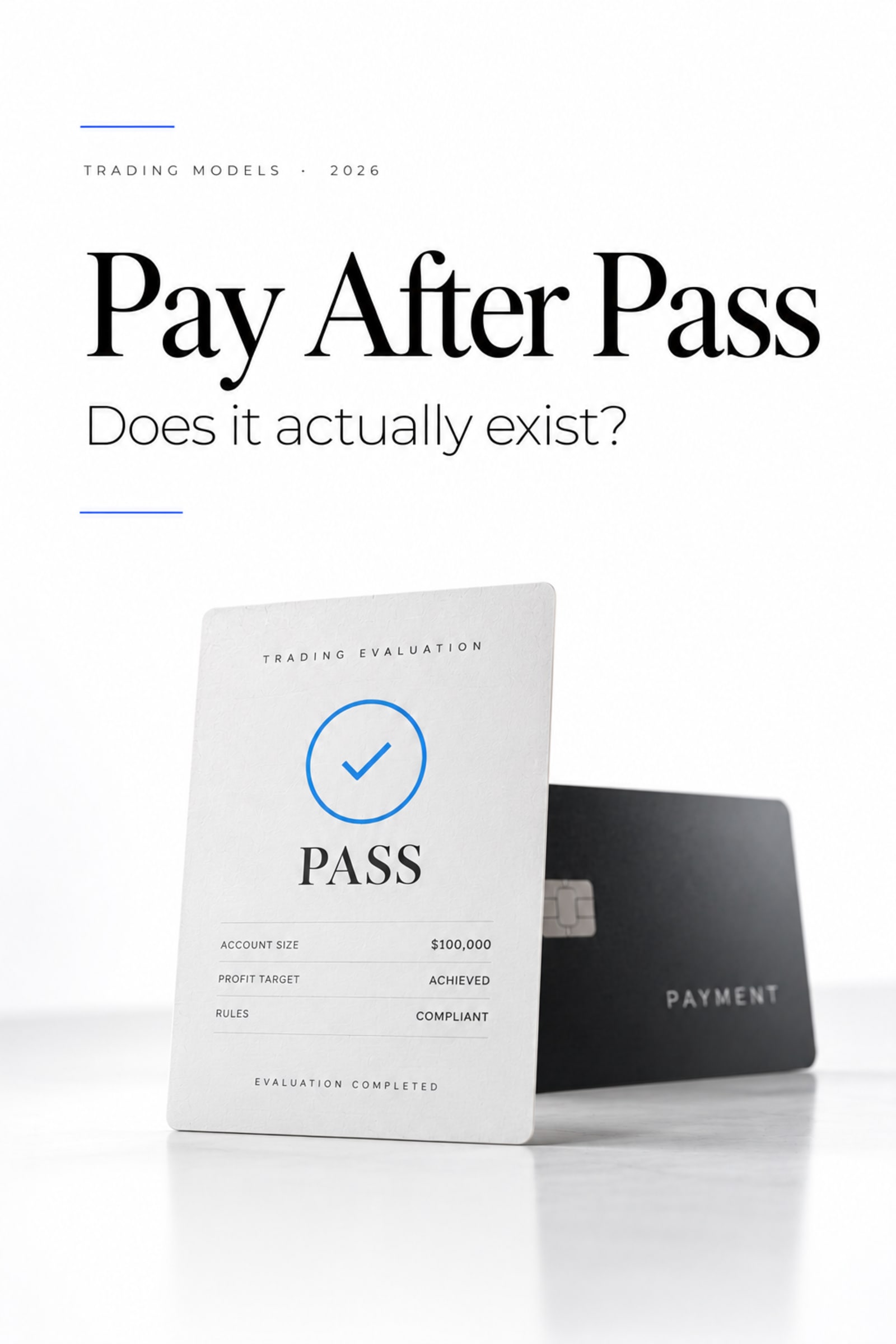
You've seen the ads: 'Pass first, pay after.' It sounds like the perfect deal — no money down, get funded, then pay from your profits. But does pay-after-pass funded trading actually work that way, or is it a marketing angle designed to get you clicking? This article breaks down exactly how these models work, where the catch usually hides, and what honest alternatives actually look like for trader
You've seen the ads: 'Pass first, pay after.' It sounds like the perfect deal — no money down, get funded, then pay from your profits. But does pay-after-pass funded trading actually work that way, or is it a marketing angle designed to get you clicking? This article breaks down exactly how these models work, where the catch usually hides, and what honest alternatives actually look like for trader
Start your evaluationPay-After-Pass Funded Trading: Does It Actually Exist?
TL;DR: Pay-after-pass funded trading sounds ideal, but the model almost always comes with strings — deferred fees, higher splits, or hidden conditions. Genuinely low-barrier options do exist, and the best ones are more honest about what you're actually paying.
Key takeaways:
- Most "pay after pass" offers defer costs rather than eliminate them — you pay eventually, just differently.
- The cheapest honest path is a low entry-fee evaluation with clear, publicly posted rules.
- PropScholar offers evaluations starting at $5 (around Rs.400), with scholarships of up to 400% paid within 4 hours of verification.
- Crypto payments make PropScholar accessible globally — India, Nigeria, the Philippines, Indonesia, South Africa, and beyond.
- Understanding the evaluation model before you pay anything is the single most important step.
You saw the ad. "Pay nothing upfront. Pass the evaluation. Pay from your profits." It sounds genuinely fair — no money at risk until you've already proven you can trade. So you click, you read the page, and somewhere between the hero banner and the FAQ, things start to feel a little slippery.
That feeling is worth paying attention to.
Pay-after-pass is one of the most searched questions in funded trading right now, and that's not an accident. It's a response to a real problem: evaluation fees are genuinely expensive, especially if you're in an emerging market where $100 or $200 is a significant sum. Platforms have noticed what traders want to hear, and some of them have built their marketing around it.
This article doesn't exist to bash any platform by name. It exists to show you exactly how these models work mechanically — where the money actually flows, what "pay after pass" usually means in practice, and what a genuinely low-barrier path to funded trading actually looks like.
What "Pay-After-Pass" Actually Means in Practice
In the purest theoretical sense, pay-after-pass would mean: you attempt the evaluation for free, you pass, and only then does the platform take a fee — either from your first payout or as a setup cost. No money leaves your pocket until you've already succeeded.
That's a legitimate model, and some platforms have experimented with versions of it. But here's what you usually find when you read the terms carefully.
The fee doesn't disappear — it gets restructured. Instead of a one-time entry fee, you might face a higher monthly subscription during the evaluation. Or the profit split in your funded account drops significantly, so the platform recoups its cost over time. Or there's a mandatory "activation fee" once you pass, which is essentially the same as an entry fee, just renamed and delayed.
Some platforms do charge nothing until you pass, genuinely. But the funded account conditions — the drawdown limits, the profit targets, the maximum position sizes — tend to be tighter, because the platform is taking on more risk by letting you trade for free first. That's a fair trade-off, and some traders are fine with it. The problem is when those conditions aren't clearly disclosed upfront.
The other thing worth knowing: when a platform doesn't charge upfront, it needs to make money somewhere. That somewhere is almost always a larger slice of your earnings, a subscription, or fees buried in the withdrawal process. None of that is automatically wrong — but you need to know where it is before you sign up.
Why This Marketing Angle Became So Popular
The funded trading space grew fast over the past few years, and with that growth came a lot of competition for the same pool of aspiring traders. Platforms started differentiating on price, on rules, on payout speed — and eventually, on the emotional hook of "you don't pay unless you win."
For traders in countries where $150 for a prop firm challenge represents a week's wages, this is a powerful message. It speaks directly to the anxiety around evaluation fees: what if I pay and fail? What if I blow the account on day three?
That anxiety is completely valid. Paying to attempt an evaluation does carry risk, and many traders have burned through two or three entry fees before figuring out their process. The marketing around pay-after-pass knows this, and it positions itself as the answer.
But notice what the ad never shows you: the actual funded account terms, the profit split percentage, the withdrawal conditions, or how many traders who attempt the free evaluation end up actually receiving any money. Those details matter more than the upfront fee structure.
The Hidden Cost Structures to Watch For
If you're evaluating any platform that claims pay-after-pass, these are the specific things you need to find — in writing, in the actual terms, not on the marketing page.
Monthly Subscription Fees During the Evaluation
Some platforms charge no entry fee but bill you every month while you're attempting the challenge. If the evaluation has a 30-day window and you don't pass in time, you get charged again for an extension. Do the math: a $30/month subscription on a 60-day evaluation equals $60 — more than many standard one-time entry fees.
Reduced Profit Split After Passing
The platform absorbed your evaluation cost, so it takes a larger share of your funded profits. Instead of an 80% split, you might see 50% or 60%. Over time, that difference compounds significantly. A platform with a $50 entry fee and an 80% split could easily leave you better off than one with a "free" evaluation and a 55% split.
Activation or Setup Fees Post-Pass
This is the most straightforward sleight of hand. You pass the evaluation for free, then you're told there's a one-time "account activation" or "administration fee" required before you can access your funded account. It's the entry fee, just positioned differently.
Withdrawal Conditions That Favour the Platform
Free evaluations sometimes come attached to funded accounts with minimum withdrawal thresholds, mandatory reinvestment periods, or fees on each withdrawal. Read this section of any terms document more carefully than any other.
What Honest, Low-Barrier Evaluation Models Look Like
The most straightforward honest version of accessible funded trading isn't pay-after-pass — it's pay-a-small-amount-upfront with completely transparent rules.
Here's why that's actually better for most traders. When a platform charges a small, clear entry fee, its incentives are aligned with yours. It wants you to pass, because a trader who passes and gets funded is a success story that attracts more traders. A platform running on a free-evaluation model where most attempts fail and monthly subscriptions keep rolling is incentivised differently.
Transparency of rules matters enormously here. If the rules — profit targets, daily loss limits, maximum drawdown, payout conditions — are publicly posted, have never been changed retroactively, and are written in plain language, that's a meaningful signal about how the platform operates.
The other signal is payout speed and proof. A platform that publishes real payout confirmations (not just screenshots anyone could fake, but verifiable transaction records discussed openly in a community) gives you something to check before you commit any money.
How PropScholar Approaches This Differently
PropScholar is a scholarship-based trading evaluation platform, not a prop firm. The distinction matters: we're not allocating institutional capital or managing a fund. We run evaluations, and traders who pass receive a scholarship grant — up to 400% of their entry fee — paid within 4 hours of verification.
The entry fee starts at $5, which is roughly Rs.400 in India, or the equivalent in local currency in Nigeria, the Philippines, Indonesia, South Africa, or wherever you're reading this. That's not a subscription. It's a one-time entry cost for a single evaluation attempt, and the rules governing that attempt are public and haven't been changed retroactively since the platform launched.
We're not going to tell you that $5 is zero. It isn't. But we'll also tell you what it means: there's no hidden activation fee, no monthly billing, no reduced split buried in the footnotes. The entry fee is the cost of attempting the evaluation. If you pass, the scholarship is paid. That's the model, stated plainly.
For traders outside India, PropScholar accepts crypto globally, which means there's no barrier around bank transfers, international payment rails, or unsupported currencies. You send crypto, you get access to the evaluation. If you pass and want the scholarship paid, that verification process takes under 4 hours.
We've also built a Discord community of 3,000+ traders where payout screenshots get discussed openly — which means if you're doing due diligence before you commit $5, you can go look at real conversations and real transaction confirmations before you spend anything.
What to Actually Compare When Evaluating Any Platform
Stop comparing entry fees in isolation. That number tells you almost nothing on its own. Here's the comparison that actually matters.
Total Cost to First Payout
Add up everything: entry fee, subscription fees, activation fees, withdrawal fees, and the implied cost of a reduced profit split. That total is your real cost of participation.
Rule Transparency and Consistency
Are the rules posted publicly? Have they ever been changed after traders signed up? Can you find a history of the rules anywhere? A platform that changes its terms retroactively — even once — should be disqualifying.
Our Standard vs Plus evaluation structure, for example, differs specifically on the consistency rule and trailing drawdown — and both sets of rules are posted where any trader can read them before paying anything. If you want to understand what removing the consistency rule actually means for your trading style, that breakdown exists: Standard vs Plus: Removing the Consistency Rule and Trailing Drawdown.
Payout Speed and Verifiability
How long does a payout actually take? Can you verify that claim in a community before you commit? "Fast payouts" as a marketing claim means nothing. "Paid within 4 hours of verification, with transaction records visible in a 3,000-member Discord" means something.
Support Quality
This one gets overlooked. If something goes wrong — a trade didn't close correctly, you have a question about a rule interpretation, you need to understand why a position violated a limit — can you reach someone who actually knows the platform? PropScholar runs 24/7 support in Hindi and multiple languages, which matters practically for traders in India and across South and Southeast Asia.
The Honest Answer to the Original Question
Pay-after-pass funded trading does exist in some form. But in most real implementations, you're not avoiding cost — you're deferring it, restructuring it, or accepting worse terms in exchange for not paying upfront.
For traders who genuinely cannot afford $50 to $200 for an evaluation fee, the pay-after-pass framing might seem like the only path. But a platform with a $5 entry, fully transparent rules, verifiable payouts, and no hidden fees is actually more accessible — and more honest — than most free-evaluation models with monthly subscriptions and reduced splits.
Don't get captured by the headline. Read the terms. Do the math on total cost. Check the community. Look at actual payout records, not marketing copy.
If you want to start with the smallest honest entry point available right now, PropScholar's evaluations begin at $5 — globally, via crypto, with no subscription and no activation fee.
Questions Traders Ask About Pay-After-Pass Models
PropScholar is a scholarship-based trading evaluation platform operated by a Private Limited company registered in India. We are not a prop firm and do not manage or allocate institutional capital. Our model rewards proven trading skill with scholarship grants upon successful evaluation completion.
Related reading
- 1K1Step Explained: PropScholar's $1 One-Step Evaluation from Purchase to Payout
- $5 Prop Firm Challenge: What the Cheapest Legit Evaluation Really Gets You
- The Honest Alternative to No-Evaluation Instant Funding Offers
- Demo Trading vs Funded Evaluation: Which Actually Builds a Trading Career
- 1-Step vs 2-Step Evaluation: Which Is Right for a Beginner?
- Scholar Trading Explained: How It Works Step by Step
Ready to Prove Your Edge?
Join 500+ traders. Start from just $5. Get funded within days.
Frequently Asked Questions
Pay-after-pass trading does exist in some forms, but it almost always restructures costs rather than eliminating them. You might face monthly subscriptions during the evaluation, a lower profit split after passing, or an activation fee once you succeed. Always calculate the total cost to your first payout, not just the upfront entry fee, before choosing any platform.