Can a Nigerian Student With Zero Job Income Pass a Funded Trading Evaluation? USDT Method Explained
No salary, no card, no Western Union. Nigerian students can still enter a funded trading evaluation for as little as $10 worth of USDT — bought on a P2P exchange with naira — and claim a scholarship payout within 4 hours of passing. Here's the exact path, the real rules, and what actually stops most students before they even start.
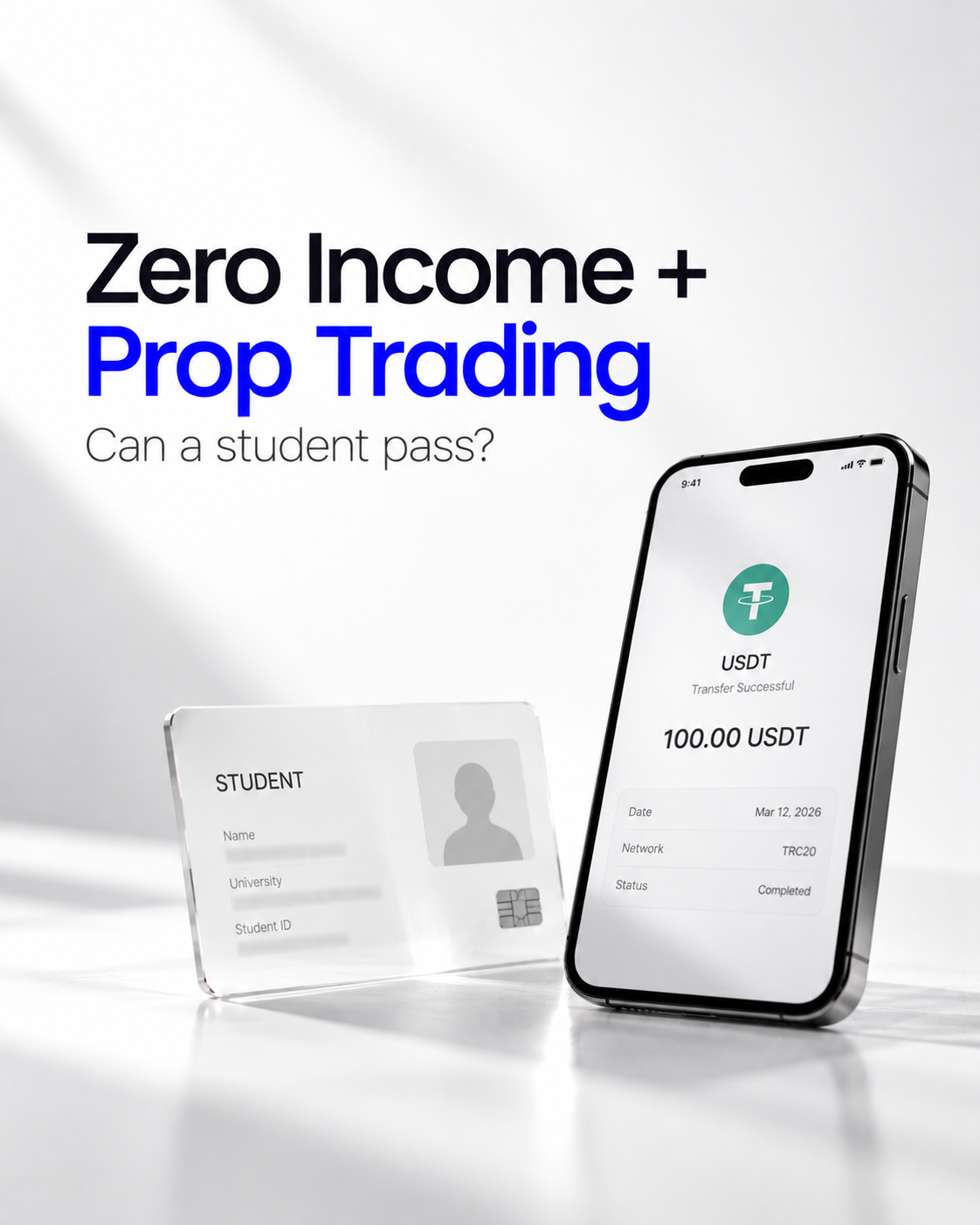
No salary, no card, no Western Union. Nigerian students can still enter a funded trading evaluation for as little as $10 worth of USDT — bought on a P2P exchange with naira — and claim a scholarship payout within 4 hours of passing. Here's the exact path, the real rules, and what actually stops most students before they even start.
Start your evaluationCan a Nigerian Student With Zero Job Income Pass a Funded Trading Evaluation? USDT Method Explained
TL;DR: Yes — a Nigerian student with no salary can enter PropScholar's Freedom Account evaluation for $10 worth of USDT, bought on a P2P exchange using naira, pass a one-step 10% profit target, and claim a scholarship payout within 4 hours. No bank card, no dollar account, no Western Union needed.
Key takeaways:
- Entry starts at $10 (for the $10,000 Freedom Account) — payable in USDT bought peer-to-peer with naira
- One step, 10% profit target, no time limit, no minimum trading days
- Maximum loss is 6% of starting account size; daily loss is 3%
- Lot limits are real and must be respected — 4.00 forex, 0.40 gold on the $10K size
- A pass earns a $42 scholarship, paid within 4 hours of request
- News trading is not allowed; copy trading between PropScholar accounts is not allowed
Most funded trading platforms were not built with you in mind. They were built for traders in the US or Europe who already have a credit card, a dollar bank account, and a few hundred dollars sitting idle. If you're a student in Lagos, Ibadan, or Port Harcourt — earning nothing yet, studying for a degree, maybe running small data resale on the side — the entry path to those platforms is genuinely broken.
The dollar card gets declined. The wire transfer requires a domiciliary account most students don't have. And even if you sort the payment, the entry fee alone can be tens or hundreds of dollars for platforms that only care about high-ticket sign-ups.
PropScholar is built differently. It's a scholarship-based trading evaluation platform, not a prop firm. The model is straightforward: pay a small entry fee, prove you can trade within a defined ruleset, and claim a scholarship grant when you pass. The $10,000 Freedom Account costs $10 to enter. That $10 can be paid in USDT — and you can get that USDT tonight using naira on a P2P exchange. That's the real story here.
What Is USDT and Why Does It Solve the Nigeria Payment Problem?
USDT (Tether) is a stablecoin — a cryptocurrency pegged to the US dollar. One USDT equals roughly one USD, so it doesn't swing around the way Bitcoin does. Nigerian traders use it constantly because it lets you hold dollar value without a dollar bank account.
The path to buying it is straightforward. On a P2P (peer-to-peer) crypto exchange — Binance P2P and Bybit P2P are the most widely used in Nigeria — you browse local sellers who are willing to accept naira bank transfers. You send naira from your Kuda, GTBank, First Bank, or any naira account directly to that seller's account. They release the USDT to your exchange wallet. The whole thing typically takes under 30 minutes if you follow the platform's verification steps correctly.
Once you have USDT in your exchange wallet, you send it to PropScholar to fund your evaluation entry. That's the complete payment chain. No dollar card. No domiciliary account. No travel to a bureau de change.
Now, the one thing you should know: P2P rates include a small spread, meaning you'll pay slightly more than the official exchange rate. Factor that in. At current rates, $10 worth of USDT costs you roughly the equivalent at the prevailing naira/USD P2P rate — shop around across two or three sellers before you confirm the transaction.
The Freedom Account: What the Rules Actually Say
Let's be precise, because vague descriptions get students into trouble.
The Freedom Account is a one-step evaluation. You need to hit a 10% profit target on your account balance. There is no time limit — trade at whatever pace suits your schedule. There are no minimum trading days, so you don't need to force trades just to clock sessions.
The loss rules are the ones you need to internalize before you place a single trade:
Maximum loss (drawdown): 6% of your initial account size. On a $10,000 account, that's $600 total. If your account ever falls $600 below the starting balance, the evaluation ends. This is not a soft limit — it's hard.
Daily loss: 3% of the higher of your starting equity or current balance. On the $10,000 account, if your balance hasn't grown, the daily loss limit is $300. As your balance grows, the daily limit scales up with it. Blow $300 in one trading day and the account is closed for that session — or terminated, depending on how the breach occurred.
Those two rules together mean you have genuine room to trade, but you cannot be reckless. A student with limited screen time actually has an advantage here: fewer trades typically means fewer emotional mistakes.
Lot Limits on the $10,000 Freedom Account: The Real Restriction
This is the one place where I want to be completely direct with you, because some evaluation platforms bury their position size rules in fine print and students only discover them mid-trade.
On the $10,000 Freedom Account, the maximum open lots per asset class are:
- Forex pairs: 4.00 lots
- Gold (XAUUSD): 0.40 lots
- Silver: 1.00 lot
- BTCUSD: 0.20 lots
- ETHUSD: 1.00 lot
- NAS100: 0.50 lots
- US30 (Dow): 0.30 lots
- US500: 0.75 lots
For a beginner student, these limits are actually a feature. They stop you from going all-in on a gut-feel trade at 3am. If you've been reading about how lot limits protect traders from emotional decisions during evaluations, you already know why this matters. The rule forces position sizing discipline that most traders don't develop until they've blown several accounts.
What You Cannot Do on the Freedom Account
Two restrictions that catch traders off guard:
No news trading. During high-impact economic events — US Non-Farm Payrolls, FOMC announcements, Nigerian CBN rate decisions — you cannot hold or open trades. The spread spikes and the platform does not allow evaluation trades during these windows. Check an economic calendar before every session.
No copy trading between PropScholar accounts. You can use external signals for your own analysis, but you cannot mirror another PropScholar account directly. Each evaluation is assessed as an independent demonstration of your skill.
The inactivity rule is also worth knowing: if you don't trade for 14 consecutive days, the account is closed. With no time limit and no minimum days, the only way to lose your evaluation through inactivity is to genuinely walk away for two full weeks.
What Happens When You Pass?
Pass the $10,000 Freedom Account — hit the 10% target while staying within all loss and lot rules — and you earn a $42 scholarship grant. PropScholar processes payouts within 4 hours of your request. Every completed payout is publicly listed at propscholar.com/payout-proof, so you can verify real payouts from real traders before you spend a single naira.
The fastest recorded pass in PropScholar's evaluation history is 2 hours. That's not a promise of what you'll do — it's evidence that the evaluation is genuinely passable with a clear, disciplined strategy. Most students will take longer, and that's fine. There's no time limit.
One practical note: you can only hold one Freedom Account at a time. This is enforced server-side — you can't buy two and run them in parallel. It's one shot, so it's worth thinking through your approach before you start.
Why the $10 Entry Actually Changes the Calculus for Students
Consider what the alternative looks like. Most funded evaluation platforms in the market price their smallest accounts at $50, $75, or $100 — with retry fees at the same level every time you fail. If you fail three times before passing, you've spent $150-$300 to earn nothing yet.
At $10 per attempt, the maths are different. For a student who might need two or three attempts to develop their evaluation discipline, the total cost of getting there is still within reach of part-time income, pocket money, or a small amount sold from airtime resale. The real cost math on low-cost evaluations shows how quickly retry fees on higher-priced platforms destroy a beginner's budget.
This is why PropScholar specifically built the Freedom Account for emerging-market traders: the entry barrier was the first wall to knock down.
A Step-by-Step Path for a Nigerian Student Starting Today
Here's the actual sequence, without fluff:
Step 1: Create an account on a P2P exchange. Binance and Bybit both operate in Nigeria and support naira deposits. Complete identity verification — this is required and typically takes a few hours.
Step 2: Browse P2P listings for USDT sellers accepting naira bank transfer. Compare rates across at least three sellers. Initiate a buy for roughly ₦9,000-₦12,000 worth of USDT (the exact naira amount depends on the day's P2P rate — check at time of purchase). You need a little over $10 to cover the entry fee plus any small network fees on transfer.
Step 3: Once USDT is in your exchange wallet, head to propscholar.com/shop, select the $10,000 Freedom Account, and follow the checkout flow to pay in USDT via NOWPayments.
Step 4: Receive your evaluation account credentials. Review the full ruleset at propscholar.com/terms-of-use before trading. Set your lot size limits before opening any position.
Step 5: Trade your plan. Hit the 10% target, stay within the 6% max loss, avoid news events, and don't touch the lot limits.
Step 6: Submit your payout request. Receive $42 within 4 hours.
If you want to talk through strategy or see how other Nigerian traders are approaching their evaluations, the PropScholar Discord has an active community of 3,000+ traders doing exactly this. It's also where you can see discussion around real payout experiences before committing.
PropScholar vs Generic Funded Platforms for Nigerian Students
On entry cost
PropScholar's $10,000 Freedom Account costs $10. Most comparable evaluation platforms price their smallest accounts at $49 to $99. For a student with no income, the difference between $10 and $75 is the difference between possible and impossible.
On payment method
PropScholar accepts USDT globally via NOWPayments. Most mainstream platforms require a credit or debit card, or a bank wire in USD. Neither of those works cleanly for a Nigerian student. The USDT P2P route that PropScholar supports is the route that actually exists for you.
On payout speed
PropScholar processes payouts within 4 hours and publishes every completed payout publicly. Platforms that take 5-15 business days to process withdrawals, or that require you to email a compliance team and wait, are a real problem when you're counting on that scholarship money.
On rules transparency
PropScholar's rules are public, fixed, and have never been changed retroactively. If a platform's terms are vague or frequently updated after traders sign up, that's the pattern to avoid — not a specific brand name, just that pattern. Before you pay anything anywhere, read the full terms. PropScholar's are at propscholar.com/terms-of-use.
For more on how students outside India are using demo trading as preparation before entering evaluations, this piece on proving trading skill in 2026 is worth a read — the core problem it describes applies everywhere, not just India.
PropScholar is a scholarship-based trading evaluation platform operated by a Private Limited company registered in India. We are not a prop firm and do not manage or allocate institutional capital. Our model rewards proven trading skill with scholarship grants upon successful evaluation completion.
Related reading
- Free Funded Account Nigeria 2026: Qualify Without Paying Upfront
- How PropScholar Scholarship Payouts of Up to 400% Actually Work
- $1 Evaluation vs Free Trial: Which Model Suits Vietnamese Beginners
- How to Get a Direct Payout From a Trading Evaluation in Hours, Not Weeks
- How to Get Paid Quickly After Passing a Trading Evaluation
- Cheap Prop Firm 4-Hour Payout: Is It Actually Real?
Ready to Prove Your Edge?
Join 500+ traders. Start from just $5. Get funded within days.
Frequently Asked Questions
Yes. PropScholar's $10,000 Freedom Account costs $10 to enter, payable in USDT bought on a P2P exchange using naira. There's no salary requirement, no minimum age beyond legal trading age, and no minimum trading days. You need to hit a 10% profit target while staying within a 6% maximum loss limit. A pass earns a $42 scholarship paid within 4 hours.