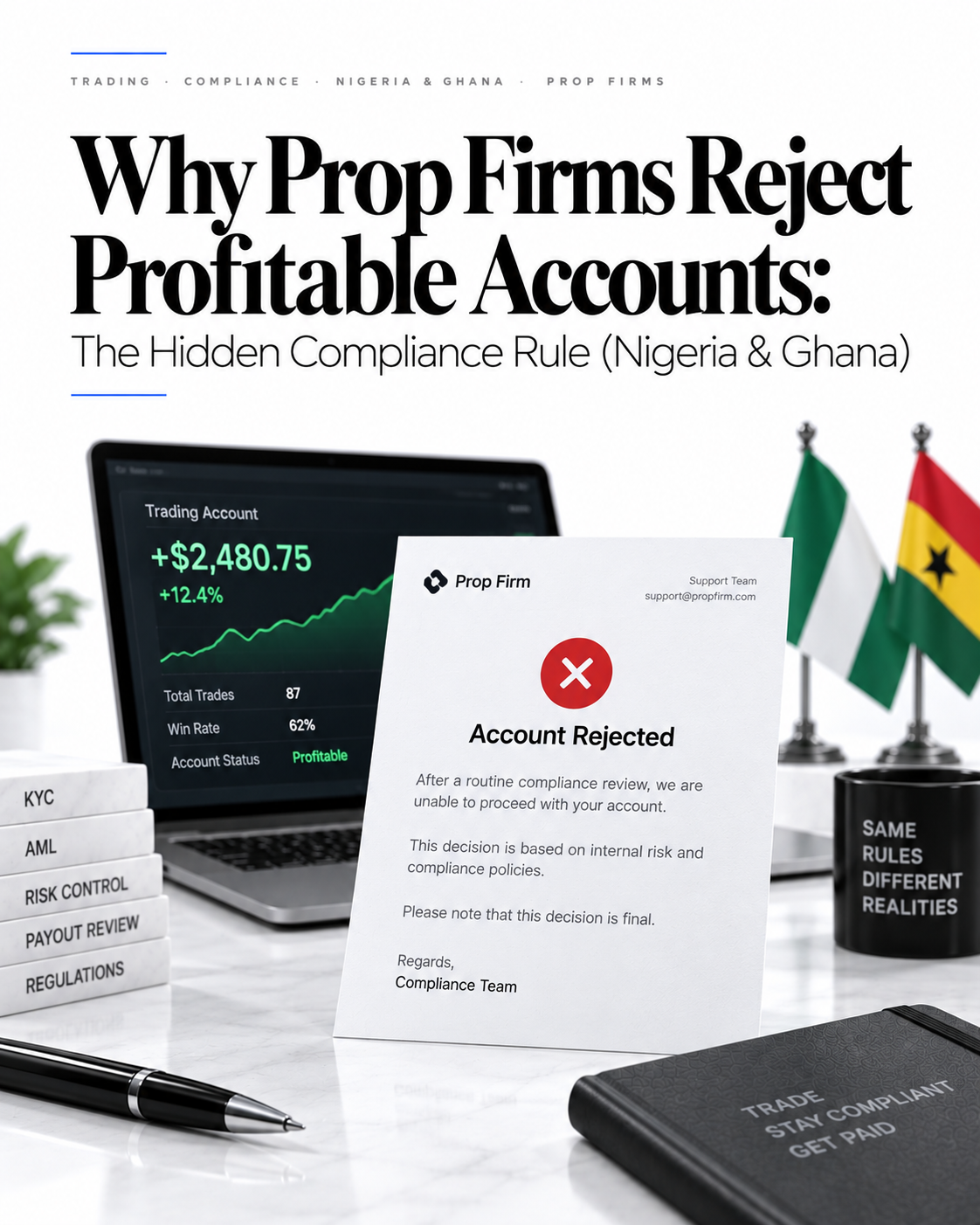
Why Prop Firms Reject Profitable Accounts: The Hidden Compliance Rule (Nigeria & Ghana)
You closed the trade in profit. You passed the drawdown rules. You followed everything you were told. And then your funded account got closed anyway. For traders in Nigeria and Ghana, this is not a rare glitch — it is a pattern rooted in compliance rules that most platforms never explain clearly. This article breaks down exactly which hidden rules kill funded accounts before payout, what the red f
You closed the trade in profit. You passed the drawdown rules. You followed everything you were told. And then your funded account got closed anyway. For traders in Nigeria and Ghana, this is not a rare glitch — it is a pattern rooted in compliance rules that most platforms never explain clearly. This article breaks down exactly which hidden rules kill funded accounts before payout, what the red f
Start your evaluationWhy Prop Firms Reject Profitable Accounts: The Hidden Compliance Rule (Nigeria & Ghana)
TL;DR: Making money on a funded account is not enough to get paid. Prop firms use a second layer of compliance rules — separate from profit targets and drawdown limits — that can close your account even when your P&L is green. Nigerian and Ghanaian traders are disproportionately affected because many of these rules are buried in dense terms-of-service documents that most platforms never explain in plain language.
Key takeaways:
- A profitable account can still be closed for rule violations that have nothing to do with your drawdown or profit target.
- Consistency rules, lot size caps, news-event bans, and "trading style" clauses are the most common silent killers.
- These rules apply during the evaluation phase AND after you receive a funded account — violations in either phase mean no payout.
- Platforms that publicise their rules clearly and never change them retroactively are a meaningful differentiator.
- PropScholar's scholarship-based model starts at $5 (roughly NGN 7,500–8,000 or GHS 80–85 at current rates), with payouts verified within 4 hours of completing the process.
You spent six weeks grinding through an evaluation. You didn't blow the drawdown. You hit the profit target. You requested a payout. And then the email arrived: account closed, violation of section 4.7 of the trading rules.
Section 4.7. You probably never read it.
This is the reality for traders in Lagos, Accra, Ibadan, and Kumasi who put real money into funded trading evaluations and then discover — at the worst possible moment — that making profit is only one piece of the compliance puzzle. The part nobody told you about is the second layer: the behavioral and stylistic rules that govern how you make the profit, not just whether you do.
Let's go through exactly what those rules are, why they hit West African traders particularly hard, and what a cleaner model looks like.
The Profit-Is-Not-Enough Problem
Most funded trading platforms advertise two headline numbers: the profit target (often 8–10%) and the maximum drawdown (often 5–10%). Those are the numbers that appear in the marketing material, the comparison charts, and the YouTube reviews.
But inside the actual terms and conditions — the document that governs whether you get paid — there are often five to ten additional rules that carry the same weight as the headline ones. Break any one of them, even accidentally, and your account can be terminated regardless of your P&L.
This is not a conspiracy. It's partly legitimate risk management: platforms need to know that traders can perform consistently and within certain parameters. But the problem is that these secondary rules are rarely explained with the same clarity as the profit target. They're buried. And when you're a trader in Nigeria or Ghana operating on a tight budget, paying NGN 50,000–150,000 (or GHS 500–1,500) for a challenge fee you've saved up for months, discovering section 4.7 after the fact is genuinely damaging.
The Consistency Rule: The Silent Killer Most Platforms Don't Advertise
The consistency rule is the most widely misunderstood compliance requirement in funded trading. The basic premise: no single trading day should account for a disproportionate share of your total profits.
Different platforms implement this differently. Some use a percentage cap — for example, no single day can represent more than 30–40% of your total gains for the evaluation period. Others use a looser qualitative standard: your trading must look "consistent" to a human reviewer.
Here's where it goes wrong. You trade conservatively for most of the evaluation. You're near the profit target with a few days left. You spot a strong setup — maybe on the US dollar or gold — and you size up slightly, catch a big move, and close the target in a day. In your mind, you traded well. In the platform's system, that single day now represents 60% of your total gains. Violation. Account closed.
For West African traders, this risk is higher for a specific reason: many of you have limited trading windows. Power cuts, internet instability, work commitments — these mean you often trade in bursts rather than every day without interruption. A trader in Accra who loses two days to DUMSOR and then makes it all up in a strong Thursday session is exactly the trader who will fail a strict consistency rule, even though the actual trading was sound.
If you want to understand the deeper logic behind how profitability and consistency intersect in evaluation scoring, this breakdown of breakeven trading vs profitable trading rules explains it clearly.
Lot Size and Risk Management Rules That Aren't in the Headline Numbers
Beyond consistency, lot size rules are another common account-closer. Platforms often impose a maximum position size relative to account equity — for example, no more than 2% risk per trade, or no open positions exceeding a certain lot size on a given instrument.
The problem: some platforms calculate this differently from how you'd expect. They might measure it as a percentage of the initial account balance rather than the current balance. Or they might have instrument-specific caps that appear only in a footnote. Open a single large gold position during a strong trend and you might be technically within your understood risk rules but outside the platform's actual contract terms.
This is especially frustrating because lot size violations often aren't flagged in real time. You don't get a warning popup. The trade executes, you close it at a profit, and weeks later — during payout review — a compliance algorithm flags it.
The News Trading Ban and What Counts as "News"
Almost every funded trading platform has some version of a news trading restriction. The strictest version bans you from holding open positions within a defined window — often 2 to 5 minutes on either side — of major economic data releases: US Non-Farm Payrolls, FOMC decisions, CPI prints.
In practice, this is harder to manage than it sounds. Economic calendars don't always agree on the exact time of a release. Some platforms count the announcement time in GMT, others in EST, and some don't specify. If your broker's execution timestamp and the platform's compliance clock differ by 90 seconds, you might be technically inside the forbidden window even if you were genuinely trying to avoid it.
For traders in GMT+1 (Nigeria) and GMT+0 (Ghana), the math is at least straightforward — major US data releases at 8:30 AM EST land at 1:30 PM or 2:30 PM your time, well within normal trading hours. But if your internet drops at 1:25 PM and you can't close a position that was open from 11 AM, a slow connection just cost you your account.
Some platforms also extend the news ban beyond scheduled events to any period of "extreme volatility" — a clause so vague it can be applied retroactively to justify almost any closure.
The "Trading Style" Clause: When Profitability Itself Becomes Suspicious
This is the rule most traders have never heard of until it's used against them.
Many platforms include a clause — sometimes labeled "prohibited trading strategies" or "abusive trading practices" — that gives them discretion to close accounts if your trading style is deemed to exploit the platform's quote feed, execution model, or simulation environment. The typical targets are high-frequency scalping, latency arbitrage, and certain hedging patterns.
The problem is that the clause is often written broadly enough to catch legitimate strategies. A disciplined scalper who takes 15–20 short-duration trades per day might be flagged under an "excessive trade frequency" interpretation of the same rule that was designed to catch arbitrage bots.
If you're a scalper — and many Nigerian and Ghanaian traders are, because short sessions fit around work and power availability — this clause is worth reading carefully in any platform's terms before you pay anything.
Why These Rules Hit West African Traders Harder
The structural reality is this: traders in Nigeria and Ghana are operating under conditions that make consistent, rule-compliant trading harder than it is for someone with a stable power supply, low-latency fiber internet, and a dedicated trading setup.
Power outages interrupt sessions mid-trade. NEPA in Nigeria and DUMSOR in Ghana are not excuses — they're genuine operational risks that affect execution. Mobile data connections in secondary cities can introduce enough latency to push a close order outside a news window. These aren't performance issues; they're infrastructure realities.
Platforms that don't account for this — or that use rigid automated compliance systems that can't distinguish a forced hold from deliberate news trading — will disproportionately penalize West African traders.
The solution is not to pretend these challenges don't exist. The solution is to choose platforms with clear, specific, non-retroactive rules — and to understand every rule before you fund any evaluation.
How to Actually Audit a Platform's Rules Before Paying
Before you pay a single naira or cedi for any funded trading evaluation, run through this checklist:
Does the platform publish its full ruleset publicly?
Not a summary. Not a FAQ. The actual enforceable terms. If you have to sign up or pay before you can read the complete rules, that's a red flag.
Is there a consistency rule, and is it quantified?
Ask specifically: "Does any single day's profit have a cap as a percentage of total evaluation profit?" If the answer is yes, get the exact number. If the answer is vague, treat that as a hard rule buried somewhere you haven't found yet.
What exactly is the news trading policy?
Which time zone does the platform use? Which releases are covered? What is the exact minute window? How is it enforced — automatically or by human review?
Has the platform ever changed rules retroactively for active accounts?
This is the most important question. A platform that modifies its rules mid-evaluation and applies those changes to accounts already in progress is one you should not use regardless of how attractive the payout sounds.
How does the platform handle force majeure — power cuts, internet outages?
Some platforms have a formal process. Most don't. Know before you're in the position of needing it.
What PropScholar Does Differently for Nigerian and Ghanaian Traders
PropScholar is a scholarship-based trading evaluation platform — not a prop firm, and it doesn't manage institutional capital. The model is: pay an entry fee, pass the evaluation, receive a scholarship payout of up to 400%, verified within 4 hours of completion.
On rule transparency
PropScholar's rules are publicly available before any payment is made. They have not been changed retroactively in the platform's 1.5+ years of operation. For a West African trader deciding whether to risk money on an evaluation, being able to read the complete ruleset in advance is not a small thing — it's the difference between an informed decision and a gamble on section 4.7.
On entry cost
The entry fee starts at $5, which is roughly NGN 7,500–8,000 or GHS 80–85 at current exchange rates. This is meaningfully different from evaluations costing NGN 50,000–200,000 that dominate the market for funded trading in West Africa. Losing a $5 evaluation to a consistency rule violation you didn't fully understand is a recoverable lesson. Losing NGN 150,000 to the same rule is not.
On payment
PropScholar accepts crypto globally, which matters for Nigerian and Ghanaian traders who face real friction with international card payments and wire transfers. The platform also offers a marketplace for real prop firm challenges at INR/UPI pricing — relevant for traders who want access to traditionally-priced evaluations without the typical dollar conversion pain.
On community
The PropScholar Discord has over 3,000 traders, and payout verification happens within 4 hours. The community is one of the more useful places to ask specific rule questions before committing to any evaluation — including whether a particular trading style is likely to trigger a compliance flag. That kind of pre-submission intelligence is worth more than you'd think.
Understanding the interaction between daily loss rules and trailing drawdown is also foundational — the same logic that applies to Pakistani traders applies directly to how West African evaluations are scored, regardless of geography.
The Practical Checklist Before You Request Any Payout
Before you hit the withdrawal button on any funded account — whether it's a PropScholar evaluation or any other platform — go through this:
Verify your daily P&L distribution across the evaluation period. If one day is unusually large relative to the others, flag it internally and check the consistency rule threshold before submitting.
Pull your trade log and check every entry and exit timestamp against the platform's news event schedule. Flag anything within five minutes of a major release.
Check your maximum position size on each trade against the platform's stated limits for each instrument — not just your usual instruments.
Read the current version of the platform's terms and confirm it matches the version you agreed to when you started the evaluation.
If anything looks ambiguous, contact support before you submit the payout request. Platforms that resolve ambiguity in writing before the review are far easier to deal with than platforms where you're arguing after a closure.
FAQs
Why do prop firms reject profitable accounts in Nigeria and Ghana?
Prop firms can close profitable accounts for violating secondary compliance rules that go beyond the advertised profit target and drawdown limits. Common reasons include consistency rule violations (one day representing too large a share of total profits), news trading during banned windows, lot size limits, or vague "trading style" clauses. These rules are often buried in terms and conditions and rarely explained clearly upfront, which disproportionately affects traders in West Africa who discover them only at payout time.
What is the consistency rule in funded trading?
The consistency rule limits how much of your total evaluation profit can come from a single trading day. Exact thresholds vary by platform, but a common version bars any single day from representing more than 30–40% of total gains. Traders who trade in bursts — common in Nigeria and Ghana due to power and internet constraints — are particularly vulnerable because their active days tend to produce concentrated profits.
Can a funded account be closed after I've already made profit?
Yes. Account closure decisions are typically made during the payout review stage, not in real time. A compliance algorithm or human reviewer checks the full trade history at the point of payout submission. A profitable account with any rule violation in the trade log — even an old one — can be closed and the payout denied at that point.
What hidden rules should I check before paying for a funded trading evaluation?
Check for: a consistency rule (and its exact percentage threshold), a news trading ban (with specific times and time zones), lot size or position size caps per instrument, any "prohibited trading strategy" clause that could target scalping or short-duration trades, and whether the platform has ever modified rules for accounts already in progress. All of these should be available in writing before you pay any fee.
How does PropScholar handle rule transparency for traders in Nigeria and Ghana?
PropScholar is a scholarship-based evaluation platform that publishes its full ruleset publicly before any payment is made. The rules have not been changed retroactively during the platform's 1.5+ years of operation. Entry fees start at $5 (roughly NGN 7,500–8,000 or GHS 80–85), with crypto payment accepted globally, and scholarship payouts are verified within 4 hours of completion.
Is PropScholar a prop firm?
No. PropScholar is a scholarship-based trading evaluation platform, not a prop firm. It does not manage or allocate institutional capital. Traders pay an entry fee, complete an evaluation, and receive a scholarship grant of up to 400% upon verified completion. The platform is operated by a Private Limited company registered in India and serves traders globally, including in Nigeria and Ghana, through crypto payment.
How can traders in West Africa avoid having funded accounts closed before payout?
Read the full terms — not a summary — before paying any evaluation fee. Specifically identify and quantify the consistency rule, news trading window, and position size limits. Audit your trade log before submitting a payout request: check daily P&L distribution, news event timestamps, and maximum lot sizes used. If anything is ambiguous, get written clarification from support before submission, not after a closure.
PropScholar is a scholarship-based trading evaluation platform operated by a Private Limited company registered in India. We are not a prop firm and do not manage or allocate institutional capital. Our model rewards proven trading skill with scholarship grants upon successful evaluation completion.
Related reading
- Alternatives to Prop Firms That Ban News Trading and Limit Lot Sizes
- Rupiah to USDT 2026: Fund a Trading Evaluation Under $5
- USDT Crypto Trading Challenge Egypt 2026: $5 Phone-Only Entry
- bKash to USDT for Trading Evaluations: Bangladesh 2026 Guide
- Nagad to USDT: Fund Your Trading Scholarship in Bangladesh 2026
- GCash to USDT: Pay $1 Trading Evaluation as OFW 2026
Ready to Prove Your Edge?
Join 500+ traders. Start from just $5. Get funded within days.
Frequently Asked Questions
Prop firms can close profitable accounts for violating secondary compliance rules beyond the advertised profit target and drawdown limits. Common reasons include consistency rule violations, news trading during banned windows, lot size limits, or vague trading style clauses. These rules are often buried in terms and conditions and rarely explained clearly upfront, which disproportionately affects traders in West Africa who discover them only at payout time.