Instant Funding Monthly Fees vs One-Time Pass Fee: Pakistan Cost Breakdown
Pakistani traders: see the real 90-day cost of instant funding subscriptions vs pay-after-pass entry fees, including USD conversion and currency control friction.
Pakistani traders: see the real 90-day cost of instant funding subscriptions vs pay-after-pass entry fees, including USD conversion and currency control friction.
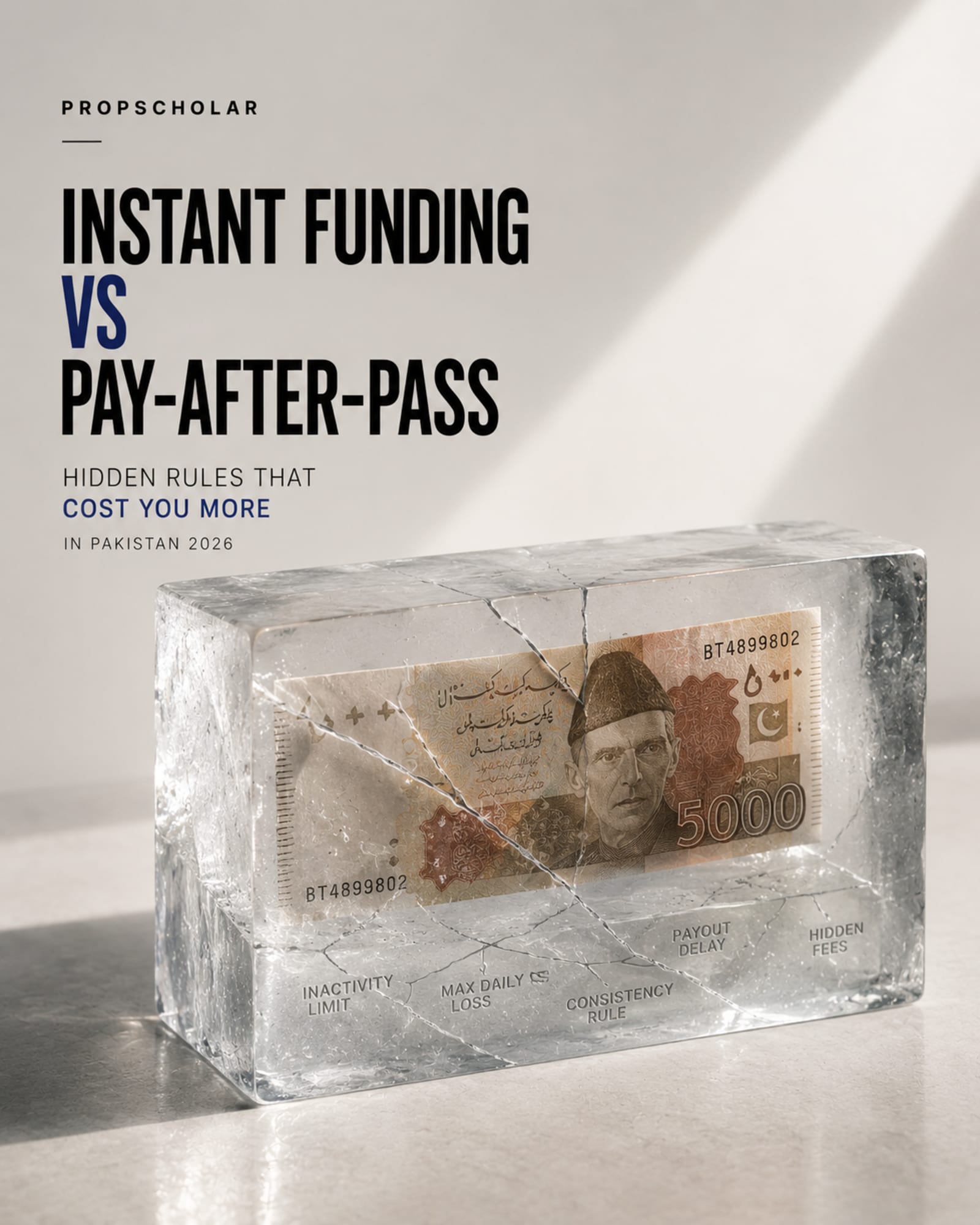
Start your evaluationInstant Funding vs Pay-After-Pass: Hidden Rules That Cost You More in Pakistan 2026
TL;DR: Instant funding sounds faster but usually costs more through monthly fees and stricter drawdown rules. Pay-after-pass evaluations can be cheaper overall — but only if the hidden rule set is fair. Know which rules to check before you pay anything.
Key takeaways:
- Instant funding typically charges recurring monthly fees; pay-after-pass charges a one-time entry fee — the total spend over three months can differ by hundreds of dollars.
- Both models have consistency rules, trailing drawdowns and scaling restrictions that can disqualify you without warning if you don't read the fine print.
- Pakistani traders face extra friction: USD payment, conversion fees, and currency controls add real cost on top of the headline price.
- PropScholar is a scholarship-based evaluation platform — not a prop firm — with entry from $5 (~Rs.1,400) and crypto payment globally, making it one of the most accessible options for Pakistani beginners.
- The single best way to avoid hidden cost is to calculate total spend over 90 days, not just the day-one fee.
You've probably seen both offers. One platform says "get a funded account today, no waiting, start trading real money right now." Another says "prove your skill first, pass the evaluation, then we pay you." As a trader in Pakistan in 2026, you're staring at these two models and trying to figure out which one won't drain your account before you ever make a cent.
Here's the honest reality: both models have legitimate uses and both have serious traps. The problem isn't which model you choose — it's choosing one without knowing what the real costs are. That gap between the headline price and the actual total spend is where most Pakistani traders lose money they couldn't afford to lose.
Let's break both models down properly.
How Instant Funding Prop Trading Actually Works
Instant funding means you pay a fee and get access to a funded simulated account immediately — no evaluation phase, no waiting period. You trade from day one. That's the appeal.
The fee structure is where it gets complicated. Most instant funding platforms charge a monthly subscription on top of the initial access fee. A typical setup might be $150 to $250 upfront, then $30 to $80 per month to keep the account active. If you don't hit withdrawal thresholds fast enough, you're paying that recurring fee for months before seeing any return. Over 90 days, a "cheap" instant funded account can easily cost $300 to $500 in real spend.
For a Pakistani trader converting PKR to USD at current rates, that's a significant outlay. And the currency conversion itself has a cost — bank transfer fees, exchange rate spreads, and in some cases restrictions on sending forex abroad depending on your bank.
The drawdown rules on instant funded accounts tend to be tighter, not looser. Platforms offering immediate access need to protect against traders just blowing the account carelessly on day one. So you'll often see trailing drawdowns (where the maximum loss threshold moves up as your balance grows, locking in a tighter ceiling), daily loss limits as low as 2%, and news trading bans that can get you disqualified for holding a position through a scheduled event — even if you didn't know about it.
The consistency rule is another one that catches traders off guard. Some instant funding platforms require that no single trading day accounts for more than a fixed percentage of your total profits. If you have one great day that represents 40% of your gains, you can fail — even with an overall profitable account. That rule exists in some pay-after-pass evaluations too, but it's more common in instant models because the platform has more to protect.
How Pay-After-Pass Evaluations Actually Work
Pay-after-pass is the model most evaluation platforms use: you pay an entry fee, trade a demo account under specific rules, hit a profit target while respecting drawdown limits, and then claim a scholarship or payout. You don't touch real capital during the evaluation — you're proving your skill in a controlled environment.
The legitimate version of this model is genuinely cheaper when you look at total cost. A one-time entry fee of $10 to $50 for a full evaluation is a fraction of what a three-month instant funding subscription costs. If you pass, your payout can be worth multiples of the fee. PropScholar, for example, offers evaluations starting at $5 — that's roughly Rs.1,400 at mid-2025 rates — with scholarships up to 400% of the entry fee paid within four hours of verification.
But pay-after-pass has its own traps.
The biggest one is the reset fee. On some platforms, if you breach a rule during the evaluation, you can pay again to restart — and some platforms structure the rules in a way that makes failure more likely than it should be. If you're resetting three times at $30 each, you've spent $90 to get something you thought was $30. That's a deliberate business model on some platforms, not an accident.
The second trap is rule retroactivity. Some platforms have been known to change the evaluation rules after you've started — or apply new interpretations to existing rules when you try to claim a payout. This is why transparency matters so much. Reviewing what honest prop firm rankings actually measure in 2026 is worth doing before committing to any platform.
The third trap is vague profit target structures. If the target says "reach 8% profit" but also requires minimum trading days, consistency rules, and a specific win-rate threshold buried in the terms, you can hit 8% profit and still fail. Read the actual rules page, not the marketing page.
The Real Cost Comparison for Pakistani Traders
Let's get specific, because vague comparisons don't help you make a real decision.
Instant Funding: What 90 Days Actually Costs
A mid-tier instant funded account priced for a Pakistani trader might look like $199 upfront plus $49/month. Over 90 days that's $199 + $98 = $297 minimum, before you've made a single withdrawal. Add the PKR-to-USD conversion cost (often 1-3% at retail rates) and a potential bank transfer fee, and you're looking at closer to Rs.90,000 to Rs.100,000 in real spend before you see any return. That's not a small number for a beginning trader.
If you breach the trailing drawdown in month one and lose access? You've paid $199 for nothing, and you have to decide whether to pay again.
Pay-After-Pass: What 90 Days Actually Costs
A fair evaluation platform charges once. If PropScholar's lowest entry is $5 and you pass, you're done spending. If you fail and retry, you pay again — but at $5 per attempt, three retries costs $15 total. You can afford to learn.
Even at a higher entry fee of $30 to $50 for a larger account size, the math is dramatically different from a monthly subscription model. The key variable is pass rate — and that's in your hands based on whether you understand the rules before you start.
The Hidden Currency Cost
This one affects Pakistan specifically. Many international platforms don't accept PKR directly. You're either converting through a bank (expensive, slow, sometimes flagged) or using crypto. Platforms that accept crypto globally remove this friction entirely. For Pakistani traders, crypto payment is often the most practical route — and it's exactly what PropScholar uses for international traders.
Which Hidden Rules Actually Cause the Most Damage
Across both models, the rules that disqualify the most traders aren't the obvious ones. The big drawdown breach is visible — you know when you've lost too much. The traps are subtler.
The Trailing Drawdown vs Fixed Drawdown Distinction
A fixed drawdown means your maximum loss is calculated from your starting balance. If you start at $10,000 with a 10% drawdown limit, you can lose up to $1,000 total before disqualification. That number doesn't move.
A trailing drawdown moves. If you take your account to $11,000 and then it trails, your drawdown limit is now calculated from $11,000. You can get disqualified for losing $1,000 from a peak you already passed — even though your account might still be above your starting balance. This structure is common in instant funded accounts and catches traders who think they're safe because they're still profitable.
The Consistency Rule No One Reads
Some platforms, both instant and evaluation-based, require that your best single trading day doesn't exceed a percentage of your total profit. This is designed to prevent people from getting lucky once. But for legitimate traders with volatile strategies or news-based approaches, it can make passing nearly impossible without planning specifically for it.
Before you pay anything, find out: does this platform have a consistency rule, and what percentage applies? PropScholar publishes its rules openly — see the evaluation options here — so you know exactly what you're agreeing to before the fee is charged.
The Scaling Cap That Stops Withdrawals
Some platforms advertise large funded accounts — $50,000, $100,000 — but cap how much you can withdraw until you've traded for a set period and hit a scaling milestone. You could have a $50,000 account on paper and only be able to withdraw from $5,000 of it for the first several months. This is legal, but it's not what the headline implies.
Check the withdrawal structure before the account size. The number that matters is: "how much can I actually withdraw in month one if I'm profitable?"
Where PropScholar Sits in This Comparison
PropScholar isn't a prop firm. It's a scholarship-based evaluation platform — the distinction matters because it means there's no pretense about managing institutional capital or giving you access to real market positions. What you're doing is proving your trading skill against defined rules, and the reward is a scholarship grant paid within four hours of verification.
For Pakistani traders, the relevant advantages are practical ones.
The Entry Cost Is Actually Low
At $5 entry — roughly Rs.1,400 — PropScholar is accessible at a level that most instant funded accounts aren't. You're not committing Rs.50,000 to Rs.100,000 to test a platform's rules. You're committing Rs.1,400. If the rules don't suit your strategy, the cost of finding that out is minimal.
Crypto Payment Solves the Banking Problem
Pakistan has real friction around international payments. Crypto acceptance means you're not navigating bank transfer restrictions or paying 3% conversion spreads. You pay in crypto, globally, at the real rate. For a Pakistani trader this is a genuine operational advantage, not a marketing point.
The Rules Are Public and Don't Change Retroactively
After 1.5+ years of operation, PropScholar has not changed its rules retroactively on traders who started an evaluation. That's not a small thing. The most common complaint about evaluation platforms isn't the fee — it's getting disqualified under rules that didn't exist or weren't visible when you started. Knowing the rules are stable and public is worth more than a slightly lower entry fee from a platform that might shift the goalposts.
For a fuller view of how different platforms compare on these dimensions, the cheapest funded account breakdown covering real total costs is worth reading alongside this article.
What to Check Before Choosing Either Model in Pakistan
If you're deciding between instant funding and a pay-after-pass evaluation right now, run through this before paying:
What is the total cost over 90 days — not just day one? For instant funding, add every monthly fee. For evaluations, calculate worst-case reset fees.
Is the drawdown fixed or trailing? Write out the exact scenario where you lose access and make sure you understand it.
Is there a consistency rule? If yes, what percentage applies to your best day?
How do withdrawals work and when can you make the first one?
Does the platform accept crypto, and what does the actual payment flow look like from Pakistan?
Are the rules published in full before you pay, and is there a community where you can verify real payout experiences?
None of these questions should be hard to answer. If a platform makes it difficult to get clear answers to any of them, that tells you something important before your money leaves your account.
The Bottom Line
Instant funding isn't inherently worse than pay-after-pass. Pay-after-pass isn't automatically safer than instant funding. What matters is the total cost over time, the specific rule structure, and whether the platform behaves honestly when it's time to pay you.
For most Pakistani traders working with limited capital in 2026 — especially beginners who are still calibrating their strategies — the lower absolute risk of a small evaluation fee beats the recurring spend of most instant funded accounts. The ability to retry at low cost while learning the specific rule set is genuinely valuable.
PropScholar's model is designed for exactly this situation: a beginner or intermediate trader who has real skill but limited capital, who needs a fair, transparent evaluation with a meaningful reward on the other side. At $5 entry with crypto payment and a payout window of four hours post-verification, the model is built to remove the barriers that make prop trading inaccessible in markets like Pakistan.
Check the PropScholar evaluation options, ask your rule questions in the Discord community before paying, and go in with full knowledge of what you're signing up for. That preparation — not the model you choose — is what actually determines whether funded trading works for you.
PropScholar is a scholarship-based trading evaluation platform operated by a Private Limited company registered in India. We are not a prop firm and do not manage or allocate institutional capital. Our model rewards proven trading skill with scholarship grants upon successful evaluation completion.
Related reading
- Best $1 Trading Challenge 2026: Why 1K 1-Step Wins
- Cheapest Legit Way to Access a Funded-Style Trading Account From $5
- Cheapest Prop Firm in 2026: The Complete Price Comparison Guide (From ₹300 With FIFA Discount)
- Cheapest Prop Trading Evaluation in 2026 Ranked by Real Total Cost
- Pay-After-Pass Prop Firms: What the Alternative Actually Is
- How to Start a Trading Evaluation for Under ₹500 or Under $10
Ready to Prove Your Edge?
Join 500+ traders. Start from just $5. Get funded within days.
Frequently Asked Questions
Instant funding gives you account access immediately for a fee, usually with monthly charges to keep it active. Pay-after-pass requires you to trade a demo evaluation first and only rewards you after meeting profit and rule targets. For Pakistani traders, the total 90-day cost of instant funding is typically much higher due to recurring fees and currency conversion costs.