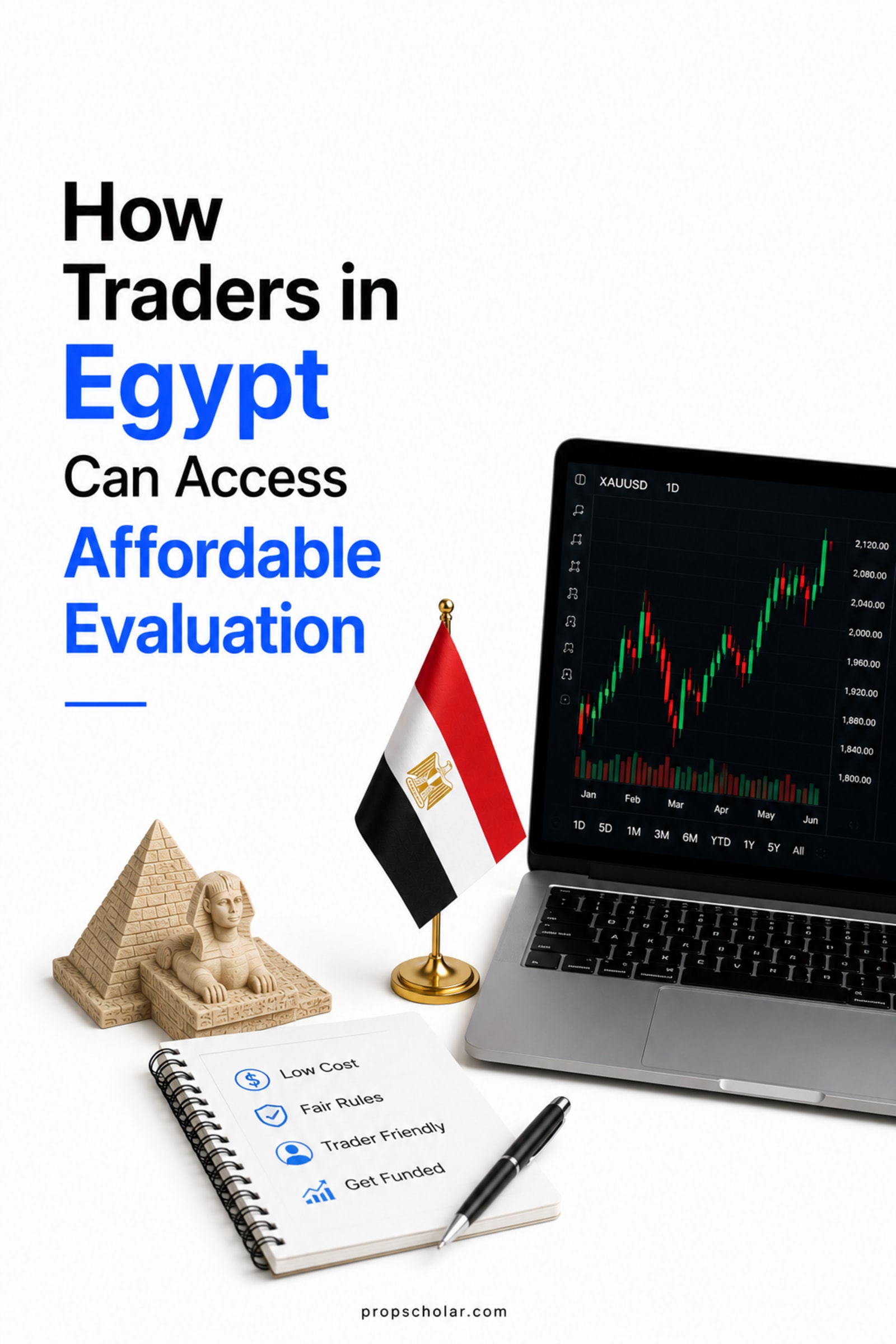
How Traders in Egypt Can Access Affordable Evaluations
Egyptian traders face a real problem: global trading evaluations cost hundreds of dollars, local payment options are limited, and the Egyptian Pound makes USD-priced fees painful. This guide breaks down exactly how traders in Egypt can access affordable evaluations — including a scholarship-based option starting at just $5, payable in crypto — with no bank account hurdles or inflated local prices.
Egyptian traders face a real problem: global trading evaluations cost hundreds of dollars, local payment options are limited, and the Egyptian Pound makes USD-priced fees painful. This guide breaks down exactly how traders in Egypt can access affordable evaluations — including a scholarship-based option starting at just $5, payable in crypto — with no bank account hurdles or inflated local prices.
Start your evaluationHow Traders in Egypt Can Access Affordable Evaluations
TL;DR: Egyptian traders can access a legitimate trading evaluation starting at just $5, paid in crypto — no USD bank account, no inflated local pricing, no conversion headaches.
Key takeaways:
- Most global prop evaluations cost $100–$500 upfront in USD, which is a serious barrier when you're earning in Egyptian Pounds
- PropScholar's scholarship-based evaluation starts at $5 (roughly 250 EGP at current rates), paid in crypto like USDT
- A passed evaluation qualifies you for a scholarship of up to 400%, paid within 4 hours of verification
- PropScholar is not a prop firm — it's a scholarship-based evaluation platform registered as a Private Limited company in India
- You don't need a foreign bank account, an international credit card, or a Western Union trip to get started
You're in Egypt, you want to trade seriously, and you've looked at the big prop firm evaluation platforms — FTMO, Funding Pips, the others. The prices are in USD. Your options for sending that money internationally are frustrating at best. And even if you figure out the payment, you're committing $100, $200, maybe $500, to an evaluation you might not pass on the first try.
That's a real barrier. It's not a mindset problem or a lack of ambition. It's a structural one that affects traders across the entire region.
This guide is specifically about how you, as a trader in Egypt, can work around that barrier — and what a genuinely affordable, crypto-accessible evaluation path actually looks like in practice.
Why Global Trading Evaluations Are Expensive for Egyptian Traders
The core issue isn't that evaluations are overpriced globally. It's that they're priced in USD for a market that earns in EGP — and the payment infrastructure doesn't translate cleanly.
Most major evaluation platforms charge between $100 and $500 for their standard challenges. At the time of writing, that's roughly 5,000 to 25,000 Egyptian Pounds. For a retail trader in Egypt who's still learning, that's not pocket change. It's a significant stake on an outcome that's never guaranteed.
Then there's the payment problem. Many platforms accept credit cards issued in Western countries or direct wire transfers from international bank accounts. Egypt has foreign currency controls that have tightened and loosened repeatedly over the past few years. Getting USD out of an Egyptian bank account to pay a foreign platform is not always straightforward. Some traders resort to buying USDT on peer-to-peer exchanges locally, which works — but adds cost and friction.
The result is that Egyptian traders often end up paying more than the listed price, just to cover conversion fees, P2P premiums, and transfer costs. A $150 evaluation might actually cost you $170–$180 by the time the money moves.
What "Affordable" Actually Means in This Context
Affordable doesn't just mean cheap. It means proportionate — the entry cost should be low enough that if you don't pass on the first attempt, you can try again without it being financially damaging.
That's why the $5 entry point matters. PropScholar's scholarship-based evaluations start at $5 — that's around 250 EGP at current rates. That's a figure most active traders can allocate without it being a crisis. It's less than a few cups of coffee in Cairo.
Yes, the account sizes at that entry level are smaller. That's expected. You're not getting a $200,000 funded account for $5. But you are getting a legitimate evaluation, a real ruleset, and a real scholarship payout if you pass — up to 400% of the fee, paid within 4 hours of verification.
The math matters here. If you pay $5 and qualify for a 400% scholarship, that's $20 back on a $5 stake. Small in absolute terms, but a meaningful proof of concept — and it scales. PropScholar also runs evaluations at higher tiers. The point of the $5 entry is that it removes the excuse of not having enough to start.
How Egyptian Traders Can Actually Pay
This is where PropScholar's global setup becomes specifically relevant for Egypt.
PropScholar accepts crypto payments globally. That means USDT (Tether) and other crypto assets. For Egyptian traders, this is actually the most practical route — and here's why: Egypt has an active peer-to-peer crypto market. Binance P2P, for example, allows Egyptian users to buy USDT using local payment methods including Egyptian bank transfers and mobile wallets.
The process looks like this in practice. You buy USDT on a P2P platform using EGP through your local bank transfer. You then use that USDT to pay for your PropScholar evaluation at checkout. No international credit card. No Western Union. No waiting for a wire transfer to clear.
This isn't a hack or a workaround — it's exactly how crypto was designed to work, and it's what makes global platforms like PropScholar genuinely accessible to traders in Egypt, Nigeria, Pakistan, the Philippines, and dozens of other markets where traditional international payments are friction-heavy.
One thing to note: always check your local regulations around crypto use. Egypt has had evolving policies on cryptocurrency, and while P2P trading is widely practiced, you should stay informed about current rules in your region.
PropScholar's Evaluation Model: What Egyptian Traders Need to Know
PropScholar is not a prop firm. That distinction matters legally and practically. It's a scholarship-based trading evaluation platform — a Private Limited company registered in India, operating for over 1.5 years.
The model works like this. You pay an entry fee (from $5). You trade on a demo account under a specific ruleset — things like drawdown limits, profit targets, and consistency rules. If you pass the evaluation, PropScholar verifies your performance and pays out a scholarship of up to 400% of the entry fee, within 4 hours of verification.
You're not trading real institutional capital. The scholarship is the reward for demonstrating trading skill within the evaluation parameters. Think of it like a skills test with a cash prize for passing — rather than a firm giving you a live account to manage.
Why does this model work for beginners in Egypt specifically? A few reasons.
The rules are public and have never been changed retroactively. That's a bigger deal than it sounds — one of the most common complaints about traditional prop evaluation firms is that they shift the goalposts after traders have already paid. PropScholar's ruleset is what it is before you start, and that's what it stays.
The 24/7 support in multiple languages, including Hindi and others, means you're not stuck navigating a help system designed exclusively for English speakers in Western time zones. The Discord community of 3,000+ traders is also a real resource — you can ask questions, see payout screenshots, and understand what you're getting into before you spend a single dollar.
If you want to see how this compares to what traders in other emerging markets experience, the guide on prop firm alternatives for South African traders on a budget covers similar structural issues, and the affordable funded trading guide for Filipino traders walks through similar payment realities.
The PropScholar Marketplace: Another Option Worth Knowing
Aside from its own evaluations, PropScholar also runs a marketplace where you can purchase challenges from well-known global prop firms — sometimes at lower effective costs than buying directly.
This is particularly useful if you've already done your research on a specific firm's ruleset and want access at a more accessible price point. The guide on getting top prop firm evaluations at a lower effective cost explains how that works in detail.
For an Egyptian trader, the advantage here is similar to PropScholar's own evaluations: you're paying via a platform that accepts crypto, rather than navigating direct payments to a foreign company that may not have smooth infrastructure for Egyptian payment methods.
What to Watch Out For When Choosing Any Evaluation Platform
This section isn't about naming names. It's about patterns that cost Egyptian traders money — and that you should actively look for before handing over any fee.
The first pattern is retroactive rule changes. Some evaluation platforms update their terms after traders have passed, finding technical reasons to deny payouts. The safeguard here is simple: look for platforms where the rules are publicly documented and where you can find community verification — payout screenshots, user discussions, independent reviews — before you pay.
The second is inflated local pricing. Some platforms that offer INR or localized pricing for Indian traders have no equivalent for Egyptian users, meaning Egyptians pay at a different effective rate. PropScholar charges in USD via crypto, which is at least transparent — you know what you're paying.
The third is the disappearing platform problem. Newer platforms without verifiable operating history can vanish. PropScholar has been running for over 1.5 years with a public company registration, public Discord with 3,000+ active members, and documented payouts. That's not a guarantee of anything, but it's measurable track record — far better than a platform that launched six months ago with no verifiable history.
The broader framework for evaluating any platform is covered in the guide on how to get top prop firm evaluations at a lower effective cost, which is worth reading alongside this one.
How to Actually Get Started as an Egyptian Trader
Here's the practical sequence — no vagueness, just steps.
First, get your USDT ready. Use a reputable P2P platform available in Egypt to buy USDT with EGP. Decide how much you want to start with. For a first evaluation, the $5 entry makes sense — it's low enough to be educational without being a financial burden.
Second, go to the PropScholar shop at propscholar.com/shop and select the evaluation that fits your current budget and experience level. Read the rules before buying. Every rule is posted — drawdown limits, profit targets, time constraints — and you should understand them before you start trading.
Third, complete checkout using crypto. The payment process accepts USDT and other supported assets globally.
Fourth, trade. This is the part that's actually on you. The evaluation is a skills test. Treat it like one. Don't overtrade on day one, don't violate drawdown limits chasing a loss, and don't try to rush to the profit target.
Fifth, if you pass, submit for verification. Payouts are processed within 4 hours of verification — in crypto, which means you receive back in USDT or the relevant asset, which you can then convert back to EGP on the same P2P platform you used to buy.
If you want to ask questions before committing even $5, the PropScholar Discord has active members who can answer from direct experience. That community exists for exactly this kind of pre-purchase research.
How PropScholar Compares to Standard Prop Evaluations for Egyptian Traders
Entry Cost
Most mainstream prop firm evaluations start at $100 or above for their smallest account size. PropScholar's scholarship evaluations start at $5. For a trader in Egypt earning in EGP and navigating foreign currency friction, that difference is significant — not because $100 is unmanageable globally, but because losing $100 on a failed first evaluation stings in a way that losing $5 does not.
Payment Method
Standard platforms typically accept credit/debit cards issued by international banks, PayPal, or wire transfers — all of which present friction for Egyptian traders. PropScholar accepts crypto globally. That single difference removes most of the payment infrastructure problem that Egyptian traders face.
Payout Speed
Many traditional evaluation firms have payout timelines of 1–5 business days, sometimes longer depending on verification queues. PropScholar's stated payout window is within 4 hours of verification. For a trader who just passed and wants to see their scholarship quickly, that's a meaningful difference.
Rule Transparency
PropScholar's rules are publicly posted and have not been changed retroactively in its 1.5+ years of operation. That's verifiable — not a marketing claim but an operational track record you can investigate by checking the Discord history and community discussions.
Scale of Scholarship
The scholarship payout can reach up to 400% of the entry fee. On a $5 evaluation, that's $20. On a larger evaluation, the absolute numbers scale accordingly. This isn't a guarantee of profit — you have to pass the evaluation to receive anything. But the structure is transparent and consistent.
A Final Word on Expectations
Trading evaluations are not a guaranteed income stream. Anyone who tells you otherwise is either misinformed or selling something. The evaluation is a test. Some traders pass on the first attempt. Many don't. The advantage of a $5 entry point is that failing doesn't set you back significantly — you learn, adjust, and try again.
What PropScholar offers Egyptian traders isn't a shortcut to easy money. It's proportionate access — a way to participate in a global evaluation ecosystem without needing a foreign bank account, a large USD balance, or a tolerance for losing hundreds of dollars on a learning experience.
For traders across emerging markets who've been priced out of this space, that's genuinely meaningful. If you're serious about developing real trading skills and want a low-cost way to test yourself against a legitimate ruleset, starting at $5 with crypto payment is the most accessible on-ramp that currently exists.
PropScholar is a scholarship-based trading evaluation platform operated by a Private Limited company registered in India. We are not a prop firm and do not manage or allocate institutional capital. Our model rewards proven trading skill with scholarship grants upon successful evaluation completion.
Related reading
- Best $1 Trading Challenge 2026: Why 1K 1-Step Wins
- Cheapest Legit Way to Access a Funded-Style Trading Account From $5
- Best Prop Firm in India 2026 (UPI-Friendly): Honest Comparison
- Cheapest Prop Firm in 2026: The Complete Price Comparison Guide (From ₹300 With FIFA Discount)
- Prop Firm Challenge Under $5: Cheapest Legit Funded Accounts Compared
- Cheapest Prop Trading Evaluation in 2026 Ranked by Real Total Cost
Ready to Prove Your Edge?
Join 500+ traders. Start from just $5. Get funded within days.
Frequently Asked Questions
Egyptian traders can access trading evaluations starting at $5 through PropScholar, a scholarship-based evaluation platform that accepts crypto payments globally. You buy USDT on a local P2P platform using EGP, then pay at checkout — no foreign bank account or international credit card needed. If you pass the evaluation, a scholarship of up to 400% of your entry fee is paid within 4 hours of verification.