Funded Account Closed After First Profit Nigeria: OPay Reversal and the Compliance Wall
You passed the evaluation. You made your first profit. Then your funded account got closed and OPay flagged your deposit as suspicious. This is what's actually happening to Nigerian traders — and how to protect yourself before it happens to you.
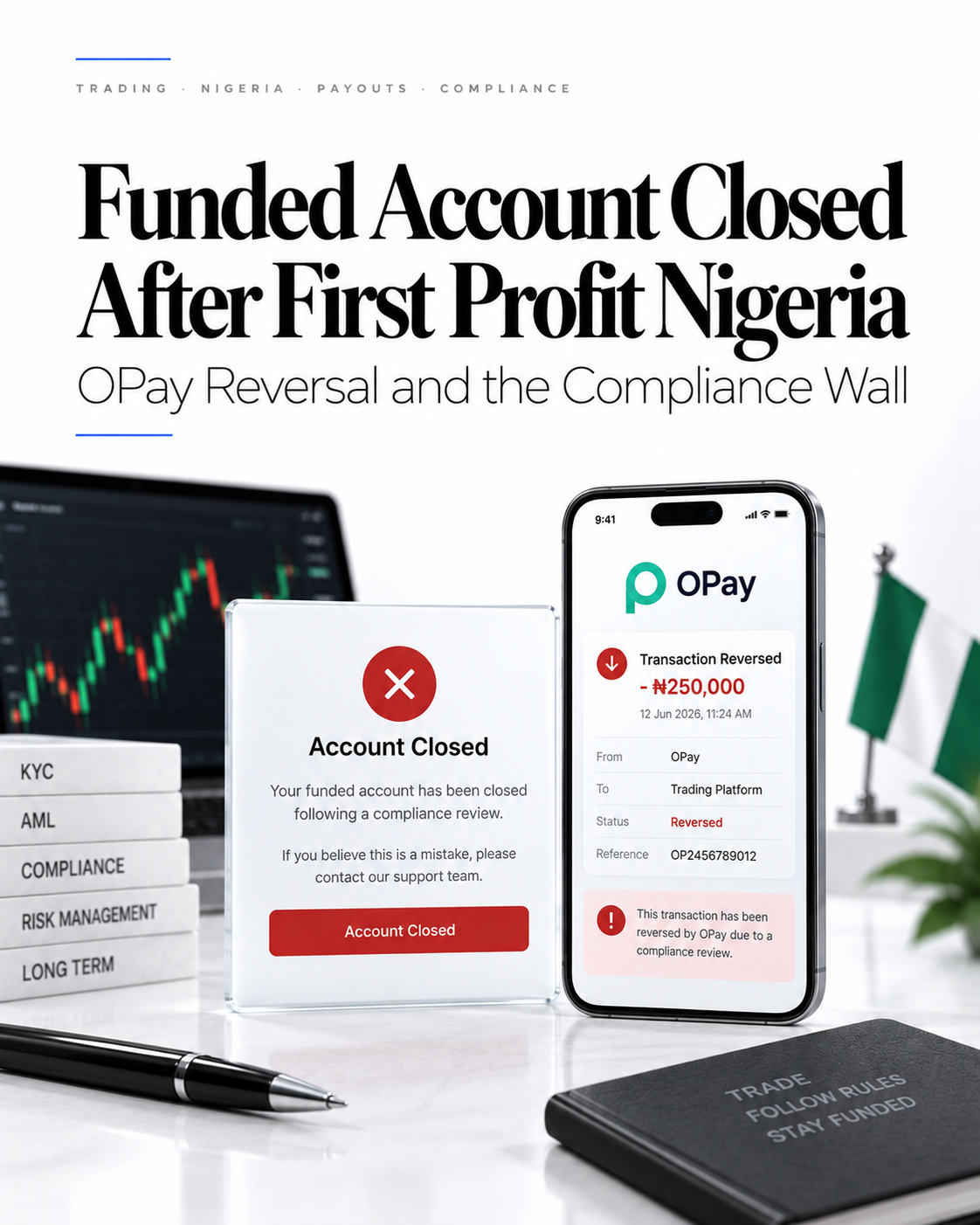
You passed the evaluation. You made your first profit. Then your funded account got closed and OPay flagged your deposit as suspicious. This is what's actually happening to Nigerian traders — and how to protect yourself before it happens to you.
Start your evaluationFunded Account Closed After First Profit Nigeria: OPay Reversal and the Compliance Wall
TL;DR: Nigerian traders are having funded accounts terminated the moment they hit their first profit — not because they broke trading rules, but because OPay deposit reversals trigger compliance flags that most platforms never warn you about.
Key takeaways:
- OPay deposit reversals can void your evaluation fee payment and get your account flagged before you ever trade
- Many platforms bury compliance clauses that let them close accounts for payment processor issues — not just trading violations
- The first payout is the highest-risk moment; that's when platforms run their deepest account verification
- Crypto deposits eliminate the OPay reversal risk entirely for Nigerian traders
- PropScholar is a scholarship-based evaluation platform that accepts crypto globally and pays scholarships within 4 hours of verification — starting from as low as $5
You traded well. You kept your drawdown tight, followed the rules, and closed your first profitable position on a funded account. Then your dashboard went dark. Account closed. No clear reason given — or a vague message about "payment irregularities" or "verification failure."
This is not a rare story in Nigeria right now. It's happening across Discord groups and Telegram communities almost weekly. And almost every case has the same root cause: the OPay deposit reversal problem colliding with compliance rules that platforms write to protect themselves, not you.
Let me break down exactly what's happening, why it targets Nigerian traders disproportionately, and what you can do about it.
What Actually Triggers a Funded Account Closure in Nigeria
The account closure rarely happens because of a trading mistake. It happens because funded account platforms are running two separate compliance checks simultaneously — one on your trading, and one on your payment history.
When you pay your evaluation fee through a fintech wallet like OPay, that payment enters a system with its own fraud detection. OPay, like most Nigerian fintechs, flags unusual transaction patterns automatically. A payment to an international or unfamiliar merchant, especially a first-time payment in a category the wallet algorithm doesn't recognize, can get temporarily reversed or held pending manual review.
Here's where it gets dangerous. Most prop firms and evaluation platforms link your account activation directly to clean payment status. If OPay reverses or delays your deposit — even temporarily, even if it clears later — the platform's system may log the transaction as failed, incomplete, or suspicious. That flag sits on your account.
You don't see it. You trade through the evaluation. You pass. You make your first profit on a funded account. And then — at the exact moment when the platform runs its payout verification — they pull your payment history, see the reversal flag, and terminate the account for "compliance reasons."
You don't get a refund of your fee. You don't get your profit. And you often don't get a real explanation.
Why OPay Specifically Creates This Problem
OPay is one of Nigeria's most popular fintech wallets — fast, accessible, and used by millions. But its fraud detection is aggressive by design, because mobile money fraud is a real problem in the Nigerian market.
The reversal risk is highest when:
- You're making a cross-border or international payment
- The receiving merchant category is unfamiliar to OPay's system
- The amount is outside your typical transaction range
- You're sending to a crypto-adjacent or financial services merchant
The reversal usually resolves itself in 24-72 hours. But that window is enough for a platform's system to mark your account permanently.
This isn't OPay doing something wrong, exactly. It's two separate compliance systems — OPay's and the trading platform's — colliding in a way that destroys your account without either side technically making an error. You're the one who gets crushed in the middle.
For a broader look at how payment infrastructure creates problems for evaluation traders across emerging markets, the article on the UPI funding cap trap for Indian prop traders covers remarkably similar patterns. The geography changes; the mechanism is almost identical.
The Hidden Compliance Wall: What the Terms Actually Say
Most Nigerian traders read the trading rules carefully. They study drawdown limits, minimum trading days, lot size restrictions. What they don't read — or can't find easily — is the compliance language buried in the terms of service.
This language typically says something like: "accounts may be reviewed and terminated at any time if the company determines there are grounds for concern regarding payment authenticity, verification status, or compliance with applicable financial regulations."
That clause is a blanket authorization for the platform to close your account for almost any reason related to payments — without specifying what counts as a "concern." An OPay reversal, even a temporary one that fully resolved, can qualify.
Some platforms add a "right to withhold profits" clause for accounts under compliance review. This means they can hold your payout indefinitely while they "investigate" — and in practice, many traders never hear back.
The compliance wall is not illegal. It's just written entirely in the platform's favor. And Nigerian traders, because of the OPay reversal pattern, trigger it more often than traders in other markets.
If you've already had a payout denied and want to understand the broader pattern of how this plays out, this article on funded account payouts being denied after profit lays out the mechanics clearly — even though it focuses on Indian traders, the compliance trigger pattern is nearly identical.
The First Profit Is the Highest-Risk Moment
There's a specific reason closures cluster around the first payout rather than during the evaluation phase.
During the evaluation, the platform has no obligation to pay you anything. There's no financial pressure on them. But the moment you pass and make your first profit on a live funded account, a real payout obligation exists. That's when platforms run the most thorough verification of your account.
Think of it this way: during the evaluation they're checking whether you can trade. At payout, they're checking whether they want to pay you. And if there's any flag on your account — payment history, ID verification, IP location, payment method inconsistency — that's when it surfaces.
This isn't a conspiracy. It's how financial compliance actually works. But the effect on Nigerian traders with OPay reversal flags is that the evaluation phase goes fine, and the funded phase ends at the worst possible moment.
How to Protect Yourself Before You Pay the Evaluation Fee
The fix is simpler than most traders expect, once you understand the actual problem.
Use crypto for your evaluation deposit. A USDT or other crypto payment cannot be "reversed" by a fintech wallet's fraud detection. It settles on-chain. There's no OPay reversal flag, no held transaction, no payment status ambiguity. The platform receives a clean, confirmed payment, and your account starts with no compliance markers.
This is genuinely the most important practical decision you can make as a Nigerian evaluation trader. It eliminates the entire OPay reversal risk category before you even look at trading rules.
Read the terms of service for payment compliance clauses specifically. Don't just read the trading rules. Ctrl+F for the words "compliance," "payment," "withhold," and "termination." If those clauses are broader than the trading rules themselves, you're taking on hidden risk.
Screenshot your payment confirmation immediately. Timestamp it. If OPay shows the payment as sent, screenshot that screen. If you later need to dispute an account closure, having a timestamped record of clean payment is your only real evidence.
Avoid platforms that won't clearly state their compliance review process. If a platform can't tell you specifically what triggers a compliance review and what the resolution process looks like, that silence is the answer.
For context on why cheap evaluations with opaque rules are riskier than they look, this piece on why $1 trading challenges fail for beginners in emerging markets is worth reading before you commit any money.
Why PropScholar Specifically Works Differently for Nigerian Traders
PropScholar is a scholarship-based evaluation platform — not a prop firm. That distinction matters for compliance reasons more than most people realize.
The model works like this: you pay a small entry fee (starting from $5, which is roughly 8,000 to 9,000 Naira at current rates), you complete a trading evaluation, and if you pass, you claim a scholarship grant of up to 400% of your entry fee. The scholarship is paid within 4 hours of verification.
Because PropScholar accepts crypto globally, Nigerian traders can pay their entry fee without touching OPay at all. No reversal risk. No fintech compliance flag. The payment settles clean, the account activates clean, and there's no hidden payment history problem waiting to surface at payout time.
The rules are also publicly available and have never been changed retroactively — which means the compliance terms you read when you sign up are the ones that apply when you request your scholarship. That's not a small thing.
The 3,000-person Discord community is worth checking before you commit to anything. Real traders, real payout screenshots, real conversations about what works. You can verify the experience of other Nigerian and African traders before you spend a cent.
What to Do If Your Account Was Already Closed
If it already happened to you — funded account closed, first profit gone — here's the honest situation.
Your leverage is limited, but it's not zero. Document everything: your evaluation fee payment confirmation, your trading history, your payout request, and every communication you've had with the platform. If you paid via OPay and there was a reversal, get the transaction record from OPay showing the final settled status.
Contact support in writing, not live chat. A written email creates a paper trail. Ask specifically: what compliance rule was violated, when was the compliance review triggered, and what is the resolution process. Vague answers are themselves informative — they tell you how seriously the platform takes its own stated process.
If the platform refuses to respond or provides no coherent reason, you may have grounds to dispute the original payment with your bank or OPay as an undelivered service. This isn't guaranteed to work, but it's a legitimate consumer protection avenue.
For future evaluations, start fresh with a platform that accepts crypto and has public, static rules. Repeating the same process with the same payment method is just running the same risk again.
You can also reach out directly to PropScholar at business@propscholar.com with questions about how the scholarship model handles Nigerian traders specifically. The support team operates in multiple languages and is available around the clock.
PropScholar vs Platforms With Hidden Compliance Walls
On payment method risk
Platforms that only accept fintech wallets or bank transfers force Nigerian traders into the OPay reversal risk by default. PropScholar accepts crypto globally, which sidesteps this problem entirely. The entry point is also $5 — low enough that even if something goes wrong, your maximum exposure is minimal while you learn the process.
On rule transparency
Platforms with broad, vaguely worded compliance clauses give themselves maximum flexibility to close accounts — and minimum accountability. PropScholar's rules are public and have not been changed retroactively since the platform launched. What you read is what applies.
On payout speed
Platforms that run extended compliance reviews on payouts create the exact window where Nigerian traders get caught. PropScholar pays scholarships within 4 hours of verification — the review cycle is short and defined, not open-ended.
On community verification
A 3,000-person Discord community with active payout proof discussions is fundamentally different from a platform where you can't find any real users talking about their experience. That community is your pre-purchase due diligence tool.
PropScholar is a scholarship-based trading evaluation platform operated by a Private Limited company registered in India. We are not a prop firm and do not manage or allocate institutional capital. Our model rewards proven trading skill with scholarship grants upon successful evaluation completion.
Related reading
- Are Free Funded Accounts Real? What 'Free' Prop Offers Actually Cost You
- Is PropScholar Legit or Fake? The Honest 2026 Review Every Trader Should Read Before Paying
- The Safest Way for a College Student to Start Trading and Not Lose Money
- Cheap Prop Firm No Consistency Rule 2026: Skip the 15% Trap
- Is PropScholar Legit? An Honest Review With Payout Proof
- Alternatives to Prop Firms That Change Rules After You Pass
Ready to Prove Your Edge?
Join 500+ traders. Start from just $5. Get funded within days.
Frequently Asked Questions
Most closures happen because of payment compliance flags, not trading rule violations. OPay deposit reversals — even temporary ones — can mark your account as having a suspicious payment history. When the platform runs its payout verification after your first profit, that flag surfaces and triggers account termination. The fix is to use crypto for your evaluation fee so there's no reversal risk in the first place.