Daily Drawdown Calculated from Balance vs Equity: Key Difference
Daily drawdown from balance vs equity changes your real loss floor. See exactly how each method is calculated and why it catches traders off guard.
Daily drawdown from balance vs equity changes your real loss floor. See exactly how each method is calculated and why it catches traders off guard.
Start your evaluationDaily Drawdown vs Maximum Drawdown: The Difference That Fails Traders
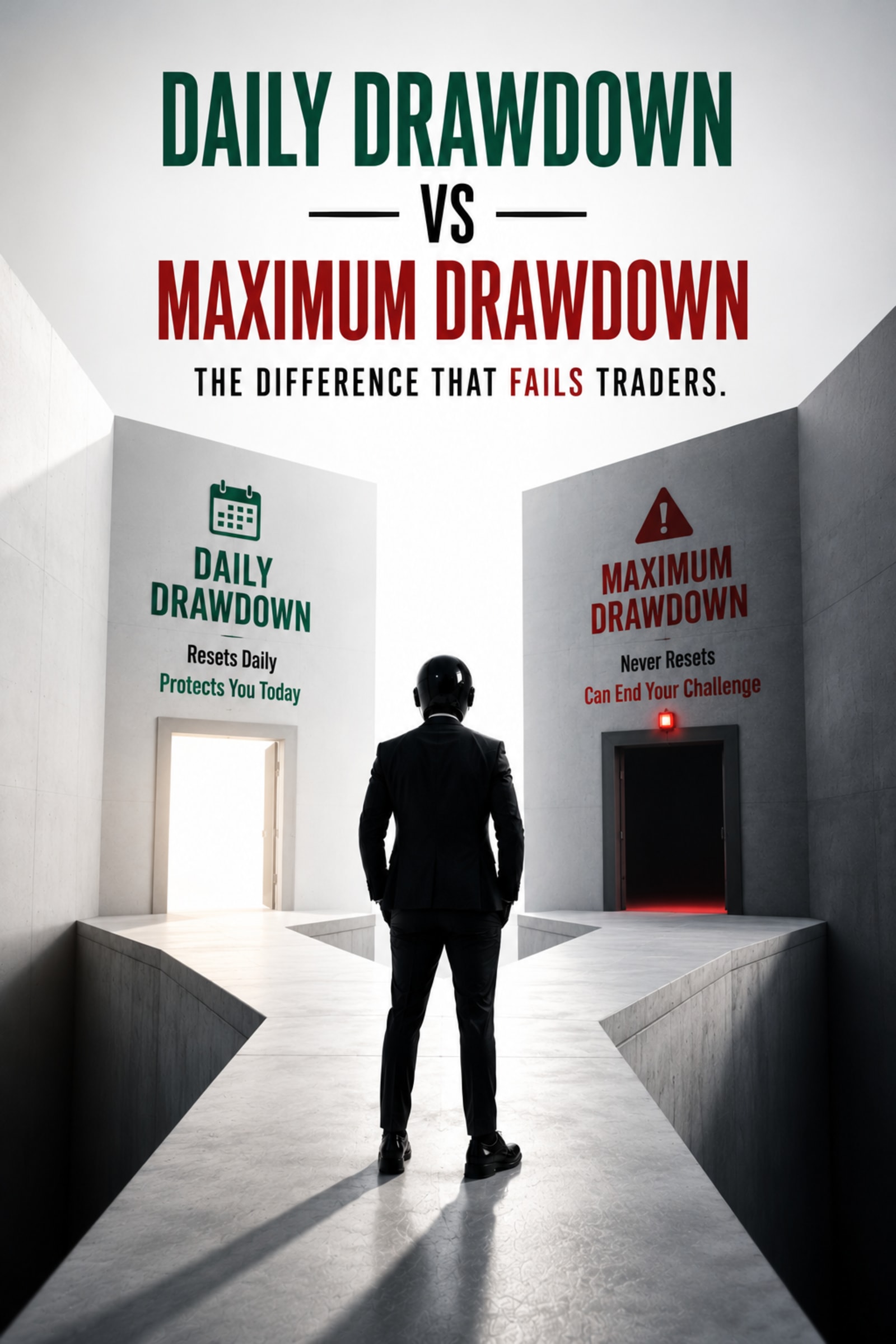
TL;DR: Daily drawdown is a per-day loss ceiling that resets. Maximum drawdown is the absolute floor your account can never touch. Break either one and the evaluation ends immediately.
Key takeaways:
- Daily drawdown limits how much you can lose in a single trading day — it resets each day.
- Maximum drawdown is the total loss allowed from your starting balance, ever.
- You can breach daily drawdown even on a day you're profitable overall, depending on how the rule is calculated.
- Most traders who fail evaluations break the daily rule, not the max rule.
- Understanding exactly how each limit is calculated — from balance or from equity — changes your entire approach to position sizing.
You pass two weeks of an evaluation. You're up 7%. You open a trade on a Thursday morning, it spikes against you by 4% intraday, then recovers and you close flat for the day. Evaluation over. Account failed.
That scenario plays out constantly, and the reason is almost always the same: the trader understood their maximum drawdown but didn't pay close enough attention to the daily rule. These two limits coexist in almost every evaluation, they protect different things, and violating either one ends everything — no exceptions, no appeals.
If you're serious about passing any trading evaluation, you need to understand both rules at a mechanical level. Not just "there's a 5% daily limit" but how that 5% is calculated, when it resets, and what happens if your open positions dip past it even briefly.
What Daily Drawdown Actually Measures
Daily drawdown is a single-day loss ceiling. It defines the maximum amount your account can fall within one trading day before your account is automatically closed or flagged for breach.
The most common figure you'll see is 5% per day. On a $10,000 account, that's $500. Simple enough on the surface. What trips traders up is what that 5% is measured from.
There are two main methods platforms use:
Balance-Based Daily Drawdown
Your daily limit is calculated from your account balance at the start of that trading day (or the end of the previous day). If you started Thursday with a $10,200 balance, your floor for that day is $10,200 minus 5%, which equals $9,690. Your equity — the real-time value of your account including open trades — cannot dip below $9,690 at any point during that day.
This matters enormously. If you have an open trade sitting at a $600 floating loss at 2pm, you've already breached the limit, even if you believe the trade will recover. The system doesn't wait for recovery.
Equity-Based Daily Drawdown
Some platforms calculate the daily limit from your highest equity during the day rather than the opening balance. This version is stricter. Say you opened a winning trade early and your equity peaked at $10,600. Now your 5% daily drawdown is measured from $10,600, meaning your floor is $10,070 — higher than yesterday's closing balance. You can lose your gains and then breach into a zone you didn't even think was dangerous.
Always confirm which method a platform uses before you place a single trade. Ask directly. Read the rules page. This single detail has ended more evaluations than almost anything else.
What Maximum Drawdown Actually Measures
Maximum drawdown is your all-time loss limit from the account's starting point. It doesn't reset. It doesn't move (unless it's a trailing version — more on that in a moment).
On a typical 10% maximum drawdown rule for a $10,000 account, your absolute floor is $9,000. You could have a terrible week and lose $800, recover $400, lose $300 more — as long as your balance never falls below $9,000, the maximum drawdown rule hasn't been broken. The daily rule could have been broken twenty times in that same period, though.
Fixed maximum drawdown is the fairer, more trader-friendly version of this rule. Your floor stays at the same number from day one. A trailing maximum drawdown is more aggressive — it moves upward as your balance grows, which can squeeze your risk room as you profit. If you want to understand the difference between trailing and fixed drawdown in full detail, the trailing drawdown explained article breaks it down clearly.
Why Traders Break Daily Drawdown More Often
The maximum drawdown limit fails traders who are genuinely reckless — people risking 8% on a single trade, or doubling down on losses. That's a small group.
The daily drawdown limit fails traders who are actually disciplined but underprepared. Here's why.
A trader who risks 2% per trade thinks they're being responsible. But if they have three simultaneous open positions and the market moves against all three at once, floating losses can hit 5-6% of balance within minutes. The account breaches the daily limit before any position even hits a stop-loss.
This is especially dangerous during major news events — NFP, FOMC decisions, central bank rate announcements. Spreads widen, volatility spikes, and positions that looked fine at 8:29am are suddenly deep underwater at 8:31am. The floating drawdown calculation doesn't care that you planned to hold through the volatility. If equity hits the floor, the evaluation ends.
The practical fix is simple but requires discipline: size your positions so that all open trades at maximum loss simultaneously still don't breach your daily limit. If your daily limit is 5%, treat 3% as your actual working budget for the day across all open exposure.
How to Calculate Your Real Daily Trading Budget
Here's the calculation that most beginner traders skip.
Take your daily drawdown percentage (say 5% on a $10,000 account = $500 loss limit). Now ask: how many trades do I typically have open at once? If the answer is three, and each has a maximum stop-loss risk, then your per-trade risk budget is not $500. It's roughly $150-170 per trade — leaving a buffer so that even if all three hit their stops simultaneously, you're at $450-510 loss, hovering right at (or just under) the limit.
Most traders don't do this math. They think in per-trade terms, not in simultaneous-exposure terms. That disconnect is the gap the daily drawdown rule falls into.
For traders who also run into the consistency rule — which governs how evenly spread your profits need to be — the consistency rule breakdown is worth reading alongside this article. The two rules interact.
Daily Drawdown vs Maximum Drawdown: Side by Side
Scope
Daily drawdown covers one day only. It resets at the start of each new trading day, usually at midnight server time or the platform's defined reset time. Maximum drawdown covers the entire lifetime of the evaluation — no reset, no forgiveness.
Measurement Base
Daily drawdown is measured from either the day's opening balance or the day's peak equity, depending on the platform. Maximum drawdown is measured from the original starting balance (for fixed drawdown) or from peak balance ever reached (for trailing drawdown).
Breach Consequence
Both result in immediate evaluation failure if violated. There's no grace period, no partial breach, no warning system that pauses your trades. The account is marked failed.
Which One Catches More Traders
Daily drawdown fails more traders. Maximum drawdown is a slower, more visible limit — you can see yourself approaching it. Daily drawdown can be breached in a 90-second volatility spike.
How PropScholar Handles Drawdown Rules
PropScholar is a scholarship-based trading evaluation platform — not a prop firm. The evaluation rules are public, clearly stated before you pay, and have never been changed retroactively. That's not a marketing line; it's the operating principle that makes the platform usable for traders in emerging markets who can't afford to lose fees to ambiguous rules.
Evaluations start from $5 (approximately Rs.400 for Indian traders, or the USDT equivalent for global traders). The drawdown rules are fixed — not trailing — which means your floor doesn't move against you as you profit. For traders in Nigeria, the Philippines, Indonesia, South Africa and beyond, that matters: you're not being punished for doing well.
Scholars who pass receive their scholarship payout within 4 hours of verification. You can check available evaluations — including the entry requirements and exact drawdown limits — directly at the PropScholar shop.
If you're based in Egypt and want context on low-cost evaluations more broadly, the Egypt trading challenge guide covers the regional payment landscape. Pakistani traders can find parallel context in the Pakistan evaluation guide.
Before Your Next Evaluation: A Quick Pre-Trade Checklist
Know your exact daily drawdown limit in dollar or account-unit terms, not just as a percentage. Know whether it's measured from opening balance or from peak equity. Know your platform's daily reset time — some reset at midnight UTC, others at a different server time. Calculate your maximum simultaneous open-position exposure before entering any trade. And treat floating losses as real losses the moment they appear on screen, because the evaluation system does exactly that.
One more thing worth doing: check whether your platform has an active community where traders share their real experiences. The PropScholar Discord at discord.gg/uTU85z4hft has more than 3,000 traders, and payout screenshots get posted regularly. Seeing real outcomes from real traders who navigated these same rules is worth more than any explainer article, including this one.
If you want to try your luck before your next evaluation, the PropScholar FIFA penalty game gives you a chance at 22-25% off your entry fee or up to 15% extra payout. Five penalty kicks, one goal needed, and you can retry every 4 hours.
PropScholar is a scholarship-based trading evaluation platform operated by a Private Limited company registered in India. We are not a prop firm and do not manage or allocate institutional capital. Our model rewards proven trading skill with scholarship grants upon successful evaluation completion.
Related reading
- Alternatives to Prop Firms That Ban News Trading and Limit Lot Sizes
- Trailing Drawdown Explained Simply and Why Fixed Limits Are Fairer
- The Consistency Rule: What It Means and How to Pass It
- Trailing Drawdown Traps: The Safer Alternative Traders Need in 2026
- Best Funded Trading Challenge for South African Day Job Traders (2026)
- Vodafone Cash Prop Trading Challenge Egypt 2026: Cheapest Funded Account Under 500 EGP
Ready to Prove Your Edge?
Join 500+ traders. Start from just $5. Get funded within days.
Frequently Asked Questions
Daily drawdown is a per-day loss ceiling that resets every trading day — breach it on any single day and the evaluation ends. Maximum drawdown is the total loss allowed from your starting balance across the entire evaluation. Both limits exist simultaneously, and violating either one results in immediate failure, no exceptions.