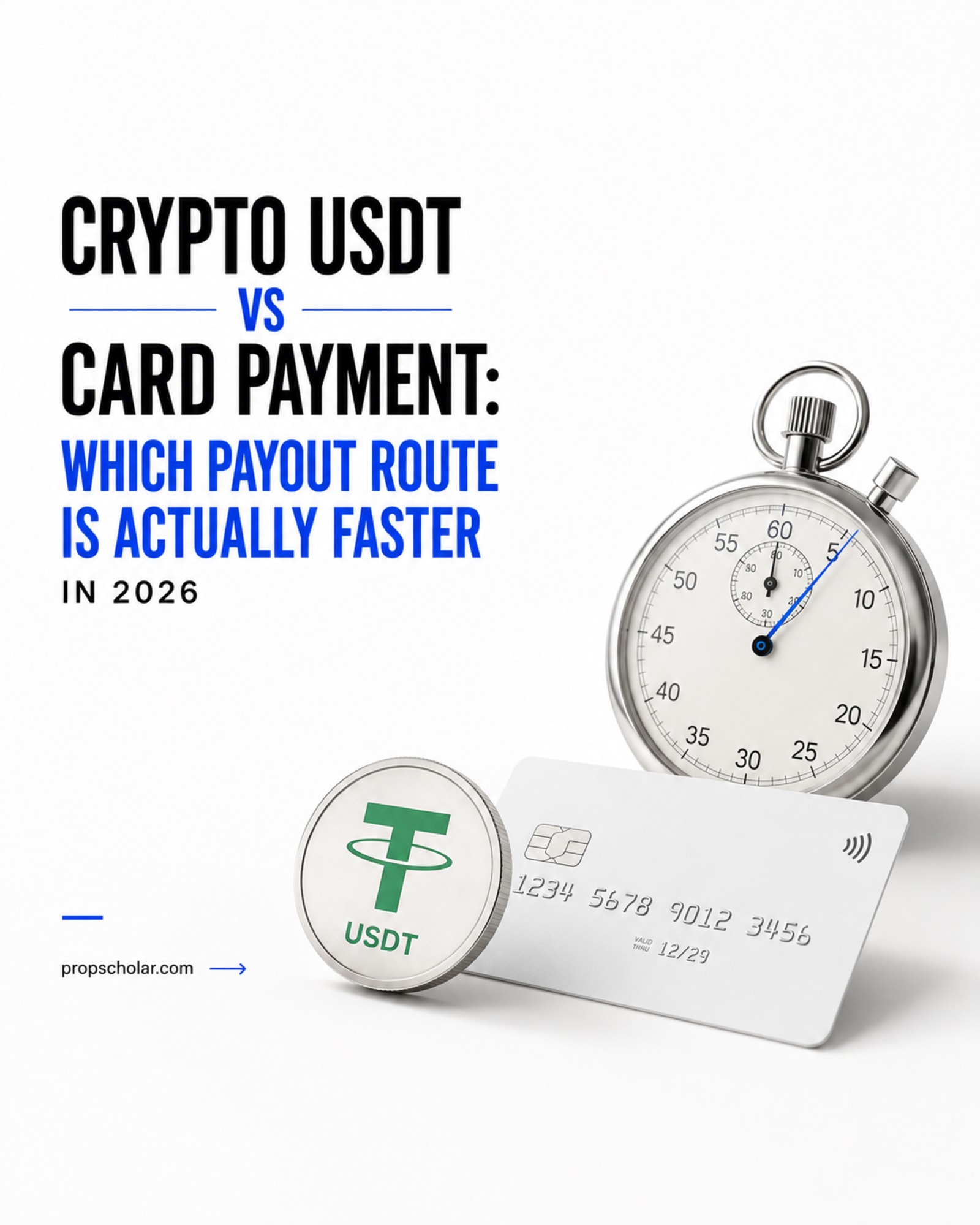
Crypto USDT vs Card Payment: Which Payout Route Is Actually Faster in 2026
Waiting days for a payout you already earned is the worst feeling in trading. This guide breaks down exactly how crypto USDT payouts compare to card-based payouts in 2026 — processing times, real costs, who wins in each scenario, and why PropScholar pays verified traders within 4 hours regardless of which route you choose.
Waiting days for a payout you already earned is the worst feeling in trading. This guide breaks down exactly how crypto USDT payouts compare to card-based payouts in 2026 — processing times, real costs, who wins in each scenario, and why PropScholar pays verified traders within 4 hours regardless of which route you choose.
Start your evaluationCrypto USDT vs Card Payment: Which Payout Route Is Actually Faster in 2026
TL;DR: Crypto USDT is almost always faster for receiving payouts in 2026 — often settling in minutes — while card-based routes can take 3 to 10 business days depending on your bank and country. PropScholar pays verified traders within 4 hours on either route.
Key takeaways:
- USDT on TRC20 typically clears in under 5 minutes with fees under $1
- Card payouts (debit or credit) depend on your bank's processing cycle, which can run 3–10 business days
- Card payments carry chargeback risk, which some platforms use to delay or deny payouts — crypto does not
- PropScholar accepts both crypto (globally) and UPI (India), and pays scholarships within 4 hours of verification
- For traders in Nigeria, the Philippines, Indonesia, South Africa or anywhere without a simple USD bank account, USDT is often the only practical option
You passed your evaluation. You did the work. Now you're watching a countdown on your payout and wondering why getting your money feels harder than making it.
This question — crypto USDT or card, which actually moves faster — matters more than most articles admit. The answer isn't just about technology. It's about bank relationships, geography, platform policy, and whether you live in a country where USD card rails work cleanly. Let's go through it properly.
How Card-Based Payouts Actually Work (And Where They Slow Down)
When a platform pays you via debit or credit card, it isn't just moving money from their account to yours instantly. It runs through a payment processor — Stripe, Adyen, a local acquirer — which batches transactions and sends them through the card network (Visa or Mastercard), which then forwards the credit to your issuing bank, which posts it to your account on their schedule.
Every single one of those steps has a handoff, and every handoff has a window.
In the US or UK with a major bank, a card credit can land in 1–3 business days. That's the optimistic version. If you're in Nigeria, the Philippines, Indonesia or Egypt, your issuing bank may not accept international card credits at all — or it holds them for fraud review for 5 to 10 business days. Some banks in emerging markets simply reject incoming card credits from foreign fintech platforms outright.
There's also the chargeback problem. Card networks allow buyers to dispute charges. Platforms that pay via card know this, and some build extra hold periods into their payout policy specifically because a trader who got paid could theoretically reverse the original fee payment through a card dispute. This is a real operational risk for the platform — and some of them solve it by making you wait longer. That wait comes out of your time.
So when someone says "card payout is easy," they usually mean easy for them, in their country, with their bank. For a large share of the world, it isn't.
How Crypto USDT Payouts Work (And Why They're Usually Faster)
USDT — Tether's dollar-pegged stablecoin — doesn't go through banks or card networks. You give the platform your wallet address. They send the USDT directly to it on the blockchain. When the transaction confirms, it's yours. No bank can hold it, no issuing institution can queue it, no fraud review delays it.
On TRC20 (the TRON network), USDT transactions typically confirm in under 2 minutes and cost less than $1 in network fees. On ERC20 (Ethereum), fees are higher and vary with network congestion — sometimes $2, sometimes $15 on a busy day. For payout purposes, most traders prefer TRC20 specifically because of the low and predictable fees.
The practical experience: a trader in Manila, Lagos, Jakarta or Cairo who receives USDT can have spendable funds — converted to local currency via a local exchange — within 20 to 60 minutes of the payout being sent. A card payout to those same cities might take a week if it arrives at all.
The one real friction point with crypto is that you need a wallet and, if you want local currency, a crypto exchange account. That's a one-time setup. Once it's done, receiving USDT is faster and cheaper than any card rail for most people outside North America and Western Europe.
The Real Speed Comparison: Crypto USDT vs Card in 2026
Let's put actual numbers to this instead of vague language.
USDT on TRC20
Network confirmation time is typically 1 to 3 minutes. If a platform processes your payout request and sends the transaction within their internal processing window, you can have confirmed USDT in your wallet in under 5 minutes from the moment they hit send. Network fees are under $1 almost always. There is no bank cut-off time — it runs 24 hours a day, 7 days a week, including weekends and public holidays.
Debit or Credit Card Credit
The card network itself can move funds in hours, but the real delay is on both ends: the platform's payment processor batches payouts (often once or twice a day), and your issuing bank posts credits on its own schedule. In practice, 1 to 3 business days is the floor for a clean transaction in a mature banking market. Add weekends and holidays and you're looking at 3 to 5 days as a realistic median. In emerging markets — Nigeria, Pakistan, Bangladesh, Vietnam — it can stretch to 7 to 10 business days, and some banks don't accept the credit at all.
Bank Wire or SWIFT Transfer
For completeness: SWIFT is slower than both. Domestic wires can be quick, but international wire transfers routinely take 3 to 7 business days, cost $15 to $40 in fees on each end, and require precise IBAN/SWIFT details. A single typo sends the money into a limbo that takes weeks to resolve. Crypto has no equivalent failure mode.
The honest conclusion: for speed and global reach in 2026, USDT wins decisively for most traders outside North America and Western Europe. Card is more familiar and requires no crypto setup, but it's slower, geography-dependent, and gives you less control.
What This Means for Traders in Emerging Markets
If you're in Nigeria trading with Naira in your pocket, a platform that only pays via international wire or card credit isn't really paying you efficiently — it's making you wait and eat fees you shouldn't have to. The same is true in the Philippines (Peso/PHP), Indonesia (Rupiah/IDR), South Africa (Rand/ZAR) and across the Middle East and South Asia.
For these traders, USDT isn't just faster — it's the difference between a payout that actually arrives and one that gets bounced, held or swallowed in fees by an intermediary bank. You receive USDT, sell on a local exchange like Binance P2P or a regional platform, and the money hits your local account in your local currency. The whole chain can take under an hour.
This is exactly why PropScholar built its payment model around crypto for global traders. You can enter an evaluation from anywhere in the world starting at $5, pay via USDT, and when you pass, receive your scholarship the same way — without needing a US bank account, a working card in USD, or any relationship with an international financial institution.
If you're based in Egypt and curious how local payment options stack up, our piece on Vodafone Cash for college student traders in Egypt is worth reading alongside this one. For South African traders specifically, we've also covered EFT payout timing in detail.
PropScholar's Payout Model: What the 4-Hour Window Actually Means
PropScholar is a scholarship-based trading evaluation platform, not a prop firm. The distinction matters here: when you pass an evaluation, you're claiming a scholarship grant, not requesting a withdrawal from a trading account holding institutional capital. That model allows for a faster, cleaner verification and payout process.
Once your evaluation is verified, PropScholar targets payout within 4 hours. That's not a vague marketing claim — it's operationally achievable specifically because the platform uses crypto (USDT) for global payouts, which don't depend on banking hours, card network batch windows or intermediary institutions.
For traders in India, UPI is also available — which has its own near-instant rails. But for the rest of the world, crypto is the route, and the 4-hour target becomes realistic when the payout mechanism itself settles in minutes.
The entry cost is also worth mentioning here because it's directly relevant to the payment topic: evaluations start at $5 (roughly Rs.400 in India, or around 6,500 NGN in Nigeria at current rates). You pay via USDT or UPI. There's no card surcharge, no international transaction fee from a middleman processor eating into your entry. You put in exactly what the plan costs.
Choosing the Right Route for Your Situation
When Card Is Fine
If you're in the US, Canada, UK, EU or Australia, have a major bank card in USD or your local currency that handles international credits cleanly, and you're not in a hurry, card can work. The familiarity is real — no wallet setup, no exchange account, no thinking about TRC20 vs ERC20. If 3 to 5 business days doesn't bother you and your bank won't bounce the credit, card is a reasonable choice.
When USDT Is the Obvious Answer
If you're anywhere in Africa, Southeast Asia, South Asia, the Middle East or Latin America — or anywhere that your card has struggled with international transactions — USDT is the right move. Set up a wallet once (Trust Wallet, MetaMask, or an exchange wallet on Binance or a local equivalent), save your TRC20 address, and every future payout to that address lands in minutes.
Also: if you want payout on a weekend, a public holiday, or at 2am — crypto doesn't care. Card networks and banks do.
For a related look at how PayPal fits into the payment picture (and where it falls short), check our guide on funding a trading evaluation without a PayPal account.
The Hidden Factor: Chargeback Risk and What Platforms Do With It
One thing most payout comparison articles skip: card payments create chargeback risk for platforms. A trader pays the evaluation fee by card, passes, gets paid, then disputes the original card charge. That's a real risk some platforms try to manage by building hold periods into payout policy for card-paying traders.
Crypto has no chargebacks. A USDT transaction is final. Platforms that receive fees via crypto have one less reason to hold your payout for risk management — and that translates directly into faster payouts for you. It's not coincidental that platforms with fast payout reputations tend to be crypto-native or crypto-friendly in their payment architecture.
PropScholar operates this way. Crypto in, crypto out, and the 4-hour payout target is operationally grounded because the payment rails on both sides don't have hold windows.
FAQs
How long does a crypto USDT payout take compared to a card payout? Crypto USDT on TRC20 typically confirms in 1 to 3 minutes once sent, making the full payout experience under 5 minutes from dispatch. Card payouts run through bank batch cycles and can take 1 to 10 business days depending on your country and issuing bank. For most traders outside North America and Western Europe, USDT is decisively faster.
Why is USDT TRC20 better than ERC20 for receiving payouts? TRC20 (TRON network) processes USDT transactions in roughly 1 to 2 minutes with fees usually under $1. ERC20 (Ethereum network) is slower and fees vary widely with network congestion — sometimes $2, sometimes much higher. For payout purposes, TRC20 is the preferred network for speed and cost.
Can I receive a PropScholar scholarship payout if I don't have a bank account? Yes. PropScholar pays globally via crypto (USDT), so you only need a crypto wallet — not a bank account. Traders in countries where banking access is limited or where international card credits are blocked regularly use this route. The entry fee is also payable via USDT.
Does PropScholar charge fees for crypto payouts? PropScholar's scholarship payout is paid to your specified wallet address. Standard blockchain network fees (typically under $1 on TRC20) apply as with any crypto transaction. There are no additional platform fees layered on top of the network fee for the payout itself.
What is PropScholar's payout timeline? PropScholar targets payout within 4 hours of evaluation verification. This applies to scholarship grants issued after a successful evaluation. The crypto payout route (USDT) enables this timeline by bypassing banking batch windows and operating 24 hours a day, including weekends.
Is crypto payout safe for receiving evaluation scholarships? Crypto transactions to a wallet you control are final and owned by you once confirmed. There's no issuing bank that can freeze or reverse the credit. The main responsibility is keeping your wallet credentials secure. Using a reputable wallet (Trust Wallet, a major exchange wallet) and keeping your seed phrase private covers the primary risk.
Can traders in Nigeria, the Philippines or Indonesia use PropScholar? Yes. PropScholar serves traders globally, and evaluations start at $5 payable via USDT — no USD bank account or international card required. The crypto payout route is specifically why the platform works smoothly for traders in countries where card-based international transactions are slow or unreliable.
PropScholar is a scholarship-based trading evaluation platform operated by a Private Limited company registered in India. We are not a prop firm and do not manage or allocate institutional capital. Our model rewards proven trading skill with scholarship grants upon successful evaluation completion.
Related reading
- Best Prop Firm You Can Pay With UPI in 2026
- Cheap Prop Firm You Can Pay With UPI in India (2026)
- Best Prop Firm You Can Pay With PayPal (No Crypto Needed)
- Buying Prop Firm Challenges With Crypto: A Global Buyer's Guide
- Bank Transfer Prop Trading Challenge Nigeria 2026: Cheapest Way for College Students to Start
- South African EFT Payout Trap: Why 'Instant' Funded Accounts Take 7–14 Days
Ready to Prove Your Edge?
Join 500+ traders. Start from just $5. Get funded within days.
Frequently Asked Questions
Crypto USDT on TRC20 typically confirms in 1 to 3 minutes once sent, making the full payout experience under 5 minutes from dispatch. Card payouts run through bank batch cycles and can take 1 to 10 business days depending on your country and issuing bank. For most traders outside North America and Western Europe, USDT is decisively faster.