Vodafone Cash Limits Egypt: Can You Pay Trading Evaluations?
Vodafone Cash hits hard walls on international transfers. See exactly what Egyptian traders can and can't pay for trading evaluations — and the workaround that works.
Vodafone Cash hits hard walls on international transfers. See exactly what Egyptian traders can and can't pay for trading evaluations — and the workaround that works.
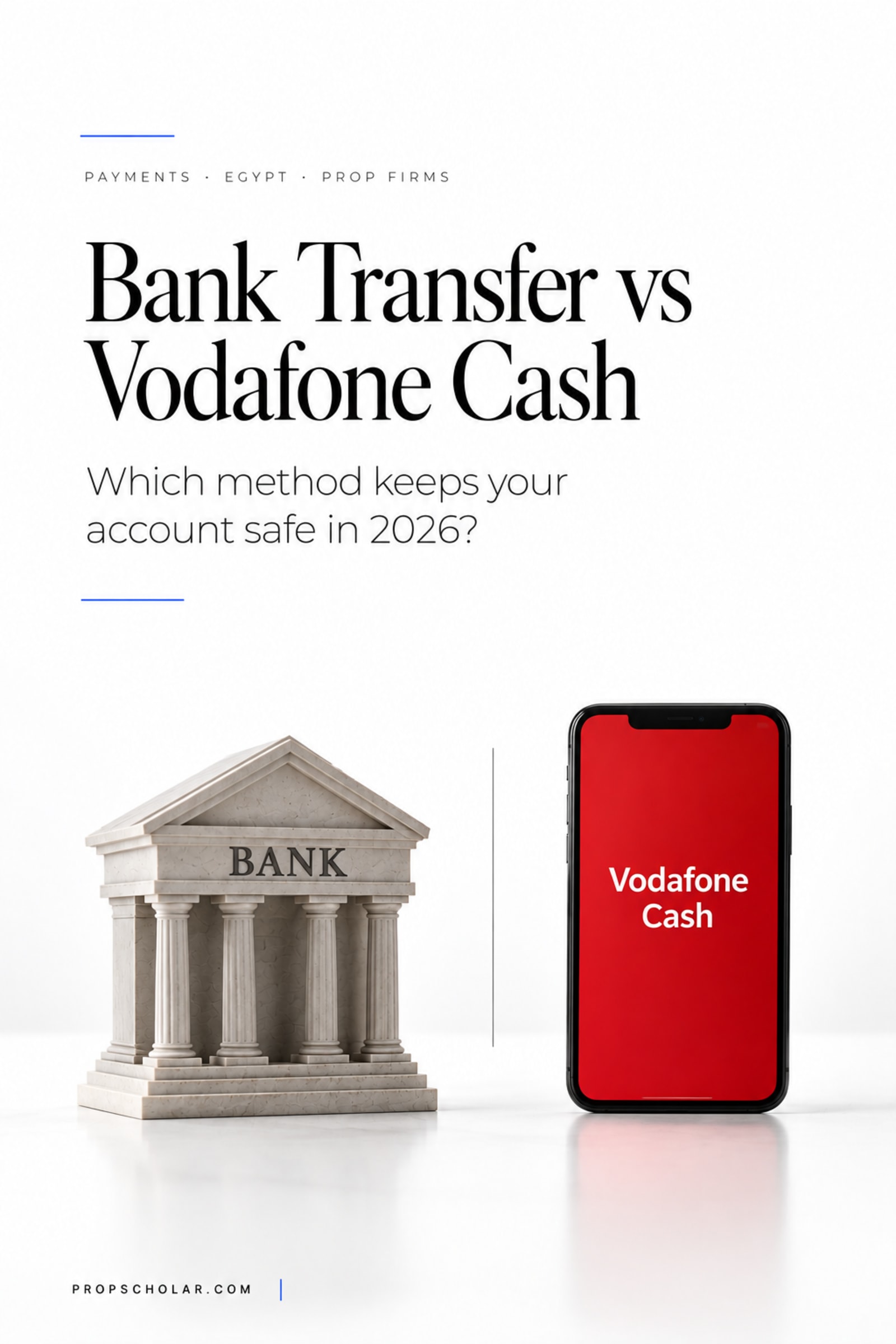
Start your evaluationBank Transfer vs Vodafone Cash for Prop Firm Payments in Egypt: Which Method Keeps Your Account Safe in 2026?
TL;DR: Both bank transfer and Vodafone Cash carry real risks for Egyptian traders paying international trading evaluation platforms in 2026. Crypto is the cleanest workaround — and PropScholar accepts it from as little as $5.
Key takeaways:
- Egyptian bank transfers to international platforms often trigger compliance holds or outright rejections due to foreign currency restrictions.
- Vodafone Cash is faster for domestic use but faces hard limits on international transfers and is not accepted directly by most global evaluation platforms.
- Crypto (USDT via TRC20/BEP20) sidesteps both problems and is accepted globally — including at PropScholar.
- PropScholar is a scholarship-based evaluation platform, not a prop firm, with entry starting at $5 and scholarships paid within 4 hours of verification.
- Your payment method choice can directly affect whether your evaluation fee reaches its destination — and whether your account gets flagged.
You've done your research, picked an evaluation platform, and now you're staring at the payment screen wondering which option won't cause you a headache. If you're in Egypt, this is not a trivial question. The Egyptian banking system has been managing dollar scarcity and foreign currency controls for years, and those pressures don't disappear the moment you try to send a payment to an international trading platform.
The two options most Egyptian beginners consider first are bank transfer and Vodafone Cash. Both are familiar, both feel "safe" because they're local — but neither one was designed with cross-border fintech payments in mind. Let's be direct about what each method actually does when you hit pay.
How Bank Transfers Work for International Trading Payments in Egypt
A standard Egyptian bank transfer to an international recipient — whether that's a wire or a card payment linked to your EGP account — has to pass through foreign currency allocation. Since the Central Bank of Egypt tightened controls on outward capital flows, many retail banks have placed informal or formal caps on what individuals can send abroad, especially for non-essential purchases.
Here's what happens in practice. You try to send EGP to pay for a trading evaluation. The bank converts it (at the official rate, not the parallel market rate), attempts to route it internationally, and the transaction either goes through slowly, gets held for compliance review, or gets rejected entirely. Some banks block transactions to fintech platforms outright because the merchant category code looks unfamiliar.
Even if it goes through, the conversion loss is real. The spread between the official exchange rate and what you'd get converting informally can be significant, meaning you're effectively paying more than the listed price. And if the transaction is rejected after several days, getting your money back is a process that can take weeks.
The risk to your account here isn't just money — it's time. If you've committed to an evaluation window and your payment is held, you may miss it.
Does Vodafone Cash Work for Paying Trading Platforms?
Vodafone Cash is genuinely useful within Egypt. For domestic peer-to-peer transfers, bill payments, and small purchases, it works. But the moment you need to pay an international platform, you hit a wall.
Vodafone Cash is not a SWIFT-enabled international payment tool. It can't send funds abroad directly. Some traders try workarounds — converting Vodafone Cash to a prepaid Visa or Mastercard, for example — but those prepaid cards often fail at international merchants that don't accept Egyptian-issued cards, or they get declined specifically for financial service purchases. Evaluation platforms and scholarship-based trading platforms often fall into a merchant category that triggers automatic declines on restricted cards.
There's also a verification angle. Some platforms require the payment method to match the account holder's name for compliance purposes. A mobile wallet that doesn't carry full KYC or that routes through intermediaries can create mismatches that flag your account — or cause your payment to be treated as unverified, which can delay or invalidate your evaluation access.
So Vodafone Cash is fine for buying groceries. For paying a global trading evaluation platform in 2026, it's genuinely not fit for purpose.
The Real Account Safety Risk Egyptian Traders Miss
When people ask about "account safety" in the context of payments, they usually mean: will my money disappear? But there's a less-discussed risk that matters just as much — will a failed or flagged payment affect my standing on the platform?
On some evaluation platforms, a chargeback initiated by your bank (which can happen automatically if the bank decides the transaction looks unusual) can get your trading account suspended, even if you did nothing wrong. Your bank acts without your knowledge, the platform sees a reversal, and their fraud-prevention system flags your account.
Bank transfers that bounce back after several days can also leave your evaluation fee in limbo — debited from your account but not received by the platform, sitting in a correspondent bank somewhere. Resolving this takes emails, bank statements, and patience.
None of this is the platform's fault. It's the architecture of how Egyptian banking interacts with international fintech. But you're the one who loses evaluation time.
Why Egyptian Traders Are Switching to Crypto Payments
Crypto solves the actual problem, not just the symptom. When you pay with USDT via TRC20 or BEP20, you're moving value directly, wallet to wallet, with no correspondent bank in the middle, no foreign currency allocation request, and no merchant category code to trigger a block.
The transaction confirms in minutes. There's no spread loss beyond the normal network fee, which on TRC20 is negligible. There's no chargeback mechanism — so there's no accidental reversal that flags your account. And the receipt is on-chain, which means you have immutable proof of payment if you ever need to raise a query.
If you're already using Binance or a similar exchange — and many Egyptian traders are, because the peer-to-peer market gives you better rates than official bank channels — you likely already hold USDT. The step from holding USDT to paying a global evaluation platform with it is very small.
This is exactly why PropScholar, as a scholarship-based evaluation platform serving traders worldwide, accepts crypto globally. Traders in Egypt, Nigeria, Indonesia, Vietnam — wherever local banking creates friction with international platforms — can pay from $5 using USDT and get started without the bank-transfer headache.
For a full breakdown of how crypto payments work across different evaluation platforms, this guide on paying for a trading evaluation with crypto covers the mechanics in detail.
What PropScholar Offers Egyptian Traders Specifically
PropScholar is not a prop firm. It's a scholarship-based trading evaluation platform — you pay an entry fee (starting at $5, which converts to well under 200 EGP at current rates), you complete the evaluation, and if you pass, you claim a scholarship of up to 400% of your fee, paid within 4 hours of verification.
The platform has been operating for over 1.5 years, is registered as a Private Limited company in India, and has a public ruleset that has never been changed retroactively. That last point matters — in the evaluation world, rule changes after you've paid are a genuine concern, and PropScholar's approach here is one of the things that separates it from less transparent operators.
For Egyptian traders specifically, the crypto payment route means you're not dependent on your bank's mood that day. You're not losing money to a bad conversion rate. You're not waiting three business days to find out whether your payment went through.
Evaluation Costs in Real Terms
At $5 for the smallest challenge, you're talking about a genuinely accessible entry point. Compare that to many global evaluation platforms where the cheapest tier starts at $50 to $100 — amounts that require navigating Egyptian banking restrictions just to transfer, with real conversion losses on top. PropScholar's pricing was built with traders in emerging markets in mind.
Payout Speed That Matters
Scholarships are paid within 4 hours of verification. That's not a vague "fast" — it's a specific commitment. For traders who have dealt with platforms that take weeks to process payouts or require multiple KYC rounds before releasing funds, this is a meaningful difference.
Choosing the Right Payment Method: The Honest Verdict
If you're paying a local Egyptian merchant, Vodafone Cash and bank transfer are both fine. That's what they were built for.
For international trading evaluation platforms in 2026, neither holds up well. Bank transfers carry the risk of delays, rejections, conversion losses, and accidental chargebacks that can flag your account. Vodafone Cash simply can't complete the journey to most international platforms.
Crypto — specifically USDT on TRC20 — is the payment method that actually works. It's fast, traceable, and has no intermediary that can block or reverse the transaction without your involvement. If you're serious about trading and serious about not losing your evaluation fee to payment friction, it's the clear choice.
PropScholar accepts it globally, starting at $5, and pays scholarships within 4 hours. Questions? Reach the team at business@propscholar.com or get live answers in the PropScholar Discord community, where 3,000+ traders from across the world — including Egypt — are active right now.
Frequently Asked Questions
Can I pay for a prop firm or trading evaluation using a bank transfer from Egypt? Technically yes, but in practice Egyptian bank transfers to international platforms often get delayed, held for compliance review, or rejected outright due to foreign currency restrictions. Even when they succeed, the EGP-to-USD conversion at the official rate can mean you pay more than the listed price. For most Egyptian traders, crypto is a more reliable route in 2026.
Does Vodafone Cash work for paying trading evaluation platforms internationally? No — Vodafone Cash is a domestic mobile wallet and cannot send funds to international platforms directly. Some traders try routing through prepaid cards linked to Vodafone Cash, but these frequently get declined at international fintech merchants. It's not a practical payment method for global trading evaluations.
Is crypto safe to use for paying a trading evaluation fee in Egypt? Using USDT on TRC20 or BEP20 to pay for a trading evaluation is technically straightforward and avoids the bank friction Egyptian traders face with international transfers. Transactions are confirmed in minutes and are on-chain, so you have verifiable proof of payment. The main thing to confirm is that the platform accepts crypto — PropScholar does, from $5.
What is PropScholar and how does it work for Egyptian traders? PropScholar is a scholarship-based trading evaluation platform, not a prop firm. You pay an entry fee starting at $5, complete a trading evaluation, and if you pass, you receive a scholarship of up to 400% of your entry fee, paid within 4 hours of verification. It accepts crypto globally, making it accessible to Egyptian traders who face local banking restrictions on international payments.
What is the cheapest way for an Egyptian trader to access a trading evaluation in 2026? PropScholar's evaluations start at $5 — under 200 EGP at current rates — and accept USDT via crypto, bypassing Egyptian bank transfer complications. That's significantly lower than most global evaluation platforms, which typically start at $50 or more. Paying in crypto also avoids currency conversion losses.
Can a failed payment flag or suspend my trading account? Yes. If your bank initiates an automatic chargeback on a failed international transaction, some platforms' fraud-prevention systems will flag or suspend the associated account, even if you did nothing wrong. Crypto payments eliminate this risk because there is no chargeback mechanism — the transaction either confirms or it doesn't, with no intermediary reversal.
How quickly does PropScholar pay out scholarships after evaluation? PropScholar pays scholarships within 4 hours of verification after a successful evaluation. This is a specific, stated commitment — not a vague turnaround estimate. For traders in Egypt and other emerging markets used to slow international payouts, this timeline is one of the clearest practical advantages the platform offers.
PropScholar is a scholarship-based trading evaluation platform operated by a Private Limited company registered in India. We are not a prop firm and do not manage or allocate institutional capital. Our model rewards proven trading skill with scholarship grants upon successful evaluation completion.
Related reading
- Best Prop Firm You Can Pay With UPI in 2026
- Cheap Prop Firm You Can Pay With UPI in India (2026)
- Best Prop Firm You Can Pay With PayPal (No Crypto Needed)
- Best UPI-Friendly Trading Evaluation for Indian Beginners 2026
- Crypto USDT vs Card Payment: Which Payout Route Is Actually Faster in 2026
- Can You Pay for a Trading Evaluation With Crypto? A Global Guide
Ready to Prove Your Edge?
Join 500+ traders. Start from just $5. Get funded within days.
Frequently Asked Questions
Technically yes, but in practice Egyptian bank transfers to international platforms often get delayed, held for compliance review, or rejected outright due to foreign currency restrictions. Even when they succeed, the EGP-to-USD conversion at the official rate can mean you pay more than the listed price. For most Egyptian traders, crypto is a more reliable route in 2026.