Cheap Prop Firm Scam Model Explained: How to Spot It Fast
Cheap prop firms are easy to fake. Learn exactly how the fee-collection scam works, which 3 rule traps cause most losses, and how to verify a legit evaluation.
Cheap prop firms are easy to fake. Learn exactly how the fee-collection scam works, which 3 rule traps cause most losses, and how to verify a legit evaluation.
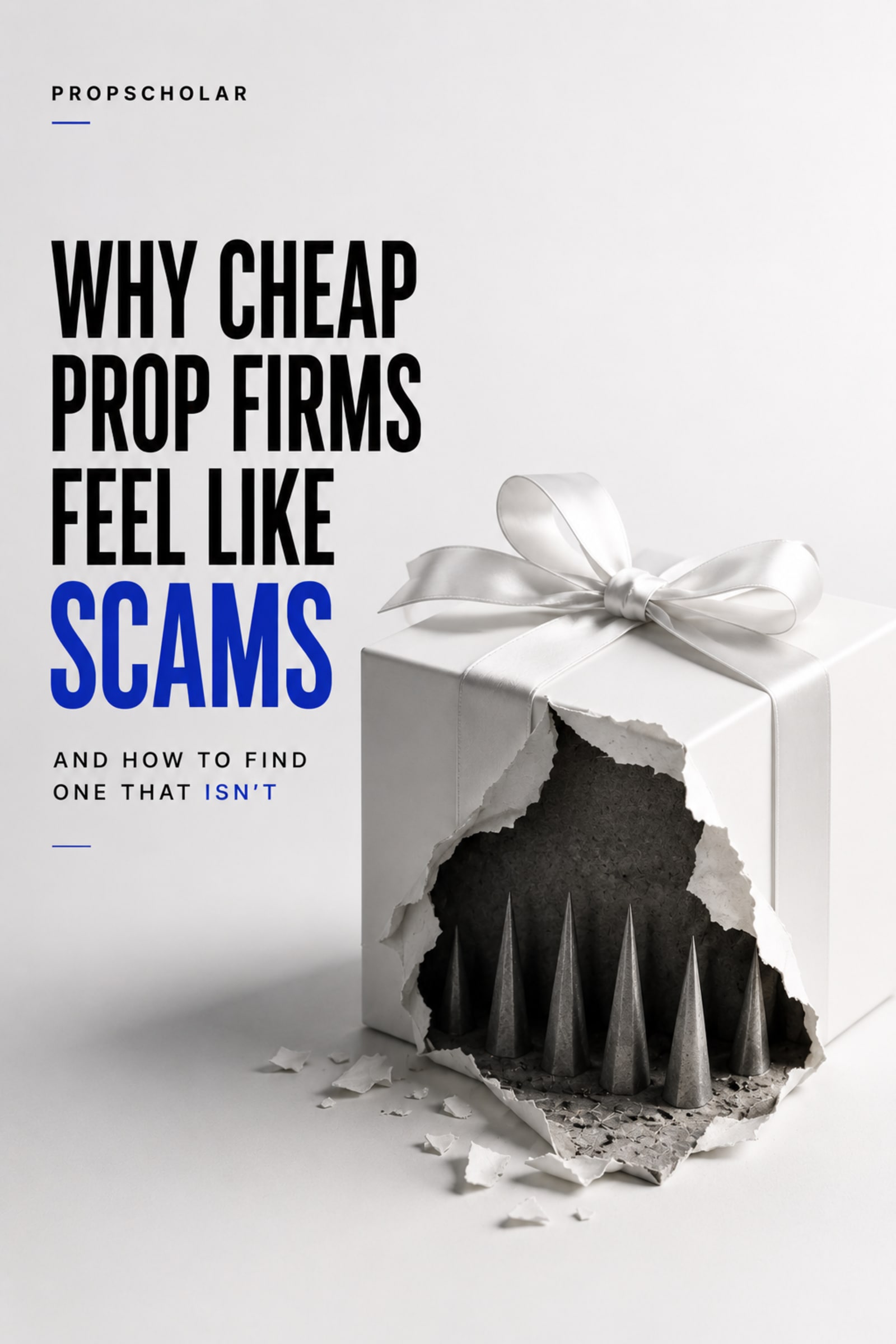
Start your evaluationWhy Cheap Prop Firms Feel Like Scams — And How to Find One That Isn't
TL;DR: Most cheap prop firms aren't worth your money — not because cheap is inherently bad, but because the model is trivially easy to fake. This guide shows you exactly how the scam works and what a genuinely cheap, verifiable evaluation looks like in 2026.
Key takeaways:
- The cheap prop firm space is full of platforms that collect fees but engineer payouts to be nearly impossible to claim.
- Three specific red flags — the 15% consistency rule, "instant funding" with no verification, and unverifiable payouts — account for most of the pain.
- A legitimate cheap evaluation exists, but you have to verify registration, payout proof, and rule stability before paying anything.
- PropScholar offers a $1 trial and evaluations from around $5, with 4-hour payouts, a scannable payout certificate, and a publicly registered company behind it.
- You can verify every PropScholar payout at propscholar.com/payout-proof before you pay a single dollar.
You found a prop firm charging $6. You're a trader on a tight budget — maybe you're in Lagos, Manila, or Jaipur — and this sounds like exactly what you needed. Cheap entry, big funded account, simple rules. You pay. You pass. Then the payout request goes unanswered for three weeks, and eventually you realize the platform is gone.
That scenario isn't rare. It's the defining experience of the cheap prop firm segment in 2026. But here's the thing: cheap doesn't have to mean scam. The problem isn't the price — it's the business model running underneath it.
Let me break down exactly why the cheap segment is so scam-heavy, and then show you what a legitimate cheap option actually looks like.
Why the Cheap Prop Firm Market Attracts Bad Actors
The model is brutally easy to fake. You build a white-label trading platform over a weekend, set a low entry fee to attract volume, and structure the rules so that almost nobody qualifies for a payout. Collect fees from hundreds of traders. Pay out nobody. The business is profitable without ever sending a single dollar to a trader.
This is not speculation — it's how the math works. A platform charging $8 per evaluation and onboarding 500 traders in a month collects $4,000. If they pay out zero, that's pure revenue. The entry fee IS the product. The evaluation is theater.
Expensive platforms have some natural incentive to actually pay — their brand and marketing budget depends on visible payout proof. A cheap platform that targets beginners in emerging markets is betting that most of those traders won't have enough reach to burn their reputation meaningfully. It's a cynical calculation, and it works often enough that new platforms copy it constantly.
The Three Mechanisms Cheap Scam Platforms Use
Knowing the pattern means you can spot it before you pay. These three mechanics show up again and again.
The 15% Consistency Rule (And Why It's a Trap)
A consistency rule sounds reasonable on paper: it says no single trade should account for more than a certain percentage of your total profit. Fifteen percent is the most common version. In practice, it means that if you have one great trade — even a perfectly valid one — you can fail the evaluation retroactively.
This rule is almost impossible to satisfy in a short challenge window unless you're trading dozens of positions with identical sizing every single day. It's designed to fail you. It gives the platform a clean, rule-based reason to deny your payout without looking obviously dishonest.
If you see a "consistency rule" in a platform's terms, read it carefully. Then ask yourself: can I realistically hit the profit target without any single trade being my best trade? The answer is usually no.
"Instant Funding" With No Evaluation
Instant funding sounds like a win — skip the challenge, get a live account immediately. What it actually means in the cheap segment is that there's no verification of your skill, no real capital at risk for the platform, and often, no intent to pay. The "live account" you receive may be a simulated environment with no actual backing.
Some instant-funding setups are legitimate, but in the cheap space, it's one of the most reliable warning signs. Platforms that skip evaluation entirely have no process for weeding out losing traders, which means if real capital were actually involved, they'd go bankrupt immediately. The conclusion that follows from that is uncomfortable.
For a more detailed look at how this model operates, Alternatives to Instant Funding Accounts That Actually Pay Out is worth reading before you commit.
Payouts That Are Unverifiable (Or Just Never Arrive)
Every legitimate platform has proof of payouts. Not screenshots — those are trivially faked. Actual verifiable records: a unique transaction code, a certificate you can look up on their site, a Discord where real traders post their payout confirmations.
If a cheap platform has no public payout proof, that's not an oversight. It means there's nothing to show. The absence of verifiable payouts is the single biggest predictor of a platform that won't pay you.
What a Legitimate Cheap Prop Firm Evaluation Actually Looks Like
Cheap and legit can coexist — it just requires the platform to have a business model that doesn't depend on failing you.
A legitimate evaluation platform makes money from entry fees, yes, but it builds its business on volume and reputation over time. That means it actually needs to pay traders who pass, because visible payout proof is what drives the next hundred sign-ups. The incentive structure is different from a fee-collection scam.
Here's what you should be able to verify before paying anything:
Company registration. A real platform has a registered legal entity you can look up. Not a name — an actual registration number in a public database.
Public payout proof that's verifiable, not just screenshot-based. This means a scannable certificate or a unique code you can cross-check on the platform's own site.
Rules that haven't changed retroactively. One of the quieter scam tactics is changing challenge rules after traders have already paid. A legitimate platform publishes its rules clearly and never moves the goalposts on an active challenge.
No gimmick consistency rule. Clean profit target, drawdown limits, and time window — nothing engineered to make it impossible to collect.
Responsive support before you've paid. If you can't get a clear answer to a question before handing over money, you definitely won't get one when you need a payout.
For a full pre-payment checklist, The Safety Checklist Every Trader Should Use Before Paying a Fee covers every step.
PropScholar: The Cheap-but-Verifiable Answer
I'm not going to pretend PropScholar is the only legitimate option out there. But I can tell you exactly what makes it the verifiable answer to the search query you typed.
The Real Costs — No Hidden Tiers
PropScholar's cheapest entry point is a $1 trial (approximately Rs.90 at checkout) at propscholar.com/trial. Full evaluations start from around $5, with the exact INR amount shown at checkout depending on the account size you choose. There is no invented $2 or $3 tier — if someone is searching for a "$2 challenge", the honest answer is that the $1 trial or the ~$5 entry is what's available, and both are real.
The scholarship on a successful evaluation can reach up to 400% of the entry fee. That's the model: you prove your skill, you get a scholarship grant paid directly to you.
Payout Verification That's Actually Public
Every PropScholar payout comes with a scannable certificate and a unique verification code you can check at propscholar.com/payout-proof. This isn't a screenshot gallery. It's a lookup system — you enter the code, you see the payout record. You can do this before you sign up. Right now, before spending a rupee or a dollar.
Payments process within 4 hours of verification. That's not a vague "fast" claim — it's a specific number that traders in the 3,000+ member Discord regularly confirm publicly.
No Consistency Rule
There's no 15% consistency trap in PropScholar's evaluation rules. The rules are public, they've never been changed retroactively, and they're written in plain language. If you hit the profit target without breaching the drawdown limits, you pass. That's it.
For a deeper look at why this matters, Cheap Prop Firm No Consistency Rule 2026: Skip the 15% Trap explains the mechanic in detail.
The Legal and Registration Layer
PropScholar Private Limited is registered in India under the MCA with CIN U85499JH2026PTC027330. That's a verifiable public record — not a brand name, an actual company you can look up. This matters because a platform with legal existence has more accountability than one that doesn't.
PropScholar is not a prop firm. It doesn't manage or allocate institutional capital. It's a scholarship-based trading evaluation platform — you pay an entry fee, you pass an evaluation, you receive a scholarship grant. The model is clear and public.
Payment Options for Global Traders
For Indian traders, PropScholar accepts UPI — GPay, PhonePe, Paytm — in rupees, processed via PhonePe/Razorpay/Cashfree. For everyone else globally, crypto (USDT, BTC, LTC) is available. PayPal is also supported. You don't need to be in India to use this platform.
What You Get Beyond the Evaluation
Buying an evaluation unlocks Scholaris AI, an MT5-sync trading journal, Trade Map and analytics tools. These aren't marketing features — they're practical tools that help you actually pass. The support is 24/7 with Hindi-language capability and multi-language responsiveness.
Your Pre-Payment Checklist for Any Cheap Evaluation
Use this before you pay anyone, PropScholar included.
Can I look up their company registration? If the answer is no, stop.
Do they have public payout proof with a verification system? Screenshots don't count. You want something you can independently look up.
Are their rules written in plain language and publicly posted? Vague rules are payout traps waiting to spring.
Is there a consistency rule? Read it carefully. Calculate whether it's actually achievable with realistic trading.
Is "instant funding" the main pitch? Be skeptical. Ask what backs it.
Can you reach support before paying? Try. See what happens.
Is there an active community where traders post results? A ghost Discord with no recent activity is a signal.
If a platform passes all seven of these, the low entry price stops being a red flag and starts being a genuine advantage — especially if you're in a market where $50 challenge fees represent a real financial strain.
For a deeper version of this checklist applied to a specific platform comparison, Cheap but Legit Prop Firm 2026: How to Spot Scams and Find the Real One is worth bookmarking.
The Bottom Line on Cheap Prop Firms in 2026
Cheap isn't the problem. The business model hidden behind the cheap price is the problem. A platform that needs you to fail is dangerous at any price point. A platform that needs you to succeed — because your visible payout is their next marketing asset — is fundamentally different, even if it charges the same $5.
The way to tell them apart is verification, not price. Look for a real company registration, a payout proof system you can actually use, clean rules with no consistency trap, and a community where traders talk openly.
PropScholar was built specifically because this gap existed. A $1 entry at propscholar.com/trial, evaluations from around $5, payouts verified with a scannable certificate, and a registered company behind all of it. If you're skeptical, the payout proof is public. Go check it before you decide anything.
Frequently Asked Questions
Are cheap prop firms scams? Not all of them, but a significant portion of cheap prop firm platforms are structured to collect entry fees rather than pay traders. The warning signs are a 15% consistency rule, unverifiable payouts, and no public company registration. A cheap evaluation can be legitimate if the platform has verifiable payout proof, clear rules, and a registered legal entity — all of which you can check before paying.
What is the cheapest legit prop firm evaluation in 2026? PropScholar offers a $1 trial (around Rs.90) at propscholar.com/trial — currently one of the lowest verifiable entry points available globally. Full evaluations start from around $5. Payouts are processed within 4 hours of passing and come with a scannable certificate you can verify at propscholar.com/payout-proof.
What is the 15% consistency rule and why is it a problem? The 15% consistency rule says no single trade can account for more than 15% of your total profit during a challenge. In practice it means one strong trade — even a valid one — can disqualify you retroactively. It's commonly used by cheap platforms to deny payouts without appearing dishonest. PropScholar has no such rule.
How do I verify a prop firm payout is real before I sign up? Look for a payout verification system, not just screenshots. PropScholar's payouts each have a unique code and scannable certificate at propscholar.com/payout-proof — you can check these records right now, before paying anything. Also check their trader community; a real Discord where traders post payout confirmations publicly is a strong signal.
Can traders outside India use PropScholar? Yes. PropScholar serves traders globally. Indian traders pay via UPI (GPay, PhonePe, Paytm) in rupees. Traders everywhere else can pay with crypto (USDT, BTC, LTC) or PayPal. The platform is not India-only despite being registered there.
What makes PropScholar different from a prop firm? PropScholar is a scholarship-based trading evaluation platform, not a prop firm. It does not manage or allocate institutional capital. The model is: pay an entry fee, pass an evaluation proving your trading skill, and receive a scholarship grant of up to 400% of the entry fee. The company is registered in India (CIN U85499JH2026PTC027330) and its rules have never been changed retroactively.
What should I do if I can't afford even a $5 evaluation? Start with the $1 trial at propscholar.com/trial. It's the lowest-risk way to experience how the evaluation process works, check the platform's responsiveness, and verify the system before committing to a full challenge. At roughly Rs.90, it's a realistic starting point even on a very tight budget.
PropScholar is a scholarship-based trading evaluation platform operated by a Private Limited company registered in India. We are not a prop firm and do not manage or allocate institutional capital. Our model rewards proven trading skill with scholarship grants upon successful evaluation completion.
Related reading
- The Safest Way for a College Student to Start Trading and Not Lose Money
- Is PropScholar Legit or Fake? The Honest 2026 Review Every Trader Should Read Before Paying
- Is Online Prop Trading Legit or a Scam? A Complete Trust Guide
- Are Free Funded Accounts Real? What 'Free' Prop Offers Actually Cost You
- Cheap Prop Firms Are a Scam: How PropScholar Gives You the Easiest Evaluation and a Real Path to Reliable Funded Trading
- Which Trading Platforms Actually Pay Fast: What to Verify First
Ready to Prove Your Edge?
Join 500+ traders. Start from just $5. Get funded within days.
Frequently Asked Questions
Not all of them, but a significant portion of cheap prop firm platforms are structured to collect entry fees rather than pay traders. The warning signs are a 15% consistency rule, unverifiable payouts, and no public company registration. A cheap evaluation can be legitimate if the platform has verifiable payout proof, clear rules, and a registered legal entity — all of which you can check before paying.