
Prop Firm Costs in PKR: How Many Attempts to Break Even?
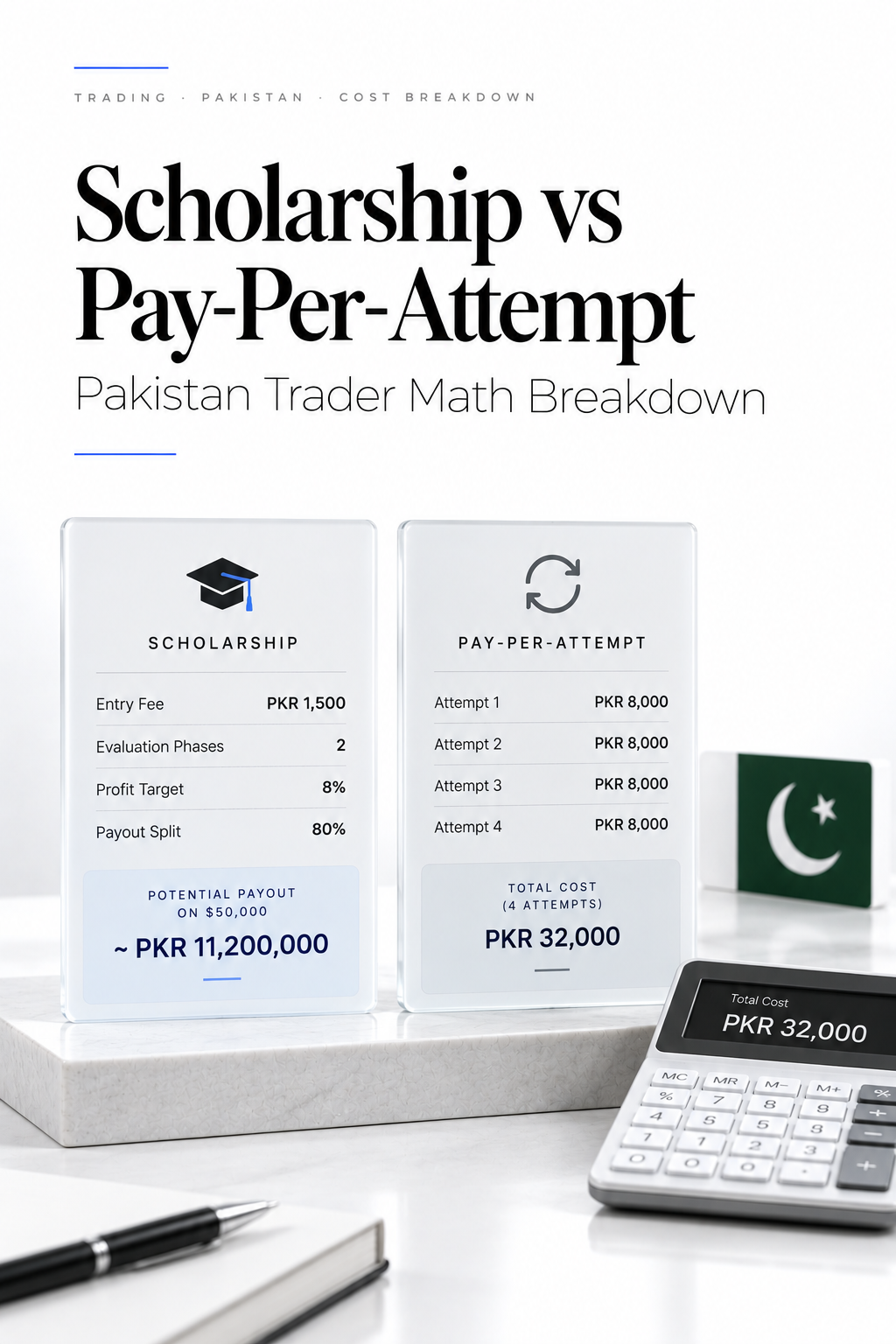
Pakistani traders: see the real PKR math on pay-per-attempt fees across 2–3 attempts vs scholarship evaluation starting at $5 (~Rs. 1,400).
Pakistani traders: see the real PKR math on pay-per-attempt fees across 2–3 attempts vs scholarship evaluation starting at $5 (~Rs. 1,400).
Start your evaluationScholarship vs Pay-Per-Attempt: Pakistan Trader Math Breakdown
TL;DR: When you do the actual math over two or three attempts, scholarship-based evaluation is almost always cheaper than pay-per-attempt prop firms for Pakistani traders — and PropScholar's $5 starting point makes that gap enormous.
Key takeaways:
- The entry fee alone is not the right number to compare — total cost over realistic attempts is.
- Pay-per-attempt models charge you full price every time you fail. That compounds fast in PKR.
- PropScholar is a scholarship-based evaluation platform starting at $5 (roughly Rs. 1,400), with scholarships up to 400%.
- Scholarships are paid within 4 hours of verification.
- PropScholar accepts crypto globally, so Pakistani traders can actually enter without payment friction.
You've probably seen prop firm ads promising a funded account for a few hundred dollars. You check the price, it looks reasonable. Then you fail the evaluation once — maybe twice — and suddenly you've spent more than a month's salary trying to prove you can trade. That's the trap most Pakistani traders don't see coming until they're already in it.
This isn't about blaming platforms. It's about understanding two fundamentally different business models, then doing the arithmetic yourself before you pay anything.
Let's do it together.
What Does Pay-Per-Attempt Actually Mean?
Pay-per-attempt is exactly what it sounds like: every time you fail the evaluation, you pay the full entry fee again to get another shot. There's no rollover, no credit, no memory of your previous attempt. The platform keeps your fee and resets the clock.
For a standard evaluation on a well-known global platform, the fee might be anywhere from $50 to $200 depending on account size. At today's exchange rate — somewhere around PKR 278-285 per dollar — a $100 fee is roughly Rs. 28,000. That's serious money for most Pakistani traders who are working full-time or studying.
Now think about your first year of trading. Are you going to pass a disciplined evaluation on your first try? Maybe. But most people don't. The rules are strict: daily drawdown limits, maximum drawdown, profit targets, minimum trading days. One bad session on a volatile news day and the attempt is over.
Two failed attempts at $100 each is Rs. 56,000 gone before you've earned a single rupee.
What Does Scholarship-Based Evaluation Mean?
Scholarship-based evaluation is a different model entirely. You pay a fee to enter an evaluation — not to buy access to real capital, but to demonstrate your trading skill. If you pass, you receive a scholarship grant: a cash reward based on your demonstrated performance. If you don't pass, you paid for a structured practice environment and a shot at a real reward.
PropScholar is a scholarship-based evaluation platform, not a prop firm. It doesn't claim to manage institutional capital or allocate real funds. What it does is reward traders who can prove skill with scholarships of up to 400%, paid within 4 hours of verification.
The key number: evaluations start at $5. That's roughly Rs. 1,400 at current rates. That's not a typo.
That's the cost of two cups of coffee in Lahore, or about one hour of tuition center fees. It's a genuinely accessible entry point for a trader in Karachi or Islamabad who wants to prove their skill without betting a month's income on a single attempt.
For more on how the model structure protects traders from the risks of instant-funding approaches, the PropScholar vs instant-funding model breakdown is worth reading.
The Math: Three Attempts at Each Model
Let's make this concrete. We'll use a mid-tier evaluation as a benchmark.
Pay-Per-Attempt Model — Three Attempts
Assume you're targeting a reasonable account size. The evaluation fee is $80 on a typical global pay-per-attempt platform. You fail once (drawdown violation on a bad GBP/USD session), pay again, fail again (hit the max daily loss during a Federal Reserve announcement), and finally pass on your third attempt.
Total spent: $240, which is roughly Rs. 67,000 at current rates. And that's assuming you pass on the third try. Some traders take five or six attempts.
That's Rs. 67,000 to get access to a funded account. The scholarship or profit split you'd then earn needs to clear that cost before you're actually ahead.
PropScholar Scholarship Model — Three Attempts
At PropScholar, let's say you enter a $5 evaluation three times — worst case, you need a few tries to understand the rules and sharpen your discipline.
Total spent: $15, or roughly Rs. 4,200.
Even if you enter a slightly higher-tier evaluation at $20 three times, you're at $60, around Rs. 17,000. You're still Rs. 50,000 ahead of the pay-per-attempt scenario.
That difference is real. For a Pakistani trader on a limited budget, Rs. 50,000 is groceries for two months, or a significant part of your monthly income.
Why Pakistani Traders Specifically Feel This Pain
The currency mismatch is brutal. When a platform prices its evaluation in dollars and you're earning in rupees, a fee that looks modest in USD can represent weeks of savings in PKR. The dollar has appreciated significantly against the PKR over the past few years, which means every dollar-denominated evaluation fee hits harder than it did before.
On top of that, payment access is genuinely difficult. Most international prop firms accept credit cards, PayPal, or bank wires — none of which are straightforward for Pakistani traders. Easypaisa and JazzCash don't plug neatly into foreign payment processors. This friction alone causes many Pakistani traders to either give up or route payments through expensive workarounds.
PropScholar accepts crypto globally. That's the practical solution for Pakistani traders: USDT or another cryptocurrency, purchased locally and sent directly. No bank wire needed, no forex conversion drama at a physical branch. You enter the evaluation and start trading.
The honest math breakdown for Pakistani students specifically covers this payment side in more detail if you want to go deeper on the mechanics.
The Hidden Cost That Never Shows Up in Ads
Pay-per-attempt platforms have one more cost that's almost never advertised: the psychological cost of a high-stakes single attempt.
When you've paid Rs. 28,000 for an evaluation slot, every trade carries enormous pressure. You're not trading your strategy — you're trading your fear of losing that money again. That changes your decisions. You move stop losses, you close profitable trades too early, you hesitate on setups you'd normally take confidently.
This is why so many experienced traders fail prop evaluations that are supposedly within their skill level. The high-stakes single-attempt structure works against you psychologically.
At $5 per attempt, the mental load is different. You're still serious — the scholarship reward is real and meaningful — but you're not in survival mode. You trade closer to how you actually trade in your best sessions. That's not a small advantage.
We've seen this pattern clearly in how PropScholar's community members approach their evaluations. Traders who treat the low entry point as a reason to apply their real strategy tend to perform better than those who treat even small fees as do-or-die moments. A comparison of results across different evaluation model structures — including among traders in markets like Vietnam, Thailand, and Malaysia — shows the same dynamic: accessible entry changes trader behavior for the better. See the funded trading evaluation comparison across Southeast Asia for how this plays out across different markets.
PropScholar's Scholarship Model: What the Numbers Actually Look Like
Let's be specific about what PropScholar offers, because vague claims don't help you make a real decision.
Entry Point
Evaluations start at $5, or roughly Rs. 1,400. This is not a teaser for a hidden upgrade — it's a real evaluation with real scholarship potential.
Scholarship Size
The scholarship can go up to 400% of what you put in. That's the upside you're working toward. The exact amount depends on the evaluation tier you choose.
Payout Speed
Scholarships are paid within 4 hours of verification. That's not "a few business days" or "after our internal review cycle" — it's 4 hours. For a Pakistani trader who's been burned by platforms that drag out payouts, this matters.
Payment for Pakistani Traders
Crypto is accepted globally. Buy USDT in Pakistan through a local P2P exchange, send it to PropScholar, and your evaluation is live. No international bank wire, no credit card requirement.
Community and Support
PropScholar has 3,000+ traders in its Discord community, 24/7 support in multiple languages including Hindi (and the team communicates with South Asian traders regularly), and has been operating for over 1.5 years. The rules have never been changed retroactively — what you read when you sign up is what applies to your evaluation.
For traders in similar situations in other parts of the world, the model works the same way. The Mexico trader comparison is a useful parallel — different currency, same core problem solved by low entry fees and crypto access.
Which Model Actually Makes Sense For You?
If you're an experienced trader with a solid track record, deep capital reserves, and a reliable way to pay in dollars, high-tier pay-per-attempt evaluations can make sense. The profit splits on large funded accounts can be significant, and one pass justifies the cost.
But if you're a Pakistani trader who's still developing consistency, working within a tight rupee budget, or simply doesn't want to bet Rs. 30,000+ on a single attempt with rules you might not fully understand yet — the math is clear. A scholarship-based model at $5 per entry is not just cheaper in absolute terms. It's cheaper in expected value across realistic outcomes.
Start where the cost of learning is low. Graduate to higher tiers as your win rate improves. Don't let the fear of a large entry fee push you to overtrade one precious attempt.
Frequently Asked Questions
Is scholarship-based evaluation actually cheaper than pay-per-attempt for Pakistani traders?
Yes, when you account for realistic multiple attempts. A pay-per-attempt evaluation priced at $80-$100 costs Rs. 22,000-28,000 per try. PropScholar's scholarship evaluations start at $5 (about Rs. 1,400). Over two or three attempts — which most traders need — the scholarship model costs dramatically less even before you factor in any scholarship earned.
How do Pakistani traders pay for PropScholar evaluations?
PropScholar accepts cryptocurrency globally. Pakistani traders typically buy USDT through a local P2P exchange and send it directly. There's no need for an international credit card, PayPal, or bank wire, which removes the biggest payment barrier Pakistani traders face with foreign platforms.
What is PropScholar exactly — is it a prop firm?
No. PropScholar is a scholarship-based trading evaluation platform, not a prop firm. It does not manage or allocate institutional capital. You pay an entry fee, complete a trading evaluation, and if you pass, you receive a scholarship grant of up to 400%, paid within 4 hours of verification.
What happens if I fail a PropScholar evaluation?
You lose the entry fee — that's the real cost and it's honest. But since entry starts at $5, the loss is minimal. You can re-enter at any time. The rules are published publicly and have never been changed retroactively, so what you're testing yourself against when you re-enter is exactly what you studied.
How quickly does PropScholar pay out scholarships?
Scholarships are paid within 4 hours of verification once you pass an evaluation. This is a firm, specific number — not a vague promise. For traders in Pakistan who've experienced long waits from international platforms, this speed is a meaningful practical difference.
Can a beginner trader in Pakistan realistically pass a PropScholar evaluation?
Beginners can enter and attempt it — the low entry fee makes experimentation feasible. That said, passing requires genuine discipline: managing drawdown, hitting profit targets, and trading consistently. The low cost means you can use early attempts to understand the rules before scaling up to higher-tier evaluations as your skills improve.
Is PropScholar available globally or just in India?
PropScholar operates globally. It's registered as a Private Limited company in India, but traders from Pakistan, Nigeria, the Philippines, Indonesia, South Africa, Kenya, and dozens of other countries can access it via crypto payment. The platform is not limited to Indian traders.
PropScholar is a scholarship-based trading evaluation platform operated by a Private Limited company registered in India. We are not a prop firm and do not manage or allocate institutional capital. Our model rewards proven trading skill with scholarship grants upon successful evaluation completion.
Related reading
- Best $1 Trading Challenge 2026: Why 1K 1-Step Wins
- Cheapest Legit Way to Access a Funded-Style Trading Account From $5
- Best Prop Firm in India 2026 (UPI-Friendly): Honest Comparison
- Prop Firm Challenge Under $5: Cheapest Legit Funded Accounts Compared
- Cheapest Prop Firm in 2026: The Complete Price Comparison Guide (From ₹300 With FIFA Discount)
- Pay-After-Pass Prop Firms: What the Alternative Actually Is
Ready to Prove Your Edge?
Join 500+ traders. Start from just $5. Get funded within days.
Frequently Asked Questions
Yes, when you account for realistic multiple attempts. A pay-per-attempt evaluation priced at $80-$100 costs Rs. 22,000-28,000 per try. PropScholar's scholarship evaluations start at $5 (about Rs. 1,400). Over two or three attempts — which most traders need — the scholarship model costs dramatically less even before you factor in any scholarship earned.
More From PropScholar

Trading Comparison
Prop Firm Fees in INR, Naira & Crypto: Real Costs Explained
12 min read

Trader Safety
Is Pay After Pass Legit or Not? The Honest Answer for 2026
11 min read
Trading Comparison
Free Scholarship vs Paid Challenge: The Real Cost of 'Risk-Free' Evaluations When Retry Fees Are Hidden
13 min read
Trading Comparison
Easypaisa vs JazzCash for Prop Evaluations: Pakistan Payment Safety Guide
14 min read
Trading Comparison
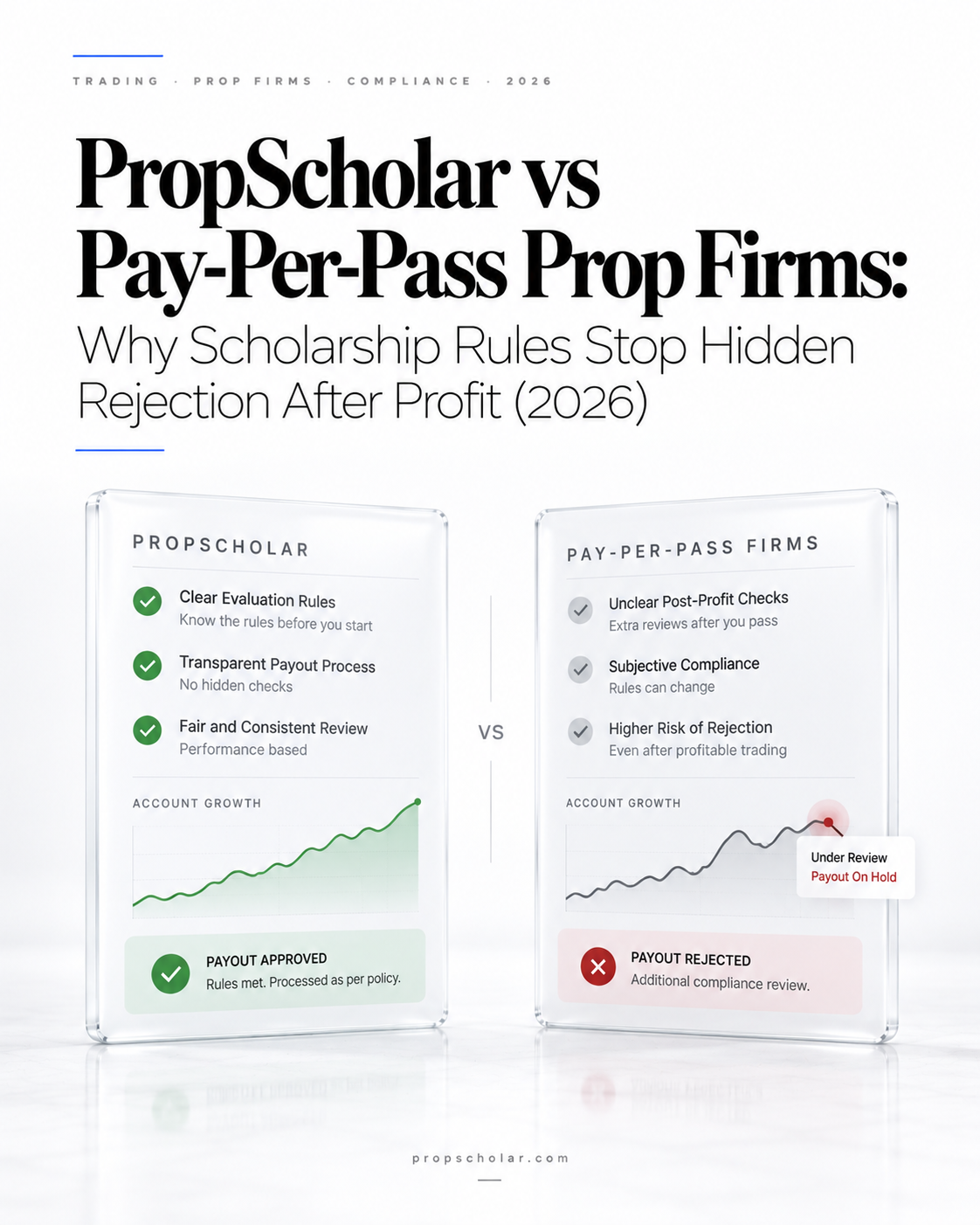
Post-Profit Rejection Explained: Scholarship Rules vs Prop Firms
11 min read
Trading Comparison
Hidden Reset Costs in Trading Evaluations: Full Breakdown
13 min read