One Account, One Pass Rule: Why Bangladesh Traders Can't Retry a Failed Evaluation Cheaply
Bangladesh traders face a brutal reality at most prop evaluation platforms: fail once and you're paying full price again. This article breaks down why the one-account-per-trader rule exists, what it actually costs to retry at different platforms, and how PropScholar's $10 entry fee changes the math for Bangladeshi traders who can't afford to throw money at repeated attempts.
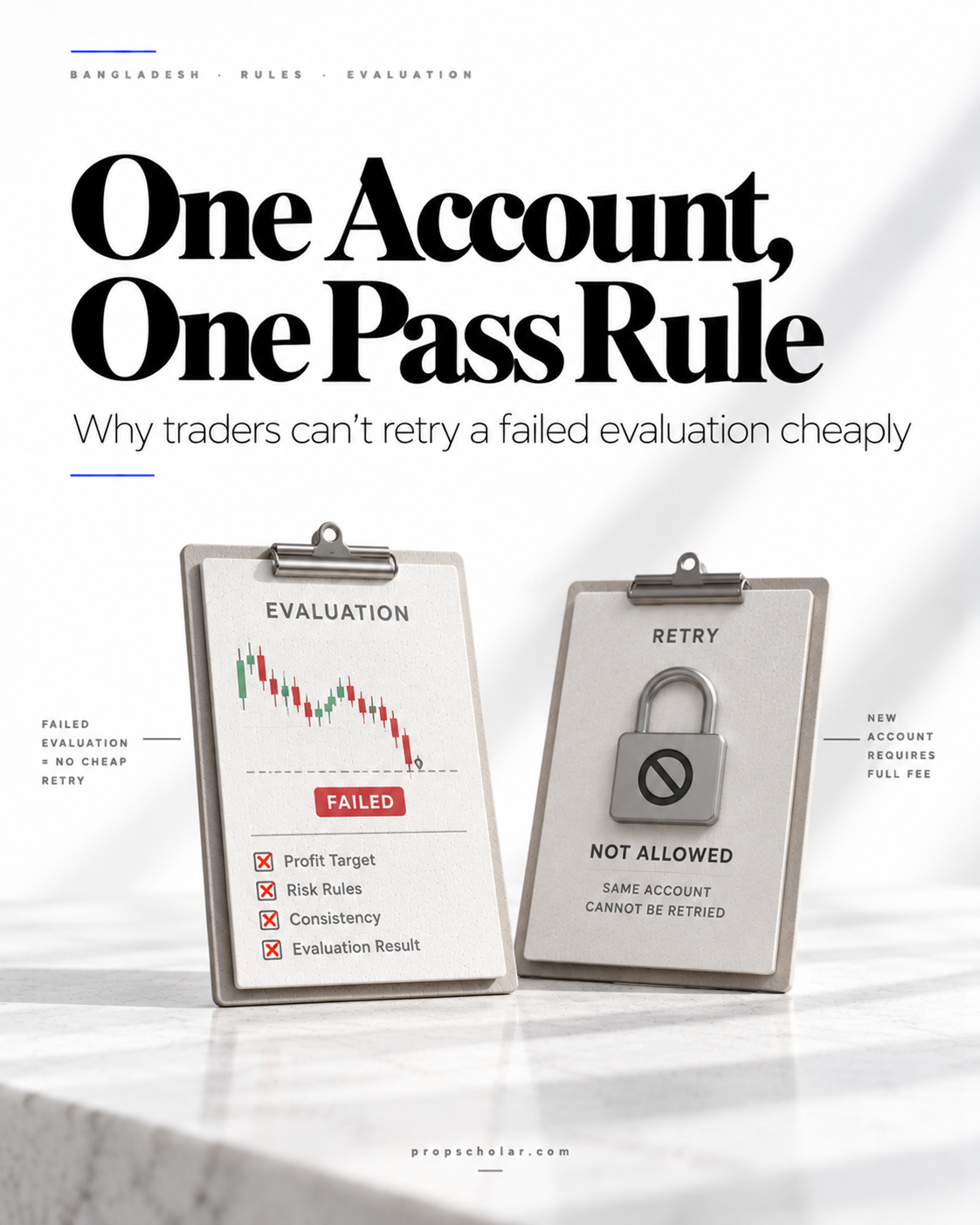
Bangladesh traders face a brutal reality at most prop evaluation platforms: fail once and you're paying full price again. This article breaks down why the one-account-per-trader rule exists, what it actually costs to retry at different platforms, and how PropScholar's $10 entry fee changes the math for Bangladeshi traders who can't afford to throw money at repeated attempts.
Start your evaluationOne Account, One Pass Rule: Why Bangladesh Traders Can't Retry a Failed Evaluation Cheaply
TL;DR: Most prop evaluation platforms let you buy unlimited retries — at full price each time. PropScholar enforces one Freedom Account per trader, which sounds stricter but is actually safer when the entry fee is just $10 for the $10,000 account.
Key takeaways:
- PropScholar's one-account-per-trader rule is enforced server-side, not on the honor system
- The Freedom Challenge starts at $10 for a $10,000 evaluation — far cheaper than a retry at most platforms
- You pay in USDT via crypto (bought on a P2P exchange in Bangladesh) or PayPal — no bank transfer needed
- No time limit, no minimum trading days — but lot limits are real and you need to know them before you start
- Every payout is publicly verifiable at propscholar.com/payout-proof
Here's the situation most Bangladesh traders find themselves in. You paid for an evaluation. You got close — maybe you hit 8% profit before a bad trade triggered the daily loss rule and wiped the account. Now the platform is asking you to pay again. Same amount. No discount. No acknowledgment that you almost made it.
That pattern is painful. And it's not accidental — it's how most evaluation platforms generate most of their revenue. Fail, pay again, fail, pay again. For a trader in Dhaka working with a limited budget, that cycle can consume months of savings before you ever see a funded account.
This article is specifically about how the one-account rule works at PropScholar, why it exists, and whether it's actually better or worse for Bangladesh traders than the "retry as many times as you want" model everywhere else.
What the One-Account Rule Actually Means
PropScholar allows one Freedom Account per trader. That's not a guideline — it's enforced at the server level. You can't register twice with different emails and buy a second account. The system catches it.
On the surface, that sounds like a restriction. But think about what it's actually saying: this platform isn't built around selling you repeated attempts. The business model isn't "fail often and pay each time."
When you combine that rule with an entry fee of $10 for the $10,000 Freedom Challenge, the math changes completely. You're not being asked to pay $150 or $200 every time you need to retry. You're being asked to pass once, cleanly, for a very small stake.
That's a meaningful difference if you're trading on a budget.
Why Unlimited Retries Sound Good But Usually Aren't
The "retry whenever you want" model feels trader-friendly. In practice, it often works the other way.
When retries are cheap in theory but expensive in reality — say, $89 or $149 per attempt — traders tend to jump back in too quickly after a failed evaluation without fixing what went wrong. The platform profits from volume of attempts. The trader keeps funding attempts instead of building skill.
There's also a subtler problem: platforms that rely on retry revenue have no structural incentive to make their evaluations passable on a first serious attempt. The rules can be set at levels where most traders fail somewhere in the 20-day window, even if they're genuinely skilled.
PropScholar's model is different. The scholarship payout on a $10,000 evaluation pass is $42. The entry is $10. That's a 320% return on the entry fee, paid within 4 hours of your payout request. That structure only works if passes are real and frequent — the platform is not betting on your failure.
The Real Cost Math for a Bangladesh Trader
Let's be concrete about what retrying actually costs at a typical platform vs PropScholar.
At a standard evaluation platform charging, say, $149 for a $10,000 evaluation, one failed attempt costs you $149. Two failed attempts: $298. Three attempts before a pass: $447 spent before you see a cent back.
At PropScholar, your one attempt on the $10,000 Freedom Challenge costs $10. If you fail — which the one-account rule means you won't get to try again on this platform — you've lost $10. That's the honest, complete picture.
The question then becomes: is $10 and one real attempt better than $447 and three low-stakes attempts? For most Bangladesh traders trying to build discipline and actually pass, one serious attempt with real consequences tends to produce better preparation than endless cheap retries.
And the $10? You pay in USDT. Which leads to the payment question every Bangladesh trader asks.
How Bangladesh Traders Actually Pay: USDT via P2P
PropScholar accepts crypto payments globally — USDT and other coins via NOWPayments. PayPal is also available. There is no bank transfer option, no bKash, no Nagad.
That's not a problem for Bangladesh traders. Here's the real path:
You buy USDT on a P2P exchange — Binance P2P is the most commonly used one in Bangladesh. You fund your Binance account using a local bank transfer or mobile banking, then you buy USDT from a P2P seller at the current rate. The USDT lands in your Binance wallet.
From there, you send USDT to PropScholar's payment address via NOWPayments. The whole process takes 20-30 minutes if you've done it once before. First time might take an hour as you verify your exchange account.
Note: bKash and Nagad are only relevant here as funding sources for your P2P exchange account. They are not ways to pay PropScholar directly.
The Rules You Need to Know Before You Start
Because you get one attempt, preparation isn't optional. Here's the complete ruleset that actually matters:
The target: 10% profit on your starting account size. On a $10,000 account, that's $1,000.
Maximum loss: 6% of the initial account size. On a $10,000 account, that's $600 total. Breach this and the evaluation ends.
Daily loss limit: 3% of the higher of your starting equity or your current balance. This resets daily and catches traders who over-leverage on a single session.
Time limit: None. You can take weeks if you want. There's no countdown pressure.
Minimum trading days: None. If you hit 10% profit in two hours, you can request your scholarship immediately. The fastest recorded pass on the platform is 2 hours.
Weekend holding: Allowed. You can keep positions open over the weekend.
News trading: Not allowed on the Freedom Account. Close your positions before high-impact news events.
Inactivity rule: 14 days. Don't go silent for two weeks straight.
Lot Limits — The One Real Restriction to Take Seriously
On the $10,000 Freedom Account, these are the maximum open lots per asset class at any given moment:
- Forex: 4.00 lots
- Gold (XAUUSD): 0.40 lots
- Silver: 1.00 lot
- BTCUSD: 0.20 lots
- ETHUSD: 1.00 lot
- NAS100: 0.50 lots
- US30: 0.30 lots
- US500: 0.75 lots
What Happens If You Pass
Pass the 10% target without breaching the 6% max loss or the daily loss rule, and you claim a scholarship. On the $10,000 account, that's $42, paid within 4 hours of your payout request.
Every payout PropScholar has ever processed is publicly listed at propscholar.com/payout-proof. You can verify before you spend $10. That level of transparency is rare, and it matters — several traders in the PropScholar Discord, which has over 3,000 members, have posted their payout confirmations there too.
For Bangladesh traders worried about whether an overseas platform actually pays out — that verification link is the answer. Check it. Look at the dates, the amounts, the frequency. Then decide.
For comparison, the kind of payout denial issues that affect traders using bank-linked payment platforms are well-documented — you can read about how compliance freezes happen even after a legitimate profit in this breakdown of payout denial patterns in Egypt. The USDT-based model avoids that layer of friction entirely.
PropScholar vs Platforms That Sell Unlimited Retries
Entry cost for a $10,000 evaluation
At PropScholar, the Freedom Challenge entry is $10. At most platforms offering unlimited retries, a $10,000 account evaluation sits in the $100-$200 range per attempt. The retry model's low apparent risk per attempt is offset by the total cost across multiple failures.
Payout transparency
PropScholar publishes every payout at propscholar.com/payout-proof. Most retry-model platforms don't offer publicly verifiable payout records — you're trusting marketing screenshots.
Rule consistency
PropScholar's rules have not been changed retroactively since launch. This matters because some evaluation platforms have a history of adding post-hoc compliance rules that disqualify profitable traders. See the full PropScholar ruleset at propscholar.com/terms-of-use.
Attempt pressure
One attempt creates real accountability. You'll plan your trades, respect the lot limits, avoid news events, and treat the daily loss rule seriously. Unlimited retries can breed sloppiness — you know there's always another shot. That mindset doesn't translate well when real money is involved.
The Nigeria and Kenya payout denial issues that traders have faced with compliance-heavy platforms — as detailed here for Nigerian traders — tend to stem from exactly that kind of platform that promises flexibility upfront and creates friction at the payout stage.
Before You Start: A Practical Checklist for Bangladesh Traders
Because you get one attempt, do these things before you open a single trade:
Read the full ruleset at propscholar.com/terms-of-use. Understand what triggers a daily loss breach — it's calculated on the higher of starting equity or balance, not just starting equity. That catches traders who run a profit up and then give it back in one session.
Practice your position sizing against the lot limits. If you trade gold, 0.40 lots is your max. Work out what that means for your risk-per-trade given the target and the 6% max loss.
Avoid news. The Freedom Account does not allow news trading. Download an economic calendar, mark the high-impact events for the week, and don't be in a trade during them.
Have your USDT ready before you buy. Don't scramble to fund your Binance account on the day you want to start. Have the $10 in USDT sitting in your wallet so the payment process is quick and clean.
Then start. One serious, prepared attempt is worth more than five careless retries.
PropScholar is a scholarship-based trading evaluation platform operated by a Private Limited company registered in India. We are not a prop firm and do not manage or allocate institutional capital. Our model rewards proven trading skill with scholarship grants upon successful evaluation completion.
Related reading
- Are Free Funded Accounts Real? What 'Free' Prop Offers Actually Cost You
- Is PropScholar Legit or Fake? The Honest 2026 Review Every Trader Should Read Before Paying
- The Safest Way for a College Student to Start Trading and Not Lose Money
- Is PropScholar Legit? An Honest Review With Payout Proof
- Cheap Prop Firm No Consistency Rule 2026: Skip the 15% Trap
- Alternatives to Prop Firms That Change Rules After You Pass
Ready to Prove Your Edge?
Join 500+ traders. Start from just $5. Get funded within days.
Frequently Asked Questions
No. PropScholar enforces a one-Freedom-Account-per-trader limit at the server level. It's not an honor system — the platform actively prevents duplicate registrations. This means you have one attempt per account size, so preparation before you start is genuinely important. The full rules are at propscholar.com/terms-of-use.