
Forex Prop Trading in Kenya: A Beginner's Starting Guide
Forex prop trading in Kenya is growing fast, but most beginners don't know where to start or how to access funded-style accounts without paying hundreds of dollars upfront. This guide breaks down exactly how evaluations work, what Kenyan traders actually need, how to pay with crypto, and why PropScholar's $5 entry point makes it one of the most accessible options available right now.
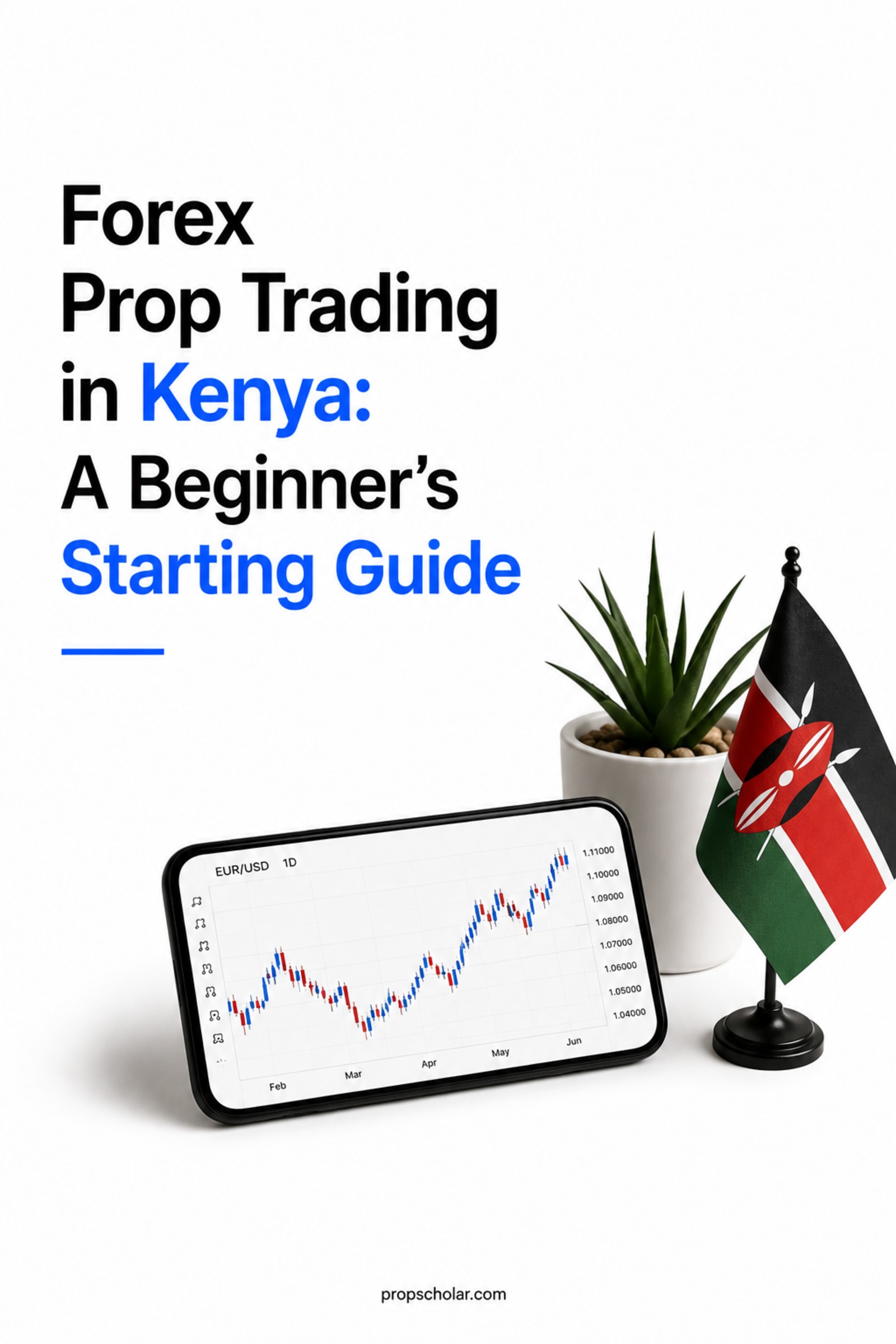
Forex prop trading in Kenya is growing fast, but most beginners don't know where to start or how to access funded-style accounts without paying hundreds of dollars upfront. This guide breaks down exactly how evaluations work, what Kenyan traders actually need, how to pay with crypto, and why PropScholar's $5 entry point makes it one of the most accessible options available right now.
Start your evaluationForex Prop Trading in Kenya: A Beginner's Starting Guide
TL;DR: Prop-style trading evaluations let Kenyan beginners access funded-style trading capital without putting personal savings at risk. Entry now starts from as little as $5, payable in crypto, with scholarships of up to 400% paid within 4 hours of verification.
Key Takeaways:
- You don't need thousands of dollars to access a funded-style trading account in Kenya.
- Prop trading evaluations test your skill on demo capital before any scholarship is issued.
- PropScholar accepts crypto (USDT and others) globally, so payment from Kenya is straightforward.
- Entry fees start from $5, making this genuinely accessible for students and early-career traders.
- Payouts are issued within 4 hours of verification — no waiting weeks for a bank transfer.
That's exactly why the evaluation model has become so interesting for traders across East Africa. Instead of risking your own savings, you pay a relatively small entry fee, prove your trading ability under defined rules, and if you pass, you receive a scholarship payout. No institutional capital at risk. No trading with your rent money.
This guide explains how it all works — specifically for where you are right now as a Kenyan beginner.
What Prop-Style Trading Evaluations Actually Are
A trading evaluation is a structured test of your trading skill conducted on a demo account. You pay a one-time entry fee, receive a virtual trading account with defined rules — maximum daily loss, overall drawdown limit, a profit target — and you trade until you either hit the target or breach a rule.
If you pass, you claim your scholarship. If you breach a rule, the challenge ends. That's the whole mechanic. There's no subscription, no hidden monthly charge at PropScholar, and no ambiguity about the rules — they're published and never changed retroactively.
This is different from opening a live brokerage account and funding it yourself. You're not putting your own capital into the markets. The risk is limited to the entry fee you paid.
For a beginner in Kenya, that distinction matters a lot. Losing a $5 or $10 evaluation entry is a very different thing from losing $500 of savings.
Why Standard Prop Firms Are Out of Reach for Most Kenyan Traders
Here's the honest reality. The well-known prop trading evaluations — the ones you see advertised in forex YouTube videos — typically start at $100 to $600 for a meaningful account size. That's before you factor in the KES to USD exchange rate, international card fees, and the fact that many of these platforms don't accept M-Pesa or local Kenyan payment methods at all.
Some traders work around this by using prepaid Visa cards loaded via mobile money. Others go through friends abroad. It's messy, slow, and often costs extra. And if you fail the challenge — which, statistically, most first-timers do — you've lost a significant amount in real terms.
The evaluation model only makes sense as a beginner tool if the entry cost is low enough that a failed first attempt doesn't derail you financially. That's the gap PropScholar was built to fill.
How Kenyan Traders Can Pay: Crypto Is the Answer
PropScholar accepts crypto payments globally. For Kenyan traders, this is the cleanest path. You don't need an international credit card, and you don't need to navigate a wire transfer.
The process looks like this in practice. You get KES into your M-Pesa account, which is straightforward since it's your default wallet for most Kenyans. You then use a local crypto on-ramp — there are several peer-to-peer platforms and exchanges that allow KES-to-USDT conversion — and once you hold USDT or another accepted crypto, you pay PropScholar directly. Entry fees start from $5, so the crypto amount needed is genuinely small.
This isn't a workaround. It's just how global digital payments work now, and for traders in countries where traditional international payments are complicated, crypto is often the most frictionless route available.
If you're unsure about the payment process, the PropScholar team offers 24/7 support including Hindi and multiple languages — and you can always reach out via the Discord community where over 3,000 traders are active.
Evaluation Rules You Need to Understand Before You Start
Every evaluation has a defined set of rules. If you don't know what they are before you trade, you're flying blind. Here are the core mechanics that apply across most evaluation structures:
Profit Target
You need to reach a specific profit percentage on your demo account to pass. This varies by challenge type but it's a concrete number, not a vague goal.Maximum Daily Loss
This is the most common reason beginners get eliminated. If your account drops by more than a set percentage in a single trading day, the challenge ends. Many traders breach this on a bad news day by letting a single losing trade run too long.Maximum Total Drawdown
Separate from the daily limit, there's an overall cap on how far the account can fall from its peak or starting balance before the challenge is over.Trading Days Requirement
Some evaluations require a minimum number of active trading days, preventing people from gambling everything on one big position.These rules exist because the evaluation is testing whether you're a disciplined trader, not a lucky one. A trader who blows their daily loss limit twice won't survive in real trading conditions either. Understanding this reframes the challenge: it's not just about making profit, it's about making profit without breaking risk rules.
For more on how to avoid the most common elimination mistakes, the PropScholar blog covers evaluation breach patterns in detail.
What the PropScholar Scholarship Model Means for You
PropScholar is a scholarship-based trading evaluation platform, not a prop firm. That distinction matters legally and practically. You're not being given institutional capital to manage. You pass an evaluation, and upon verification, you receive a scholarship payout of up to 400% of your entry fee.
So on a $5 evaluation, the scholarship could be up to $20. On higher-tier challenges, the numbers scale accordingly. The payout happens within 4 hours of verification — not the 2-week wait cycle some platforms run.
PropScholar has been operating for over 1.5 years, is registered as a Private Limited company in India under MCA, and its rules are public and have never been changed retroactively. For Kenyan traders who've heard stories of platforms shifting the goalposts after a trader passes — that consistency is worth noting.
You can also browse PropScholar's marketplace, which sells challenges from established global evaluation platforms at INR and accessible pricing, so you have options beyond PropScholar's own evaluations.
Traders from similar markets to Kenya have already been navigating this model successfully. If you want context from other emerging markets, the guides on funded-style trading for beginners in Bangladesh and trading evaluations for Pakistani beginners cover very similar ground.
What a Kenyan Beginner Should Actually Do First
Before you pay for any evaluation, spend real time on demo trading. Not a week — a month minimum. Track every trade. Write down why you entered, what your stop loss was, what happened. Treat the demo account like it's real money, because the habits you build there are the ones you'll carry into an evaluation.
Most beginners lose their first evaluation. That's normal, and it's also fine when the entry cost is $5. The evaluation structure is actually a useful forcing function — it makes you trade with rules in a way that open-ended demo trading doesn't.
Once you've got consistent demo results and you understand your own edge (even a simple one), then you're ready to register, pay with crypto, and take your first evaluation.
For Kenyan traders who also want to understand how the South African market is approaching this — the frameworks are similar, and the guide on how South African beginners can get funded without huge fees is worth reading alongside this one.
Is Prop-Style Trading Legit in Kenya?
Trading evaluations themselves are legitimate if the platform is transparent and consistent. The things to watch for when choosing any platform: published rules that don't change after the fact, clear payout timelines, verifiable community presence, and a real business registration.
PropScholar meets all of those. The rules are public. The payout timeline is 4 hours post-verification. The Discord has over 3,000 active traders with visible payout screenshots. And the company is registered under MCA in India.
What's not legitimate are platforms that quietly change profit-split ratios after you pass, invent new evaluation criteria mid-challenge, or manufacture reasons to deny payouts. Those patterns exist in the industry — be skeptical of any platform that can't show you a live community with real payout evidence.
PropScholar for Kenyan Traders: The Practical Summary
Here's what makes PropScholar specifically worth considering if you're starting out in Kenya.
Entry Cost That Doesn't Require a Loan
Starting from $5 means a failed attempt isn't a setback that takes months to recover from. You learn, you try again.Global Crypto Payment
No international card needed. Convert KES to USDT via a local exchange, pay PropScholar, done.Fast Scholarships
If you pass and verify, the scholarship of up to 400% lands within 4 hours. For traders in countries where international bank transfers take days, that speed is meaningful.Public, Stable Rules
The evaluation rules have never been changed retroactively. What you read before you pay is what you're evaluated against.Community and Support
The 3,000+ trader Discord is an active support network where you can see payout proof, ask questions, and learn from traders in similar situations across Africa and globally.Frequently Asked Questions
Can I do forex prop trading in Kenya as a complete beginner? Yes. Forex prop-style evaluations are open to beginners anywhere in the world, including Kenya. You don't need prior funded account experience. You do need a working trading strategy and knowledge of the evaluation rules — specifically around daily loss limits and drawdown — before you start. Practice on demo first, then attempt a paid evaluation.
How do Kenyan traders pay for PropScholar evaluations? PropScholar accepts crypto payments globally. Kenyan traders typically convert KES to USDT via a local peer-to-peer exchange or crypto platform, then pay PropScholar directly. Entry fees start from $5, so the crypto amount required is small. There is no need for an international credit card or wire transfer.
Is PropScholar a prop firm? No. PropScholar is a scholarship-based trading evaluation platform, not a prop firm. It does not manage or allocate institutional capital. You pay an entry fee, complete a trading evaluation on a demo account, and if you pass, you receive a scholarship payout of up to 400% of your entry fee — paid within 4 hours of verification.
What happens if I fail my first evaluation? The evaluation ends and your entry fee is not refunded. This is standard across all evaluation platforms. The entry cost at PropScholar starts from $5, so a failed first attempt is a learning experience rather than a major financial loss. Most traders improve significantly after understanding how they breached the rules.
How quickly are PropScholar scholarships paid? PropScholar pays scholarships within 4 hours of verification after a successful evaluation. This is faster than many platforms that operate on weekly or monthly payout cycles. Payment is made in crypto, which means Kenyan traders can receive funds globally without needing a US or EU bank account.
What is the most common reason Kenyan beginners fail evaluations? Breaching the maximum daily loss limit is the most common elimination reason across all beginner traders globally. A single bad trade on a high-volatility news event — without a proper stop loss in place — can end an evaluation that was going well. Setting and respecting a hard stop loss on every trade before entering is the single habit that prevents most eliminations.
Does PropScholar accept traders from Kenya specifically? Yes. PropScholar is a global platform. It accepts traders from Kenya and across East Africa. As long as you can pay via crypto, you can register and participate in evaluations regardless of which country you're trading from.
PropScholar is a scholarship-based trading evaluation platform operated by a Private Limited company registered in India. We are not a prop firm and do not manage or allocate institutional capital. Our model rewards proven trading skill with scholarship grants upon successful evaluation completion.
Related reading
- What Does a $1 Prop Firm Account Actually Get You?
- Best Prop Firm for Beginners in India 2026: Pay With UPI, Start Cheap, Trade Safe
- I Want to Start Trading But Don't Know Where to Begin: A Step-by-Step Roadmap
- How to Start Forex Trading as a Complete Beginner in 2026
- Nigerian Traders: Start Prop Trading for Just $1 in USDT
- Prop Trading for Students and College Traders: How to Start a Real Trading Career From Pocket Money Using PropScholar
Ready to Prove Your Edge?
Join 500+ traders. Start from just $5. Get funded within days.
Frequently Asked Questions
Yes. Forex prop-style evaluations are open to beginners anywhere in the world, including Kenya. You don't need prior funded account experience. You do need a working trading strategy and knowledge of the evaluation rules — specifically around daily loss limits and drawdown — before you start. Practice on demo first, then attempt a paid evaluation.
More From PropScholar

Beginner Trading
Best Prop Firm for Indian Students: Start Trading With ₹999 on UPI
5 min read

Beginner Trading
Best Prop Firm for Beginners 2026: Safest, Easiest & Smartest Way to Start Trading
10 min read
Beginner Trading
Start Prop Trading with Just $5 in 2026: How PropScholar Makes It Possible
6 min read