Prop Firm Fees in INR, Naira & Crypto: Real Costs Explained
Prop firm challenges cost 2-4x the entry fee once resets hit. See how emerging market traders pay in INR, crypto or Naira — and where $5 evaluations exist.
Prop firm challenges cost 2-4x the entry fee once resets hit. See how emerging market traders pay in INR, crypto or Naira — and where $5 evaluations exist.
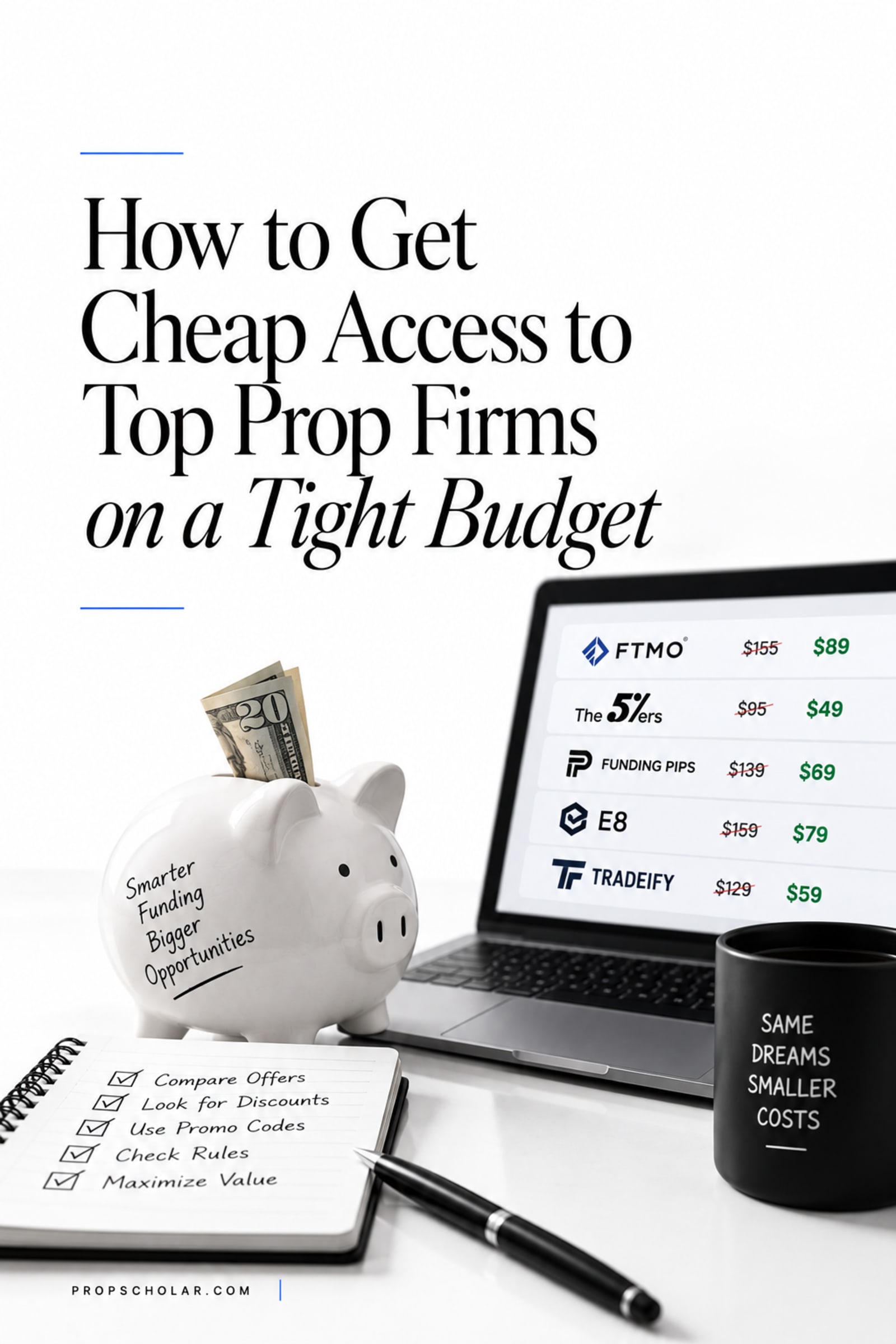
Start your evaluationHow to Get Cheap Access to Top Prop Firms on a Tight Budget
TL;DR: The real cost of top prop firm evaluations is often two to four times the advertised entry fee once you factor in resets and retakes. Budget traders have smarter options — including PropScholar's marketplace and its own scholarship evaluation starting at $5.
Key takeaways:
- The sticker price on most prop firm challenges is not the real cost. Resets, retakes and scaling fees add up fast.
- A dedicated marketplace can get you major-name prop firm challenges at INR or crypto pricing — removing the currency conversion tax.
- PropScholar's own scholarship evaluation starts at $5 (Rs.400) globally, with scholarships of up to 400% paid within 4 hours of verification.
- Crypto payments make this accessible from Nigeria, Philippines, Indonesia, South Africa — anywhere without easy USD wire access.
- The cheapest path is not always the lowest entry fee. It's the one with the fewest hidden resets and the most transparent rules.
You've looked at the big prop firm names. You know the trading rules, you've put in screen time on a demo, and you're ready to prove it. Then you see the price tag: $150, $200, sometimes $300+ just to attempt an evaluation on a $100,000 account. That's not an investment most traders in Lagos, Manila, Karachi or Jakarta can make without serious thought — especially when one bad day in phase one can wipe that fee with nothing to show for it.
This isn't a story about avoiding prop firms. The model works — passing a structured evaluation and earning a funded account is one of the most legitimate ways to trade with real capital without risking your own savings. The problem is the pricing structure, not the concept.
So let's talk about how to actually get in cheaply, what cheap really means when you look at total cost, and where PropScholar fits into this picture for budget traders around the world.
Why Top Prop Firm Fees Are a Real Barrier for Most Traders
The advertised entry fee is the beginning of the cost, not the end of it. A $150 challenge sounds manageable until you factor in what happens when you fail phase one on day 12 because you had a 4% drawdown on a volatile news day. Now you either pay a reset fee ($30–$80 on most platforms) or buy the challenge again at full price.
For traders converting from Naira, Peso, Rupiah or Rand, there's another layer: currency conversion. Paying $150 in Nigerian Naira at current exchange rates is a significant sum. Paying it via international card often adds a 2–4% conversion fee on top. And some platforms don't accept cards from certain countries at all, forcing you through third-party resellers at marked-up rates.
This is the real cost structure most beginner content ignores. If you want a deeper breakdown of how to evaluate total cost properly — not just the entry price — read our guide on how to compare prop evaluations by total cost, not entry fee. The short version: a $50 challenge with three paid resets costs more than a $120 challenge with one free reset and a transparent ruleset.
What "Cheap" Actually Means in Prop Trading
Cheap doesn't mean low entry fee. It means low total expected cost across your first few attempts. That includes:
Reset fees. If a platform charges $40 per reset and you average two resets before passing, your $100 challenge just became $180. Some platforms allow unlimited free resets — that's genuinely cheaper even if the upfront fee is higher.
Scaling fees or profit splits. A platform with a 90/10 split but a $50 entry is more expensive long-term than one with an 80/20 split and a $15 entry, once your funded account is generating consistent returns.
Rule complexity. Overly complex rules — consistency ratios, minimum trading days, trailing drawdown structures you don't fully understand — increase your chance of a technical failure that isn't about your actual trading skill. That's a hidden cost too. Simpler rules mean fewer unforced errors.
Payment friction. Every time you lose money to currency conversion or have a payment declined, that's money out of your trading budget. A platform that accepts crypto globally, or UPI in India, removes that friction entirely.
The cheapest prop firm access for any given trader depends on their country, their trading style, and how many attempts they're likely to need. There is no single universal answer — but there are principles that hold everywhere.
The PropScholar Marketplace: Top Prop Firm Challenges at Local Pricing
PropScholar runs a marketplace where you can buy real prop firm challenges — from well-known global platforms — at INR pricing via UPI, or at crypto-equivalent rates globally. This matters more than it sounds.
When you buy a challenge directly from a major prop firm as a trader in India, you're paying in USD via an international card. That means the Reserve Bank of India's forex markup, your bank's conversion fee, and sometimes an additional international transaction fee. By the time the money lands, a $150 challenge has cost you closer to Rs.14,000–15,000 depending on the rate and your card.
Through the PropScholar marketplace, the same challenges are listed in INR. You pay via UPI — PhonePe, Razorpay, Cashfree — with no international wire, no forex markup, no card decline. For traders outside India, the crypto payment route achieves the same thing: you pay the market-rate equivalent without a bank acting as gatekeeper.
This is not a gimmick. It's a structural advantage for anyone whose local currency isn't USD. The challenge itself is the same product. You just paid less for it.
Browse what's currently listed at the PropScholar shop.
PropScholar's Own Scholarship Evaluation: The $5 Starting Point
Separate from the marketplace, PropScholar runs its own scholarship-based evaluation model. This is the lowest-cost entry point for getting a funded-style trading experience with real financial upside — starting from $5 (approximately Rs.400).
Here's how it works: you pay the entry fee, attempt the evaluation, and if you pass, you claim a scholarship grant of up to 400% of your entry. Payouts are processed within 4 hours of verification. The platform is run by a Private Limited company registered in India under the MCA, and has been operating for over 1.5 years with publicly posted, never-retroactively-changed rules.
The rules are transparent. There's a 3,000+ trader Discord community where you can check payout proof before you spend a single rupee or dollar. For traders in countries where trust in new platforms is rightfully cautious, that community is worth looking at before anything else. Join the Discord here.
The 400% scholarship structure means a $5 entry could return $20. A $25 entry could return $100. It's not leveraged capital management — it's a merit-based grant system. That framing matters: you're being rewarded for demonstrating verified trading skill, not speculating on a funded account.
For traders in Nigeria, Philippines, Indonesia, South Africa, Pakistan, Bangladesh, Kenya, Egypt or Vietnam — crypto is the payment method. It works. The platform is explicitly global, not India-only.
Comparing Your Options: Marketplace vs PropScholar Evaluation vs Going Direct
Let's be honest about the three paths and who each one suits.
Going Direct to a Top Prop Firm
If you're in the US, UK or Europe with a debit card that processes USD without fees, going direct is fine. You get the original product at the advertised price, and the payment works cleanly. For everyone else — and particularly for traders in emerging markets — you're paying a hidden currency premium that could be 5–15% above the listed price, sometimes more.
Going direct also means you're alone. No community. No 24/7 support in your language. If you have a question about a rule at 2am your time, you're filing a ticket and waiting.
PropScholar Marketplace Challenges
These are for traders who have already decided which prop firm they want and just want to pay less for the challenge — in their local currency or crypto. The product is the same major-brand evaluation. The cost is lower because the currency friction is removed.
This suits a trader who has experience, knows which firms have rules that match their strategy, and wants the brand-name funded account at the end without the forex markup at the start.
PropScholar's Own Scholarship Evaluation
This is for beginners, students, and traders whose budget genuinely limits what they can risk. Starting at $5 is not a symbolic gesture — it means a trader in Lagos or Dhaka can attempt a real evaluation without betting a week's wages. The 400% scholarship cap means the upside is still meaningful relative to the cost.
This suits a trader who is newer, who wants to prove their skill with low financial risk, and who values the safety of a transparent, community-verified platform over a brand name.
You can read more about how to weigh these options in our piece on how to choose the right trading evaluation in 2026.
Practical Steps to Get Started for Under $25
Here's what a realistic low-budget path looks like.
First, join the PropScholar Discord before spending anything. Spend 20 minutes reading the payout proof channel and the rules channel. Ask a question. You'll get a response — 24/7 support, Hindi and multiple languages. This tells you whether the platform is real before your money is involved.
Second, look at the evaluation tiers at the PropScholar shop. The $5 entry is real. So is the $10, $25 tier. Decide what you can genuinely afford to lose entirely — not what you hope to win. Your first evaluation is also a learning experience about the process, not just about trading.
Third, if you're interested in a specific major prop firm from the marketplace, compare the INR or crypto price there against what you'd pay going direct after all conversion fees. Do the actual math. Often the saving is 10–20% depending on your bank.
Fourth, read the rules of whichever evaluation you choose — once, carefully, before you open a single trade. Rule violations are the most common non-skill reason for failing an evaluation. This is especially important if you're looking at accounts with consistency requirements or trailing drawdown, which are trickier than fixed drawdown structures.
For traders new to the process entirely, our best low-cost trading evaluation for beginners worldwide guide covers the mechanics in more detail.
One Thing We've Learned Running This for 18 Months
The traders who struggle most with cost aren't the ones who picked the wrong platform. They're the ones who picked the right platform but the wrong account size for their current skill level.
A trader who buys a $200 challenge because the funded account size sounds impressive — but whose strategy hasn't been stress-tested beyond a personal demo — is taking on unnecessary financial risk. They fail, they feel burned, they leave. The smarter move is to start at a tier where failing hurts minimally. If you're genuinely skilled, you'll pass and scale up. If you discover gaps in your strategy, you've paid $5–$25 to find that out rather than $200.
This is the actual case for starting small. Not because big accounts aren't worth pursuing — they are. But because your first evaluation should test your trading, not your risk tolerance to a large fee.
We've seen this pattern clearly across our community: traders who start at the $5 or $10 tier, pass, claim the scholarship, and then attempt a larger tier with more confidence and a verified track record of their own rules. That's a smarter, cheaper path to eventually accessing larger funded accounts than going straight to a $200 challenge and hoping.
The Bottom Line on Cheap Prop Firm Access
Top prop firms are not out of reach for budget traders. They're out of reach when you approach them the wrong way — paying international card fees, ignoring reset costs, and starting at account sizes your budget can't absorb multiple failures on.
The smart approach combines platform selection with realistic self-assessment. Use a marketplace like PropScholar's to remove currency friction on major-brand challenges. Use PropScholar's own $5 scholarship evaluation to prove skill and build confidence before scaling. And before any of it, verify the platform is real — which the 3,000+ Discord community makes easy.
If you want to ask a question directly, reach out at business@propscholar.com. Real people answer.
PropScholar is a scholarship-based trading evaluation platform operated by a Private Limited company registered in India. We are not a prop firm and do not manage or allocate institutional capital. Our model rewards proven trading skill with scholarship grants upon successful evaluation completion.
Related reading
- Best $1 Trading Challenge 2026: Why 1K 1-Step Wins
- Cheapest Legit Way to Access a Funded-Style Trading Account From $5
- Best Prop Firm in India 2026 (UPI-Friendly): Honest Comparison
- Cheapest Prop Firm in 2026: The Complete Price Comparison Guide (From ₹300 With FIFA Discount)
- Prop Firm Challenge Under $5: Cheapest Legit Funded Accounts Compared
- Cheapest Prop Trading Evaluation in 2026 Ranked by Real Total Cost
Ready to Prove Your Edge?
Join 500+ traders. Start from just $5. Get funded within days.
Frequently Asked Questions
The cheapest route is to use a marketplace like PropScholar's, which lists major prop firm challenges at INR or crypto pricing — removing the currency conversion fees that inflate costs for traders in emerging markets. Alternatively, PropScholar's own scholarship evaluation starts at $5 globally, making it one of the most accessible entry points available anywhere.